


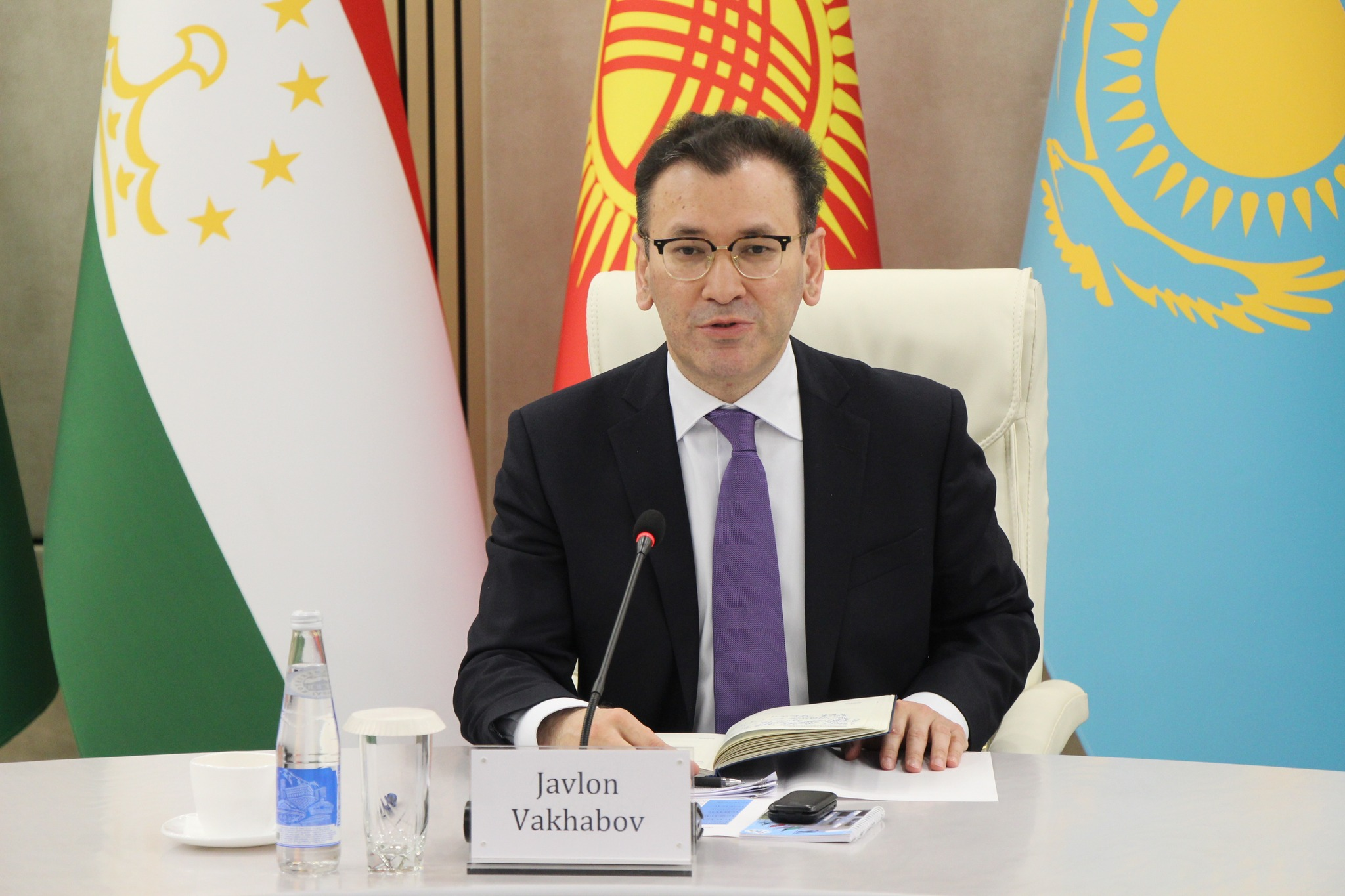
Distinguished participants,
Esteemed colleagues,
Ladies and gentlemen,
Allow me, first of all, to welcome all participants of today's roundtable and to express my appreciation for your readiness to take part in our discussion.
I would like to extend particular thanks to Dr. Abdul Hai Qanit for his participation in this event of our Institute, as well as in tomorrow's roundtable on water security in Central Asia.
The participation of a representative of an Afghan think tank in events organized at IICA is a very meaningful signal, fully consistent with the contemporary approaches of the Central Asian states toward Afghanistan.
As the head of the leading research institute in Uzbekistan, I would like to underline that we attach considerable importance to advancing Uzbekistan–Afghanistan cooperation, including through close engagement between the think tanks of our two countries.
It is precisely the expert community that is capable not only of providing intellectual support to political dialogue, but also of generating new ideas and practical proposals on promising areas of bilateral and regional partnership.
Today we will sign a Protocol on Cooperation between the International Institute for Central Asia and the Center for Strategic Studies under the Ministry of Foreign Affairs of Afghanistan, which will lay the groundwork for cooperation in political and economic research, regional security, trade, investment, industry, connectivity, environment, and water issues, as well as joint events and expert exchanges.
The practical substance of this cooperation has already begun to take shape. During the IICA delegation's visit to Kabul earlier this year, Dr. Qanit presented us with a number of academic journals and publications. In this regard, promising next steps include the publication of materials by IICA experts in the CSS journals, as well as the preparation of a joint article by the heads of our two centers.
We also believe that IICA could serve as a venue for connecting Afghan analytical institutions with American, European, and other foreign research centers. Joint events involving our centers could prove highly relevant in this regard.
A promising next step could be the establishment of an Uzbekistan–Afghanistan Expert Council as a platform for drafting joint proposals on key areas of cooperation.
We also support the initiative of the Foreign Minister of Afghanistan, Amir Khan Muttaqi, to hold in Kabul the First "Central Asia–Afghanistan" Think Tank Forum, and look forward with great interest to this important platform for shaping proposals for a roadmap of practical cooperation.
We believe that the agenda of such a forum should include trade and economic engagement, the development of transport corridors, regional security, energy, water and environmental issues, as well as the role of think tanks in advancing sustainable regional partnership.
I would like to emphasize that IICA stands ready to take an active part in organizing and conducting this event.
Distinguished participants,
In early April, the First "Central Asia–Afghanistan" Consultative Dialogue was held in Kabul, with the participation of the heads of foreign affairs of the Central Asian states.
The launch of this format has undoubtedly become a significant political and diplomatic event on a regional scale. Holding such a dialogue at a high level and the substantive content of the discussions demonstrated Kabul's commitment to open, pragmatic, and constructive engagement with the countries of our region, and signaled Afghanistan's intention to engage more actively in regional processes.
The talks laid the groundwork for a systematic and trust-based discussion of key issues of regional engagement with the direct participation of the Afghan side.
In this connection, I would like first of all to congratulate the Afghan side on the successful organization of this event.
The very fact that the meeting took place in Kabul confirmed the shared understanding among our countries that key issues concerning the future of Afghanistan and its role in the region must be discussed with the direct participation of the Afghan side itself.
The proposal of the esteemed Foreign Minister of Afghanistan, Amir Khan Muttaqi, also deserves support — namely, that alongside the further expansion of bilateral relations and coordination, consistent work should be carried out toward shaping a common regional political agenda.
It is highly significant that Afghanistan is expressing readiness to participate actively in regional programs and initiatives, particularly in transport, railway connectivity, environmental protection, and the sustainable development of Central Asia. We support the Afghan side's aspiration to obtain observer status in the Shanghai Cooperation Organization and welcome Kabul's interest in the "Green Central Asia" initiative.
It is worth particularly noting that many of the proposals put forward by the Afghan side resonate with Uzbekistan's position. This concerns, above all, the need to move engagement with Afghanistan onto a sustainable, systematic, and depoliticized track — one in which the priority is given to engagement rather than isolation; to practical cooperation rather than confrontation; and to building a space of shared opportunities rather than a narrow view through the prism of risks.
From this perspective, particular value lies in the initiatives put forward during the dialogue — to institutionalize this format, to convene a dedicated expert conference, to develop a roadmap of practical cooperation, and to align approaches on security, trade, transit, and the climate agenda.
Esteemed colleagues,
Today's discussion will touch upon a broad range of pressing topics of bilateral and regional engagement.
In this context, I would like to draw particular attention to the water agenda, which is of fundamental importance and remains of special relevance to all the countries of the region.
Issues of transboundary water use remain a critical factor in regional engagement among the countries of Central Asia and Afghanistan as an integral part of our common region.
In this regard, the President of Uzbekistan, Shavkat Mirziyoyev, at the 2023 IFAS Summit in Dushanbe, stressed the need to engage Afghanistan in the regional dialogue on water resources. We view this as a timely and forward-looking approach that serves the common interests of the entire region.
It was precisely for this reason that during our visit to Kabul earlier this year we also exchanged views on this issue, and Dr. Qanit expressed readiness to discuss water-related matters.
Building on this understanding, tomorrow we are holding a dedicated roundtable on "Ensuring Water Security in Central Asia Amid Climate Change."
The outcomes of the Tashkent Water Week 2026 forum are also significant in this context. We note with satisfaction the statement of the Deputy Minister of Water and Energy of Afghanistan, Mujib ur Rahman Omar, affirming the Afghan side's commitment to the equitable allocation of water resources, its readiness for constructive engagement, and its willingness to resolve all emerging issues through dialogue.
Esteemed colleagues,
In closing, I would like to take this opportunity to hear your assessments and views on a number of issues of practical interest to us.
First and foremost, it would be very valuable to hear your assessment of the outcomes of the recent consultative dialogue in Kabul. Which barriers, in your view, still hinder Afghanistan's closer engagement in Central Asian processes? And which practical steps could already today help translate this positive momentum into a durable practice of cooperation?
And, of course, it would be useful to hear the Afghan side's view on further engagement in the water sphere: how do Afghan colleagues see the development of cooperation within existing formats, and which steps, in their view, could contribute to strengthening practical partnership on water security?
Thank you for your attention.


