


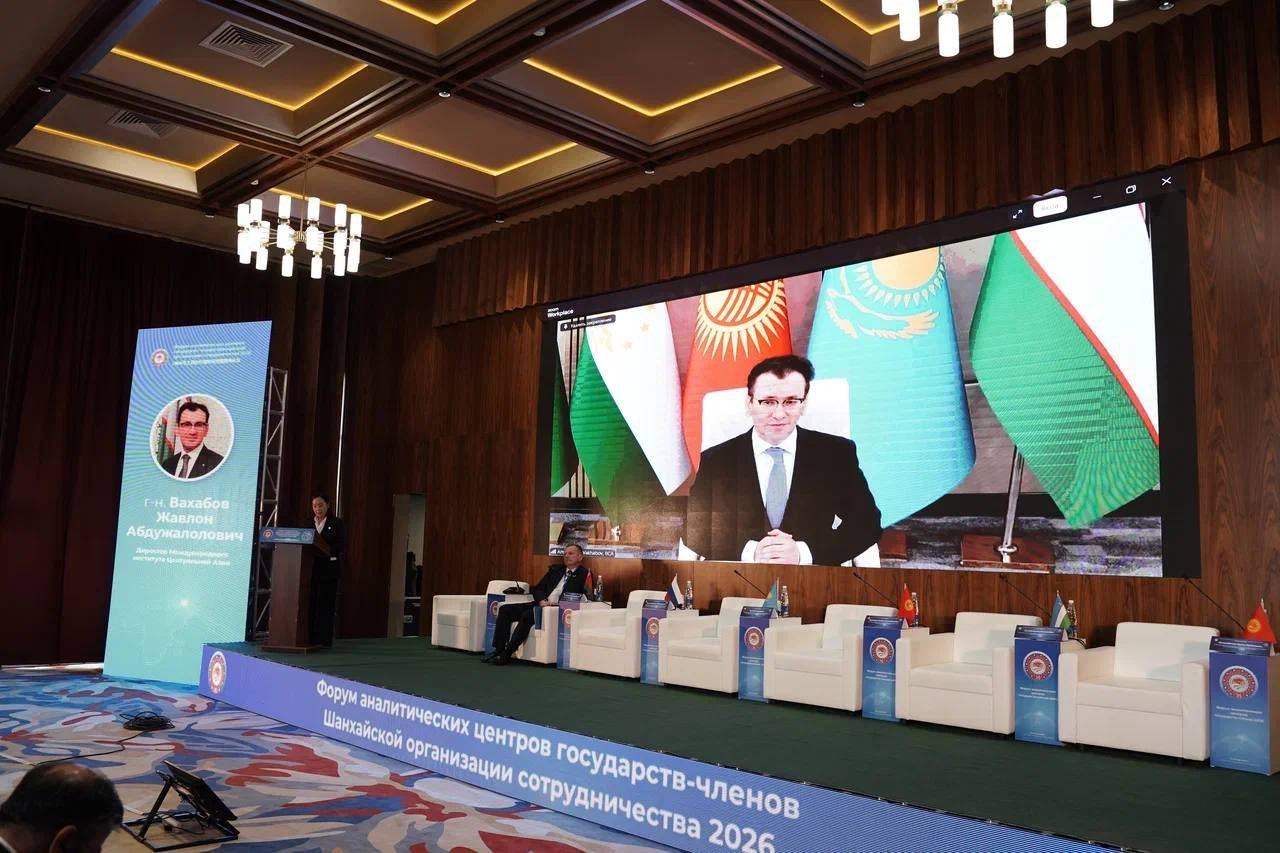
Dear Colleagues,
Distinguished Participants of the Forum,
First of all, allow me to express my sincere gratitude to the National Institute for Strategic Initiatives of Kyrgyzstan for the invitation to speak at this important event, which has brought together representatives of the expert community from the Shanghai Cooperation Organization (SCO) member states.
I would particularly like to highlight the active role of Kyrgyzstan, the current Chair of the SCO, in implementing the decisions adopted at the summits in Samarkand, Astana, and Tianjin, as well as in developing new initiatives aimed at deepening multifaceted cooperation among the member states.
Amid the current escalation of global tensions and the growing threats of an energy shock and economic crisis, special significance should be attached to the work being carried out under Kyrgyzstan’s chairmanship to coordinate issues related to the establishment of the SCO Development Bank and the transformation of the Regional Anti-Terrorist Structure (RATS) into a Universal Center for Countering Security Challenges and Threats, including the creation of a Center for Combating Transnational Organized Crime in Bishkek. Strengthening the institutional foundations of cooperation will undoubtedly contribute to further deepening our interaction.
The Uzbekistan side also supports the continuation of efforts to expand the SCO, which will enhance the Organization’s openness to broad international engagement in accordance with the “Shanghai Spirit.” We are confident that this will help deepen practical cooperation with the countries of the Global South on the principles of equality, mutual respect, and mutual benefit.
Dear forum participants,
Strengthening Central Asia's role as the core of the SCO remains one of Uzbekistan's key priorities — a goal that is undoubtedly supported by the positive changes underway in our region. The progress of regional consolidation has brought the countries of Central Asia closer together and created the conditions for deeper cooperation.
An important milestone in this process of strengthening stability, good-neighborliness, and cooperation was the signing last year by the leaders of Uzbekistan, Kyrgyzstan, and Tajikistan of the "Khujand Declaration of Eternal Friendship," in which the sides affirmed their commitment to advancing cooperation not only in regional security, but also in promoting trade, economic, and transport links.
At the same time, the growing geoeconomic significance of Central Asia — rooted in the region's rich resource base and its location at the crossroads of East–West and North–South transport corridors — is becoming one of the key factors in unlocking the trade and investment potential of the Shanghai Organization.
Amid the global processes of green and digital transformation, adaptation to climate change, and the adoption of artificial intelligence and other advanced technologies, cooperation between the countries of the region and the SCO in critical minerals, renewable energy, and cutting-edge industrial technologies is taking on particular importance.
Uzbekistan and the countries of Central Asia advocate easing trade barriers, removing and harmonizing customs procedures, and actively engaging businesses in SCO projects that strengthen connectivity and align our organization with the goals of the Belt and Road Initiative.
Strengthening transport connectivity remains a crucial area of practical cooperation. Implementing the China–Kyrgyzstan–Uzbekistan railway project and linking it with the Trans-Caspian route, the North–South International Transport Corridor, and, in the future, the Trans-Afghan Corridor will dramatically improve connectivity across the Organization.
By some estimates, the countries of Central Asia account for 10–12% of intra-SCO trade. At the same time, the region already serves as a transit bridge between the Organization's major economies — China and Russia. Once the China–Kyrgyzstan–Uzbekistan railway is completed, its transit potential will also grow for China's trade with Iran and other countries of the Middle East.
Expanding cooperation between the countries of Central Asia and Azerbaijan and other South Caucasus states could likewise help increase transit between China and the countries of Southern and Eastern Europe.
Central Asia can also play an important role in strengthening cultural and humanitarian engagement among SCO countries in the context of the Organization's enlargement. This will be facilitated, in particular, by the centuries-old civilizational ties between the peoples of the region and the countries of Eurasia, the Arab-Muslim world, and the states of South Asia.
Distinguished friends,
Considerable potential to enhance the effectiveness of the SCO's international cooperation lies in developing the roughly 12 "C5+" formats, through which the countries of the region engage with some 40 nations that together account for around 75% of global GDP — including Russia, China, and India.
The ties built with the region's external partners through these formats can be used to advance the SCO's business and expert engagement with other major countries and organizations. For example, in the countries of Central Asia, companies from the Arab world are already cooperating with Chinese suppliers on renewable energy projects. In 2024–2025, the combined project portfolio of ACWA Power and Masdar in the region exceeded $15 billion, with Chinese companies serving as key technology partners in nearly every one of them.
Last year, IICA held an expert forum, "Central Asia–Gulf Cooperation Council," and our partners from the Arab world, as well as others, could be drawn into expert engagement within the "SCO Plus" framework — for instance, in an SCO–GCC format.
Another valuable resource for the SCO's international cooperation is the ADB's Central Asia Regional Economic Cooperation (CAREC) program. Since the countries of Central Asia, China, and Pakistan are all members of this program, cooperation between the SCO and CAREC is already developing on an informal basis — in the transport sector, for example.
In particular, by financing infrastructure projects in the Central Asian region, the ADB is effectively contributing to the development of the SCO's transport cooperation.
In the expert segment, active cooperation is developing with the CAREC Institute in Urumqi, which has established partnerships with think tanks in Central Asia and China.
Looking ahead, sustained expert contacts could be established with the ADB Institute in Tokyo, which carries out valuable research on pressing topics of regional cooperation — such as cross-border e-commerce and the energy transition — as well as training programs on climate risk, financial technology, and public-private partnerships.
Another initiative I would like to draw your attention to is the launch of a joint research program along the lines of the SCO Forum and the Consortium of Economic Think Tanks of our Organization. I believe that research of this kind is in high demand, particularly amid the growing adverse impact of geopolitical processes on the economic development of our countries.
Holding a forum of think tanks from the SCO and ASEAN countries — an organization that will mark its 60th anniversary next year — could likewise help not only to broaden partnership ties among our think tanks, but also to provide expert support for the work of SCO institutions.
We could also direct our efforts toward intensifying expert contacts with the UN's analytical bodies — for instance, the institutes of the United Nations University, with which the SCO has already established close ties.
In closing, allow me to wish this conference every success, with engaging presentations and productive proposals for further deepening SCO cooperation. I am confident that the participants' best ideas will enrich the agenda of the Bishkek Summit.
Thank you for your attention!


