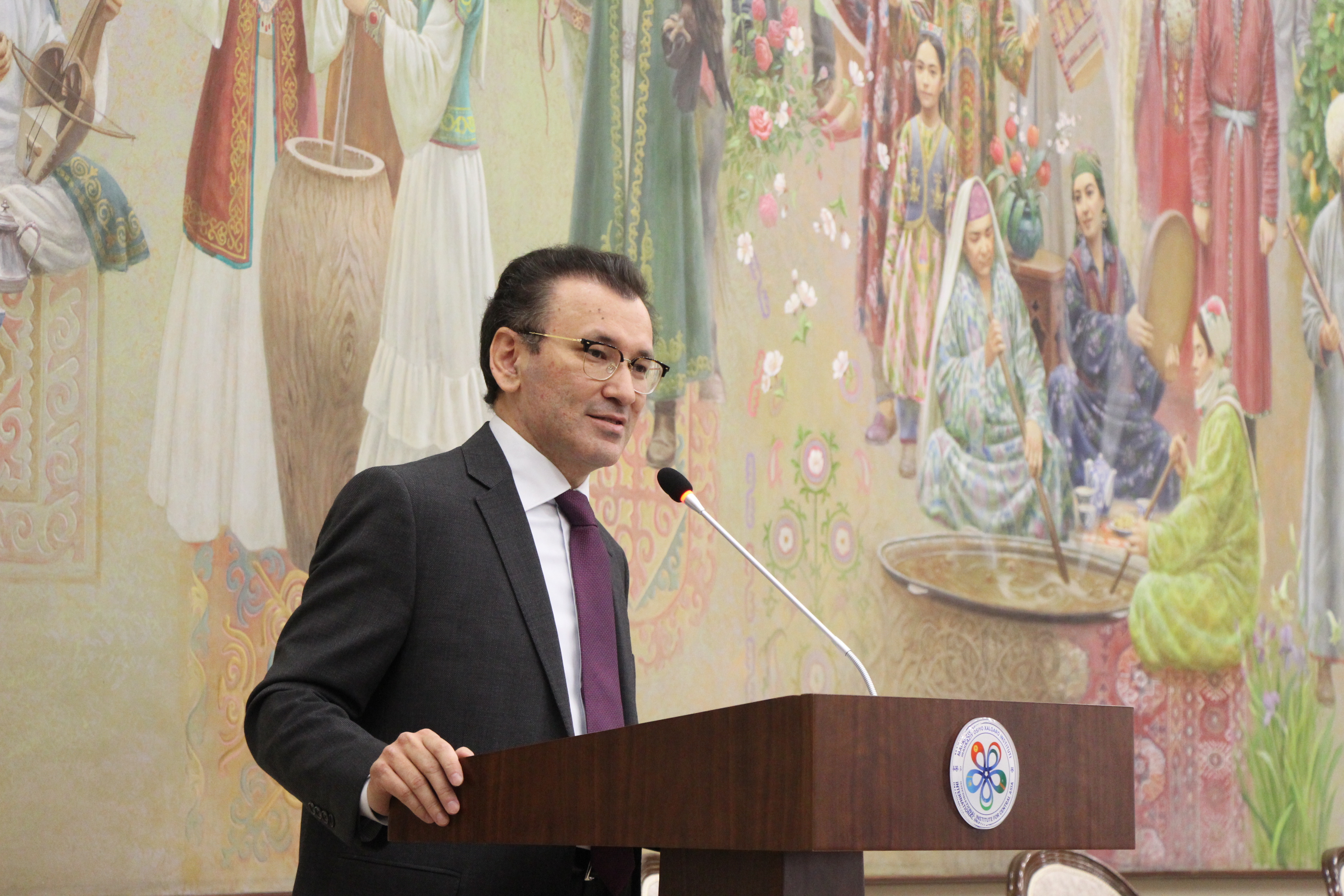
Dear colleagues, distinguished guests,
It is my great pleasure to welcome you to the inaugural Central Asia–UK Think Tank Forum at the International Institute for Central Asia.
I would like to express my sincere gratitude to Dr Rebecca Nadin, representing ODI Global, and to Ambassador Timothy Smart for their support in co-organizing this event.
I am also pleased to welcome such an outstanding group of participants, including the ambassadors and diplomats, representatives of governmental and independent think tanks, international organizations, universities, businesses and public institutions who have joined us from Central Asia, Azerbaijan and the United Kingdom.
I think there really couldn’t be a better moment for this Forum. In February this year, the foreign ministers of the five Central Asian states and the United Kingdom met together in London for the first time. That meeting created a new political framework for regional cooperation with the UK. This format of cooperation is still relatively young, which makes it especially important to develop it thoughtfully and build strong foundations from the outset.
Our next step should be to build multilevel cooperation between Central Asia and the United Kingdom, bringing together governments, parliaments, different ministries, businesses, universities, think tanks and civil society, and eventually elevate this partnership to the highest political level.
This partnership has become possible also because of regional transformation in Central Asia. Our region is no longer simply responding to initiatives developed elsewhere. The countries of Central Asia are increasingly defining their own priorities, strengthening regional cooperation and diversifying their international partnerships.
Dear participants,
The four sessions on the agenda today address different areas, but they are linked by a common strategic question: how can growing political interest be translated into workable institutions, investable projects and lasting partnerships?
Our first session will examine Eurasian connectivity. The strategic importance of the Middle Corridor is already widely recognized; the challenge now is to make it reliable, commercially viable and institutionally coordinated. The key question is how Central Asia and Azerbaijan can move from managing separate national transport systems towards building an integrated economic corridor, and what practical role the United Kingdom can play in supporting that transformation.
At the same time, we should make sure that we form a diversified network in which disruption along one corridor does not paralyze regional trade. Recent sanctions developments also show that physical infrastructure alone is insufficient: a route must remain bankable, insurable and legally usable under changing geopolitical conditions.
The second session will address critical minerals. The central issue is how to reconcile the United Kingdom’s need for secure and diversified supply chains with Central Asia’s ambition to move beyond the export of raw materials. We should consider what kind of partnership can bring investment, technology and responsible standards into the region while supporting local processing, skilled employment and long-term industrial development.
This is now even more significant as critical minerals are becoming part of a wider competition over technology and industrial power. Emerging initiatives such as the US-led Pax Silica framework and China’s World Artificial Intelligence Cooperation Organization increasingly connect access to minerals with semiconductors, artificial intelligence and advanced manufacturing. For Central Asian states, the challenge is to benefit from cooperation with all major partners without being drawn into exclusive technological or geopolitical blocs.
Our third session will focus on investor confidence. Investment decisions depend not only on opportunities and incentives, but also on confidence in institutions, rules and their consistent implementation. The strategic question is how Central Asian countries can create a more predictable regional investment environment while strengthening compliance and financial integrity.
In this regard, the newly established Tashkent International Financial Centre, which is based on English common law, and the already established Astana International Financial Centre have the potential to work together as complementary regional platforms By promoting compatible standards, sharing expertise and building stronger institutional links with the City of London, they could serve as bridges connecting Central Asian businesses and projects with international capital, legal services and financial expertise.
The fourth session will consider education, skills and safe labor mobility. British universities already have a strong presence in Uzbekistan, and representatives of these institutions are with us today. The launch of Uzbek and Old Uzbek studies at the University of Oxford demonstrates that this exchange is becoming increasingly two-way. Our task now is to turn education and mobility into shared development while building stronger partnerships with the UK’s globally recognized universities and think tanks through joint research, expert exchanges and lasting institutional links.
Dear colleagues,
These are not questions that any one government or institution can answer alone. That is precisely why this Forum brings together diplomats, researchers, investors, practitioners and representatives of international organizations.
I hope this inaugural meeting will become the beginning of a regular Central Asia–UK expert dialogue and a lasting network among the institutions represented here.
I wish you productive discussions, meaningful exchanges and every success with today’s Forum. Thank you.