Ladies and gentlemen,
Given that today's conference is about connectivity, I hope everyone had a smooth journey to Tashkent. And if not, perhaps you have already identified the first issues we should address during today's discussions.
Distinguished Dr. Ekaterine Metreveli,
Distinguished Mr. Marcel Röthig,
Excellencies, dear colleagues and friends,
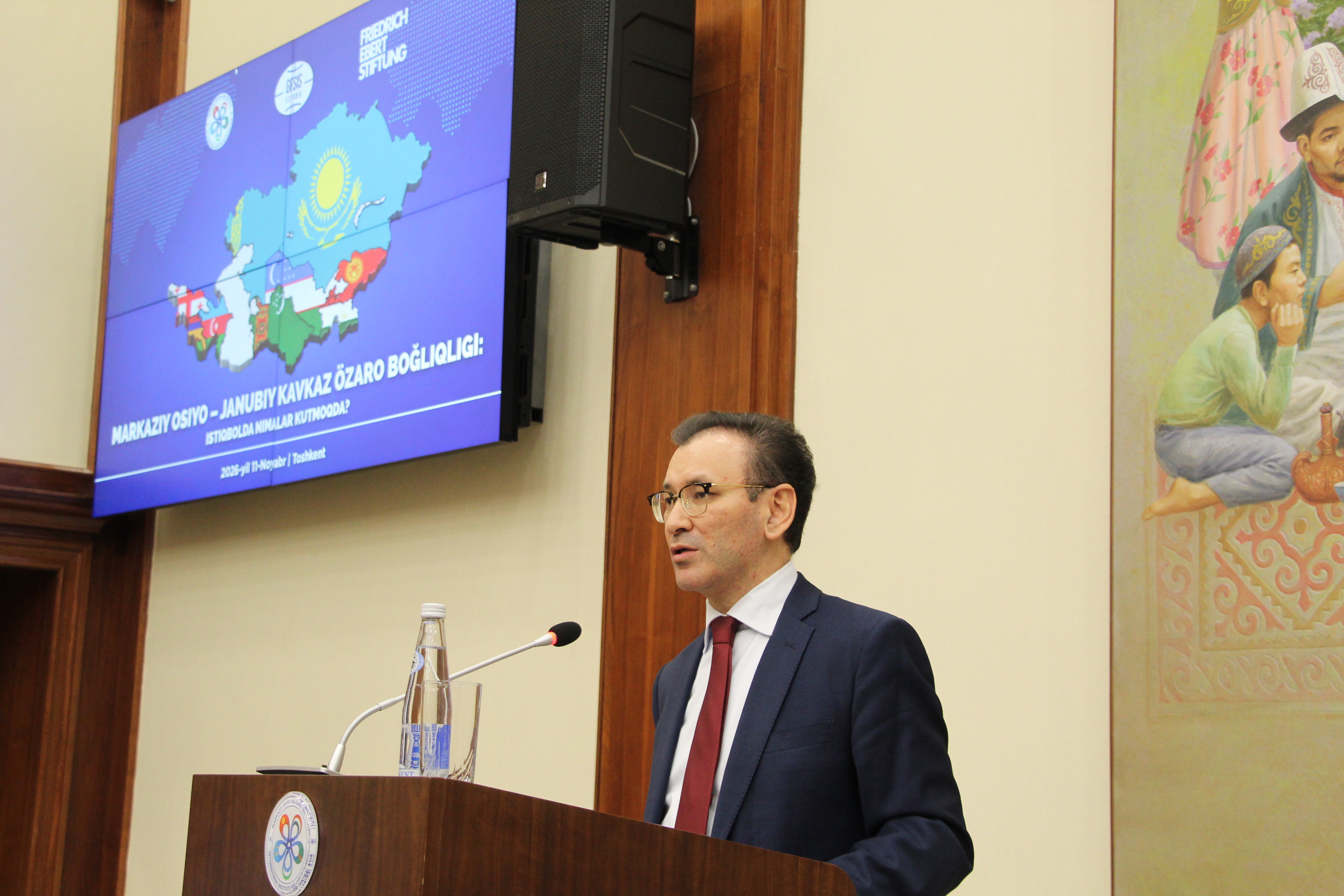
It is a great pleasure to welcome you to the International Institute for Central Asia for today's conference on the future of connectivity between Central Asia and the South Caucasus.
Let me express my sincere appreciation to our partners, the Georgian Foundation for Strategic and International Studies and the Friedrich Ebert Foundation, for their valuable cooperation in organizing this important event.
I am also very pleased to see representatives of Georgetown University, George Washington University, the Central Asia–Caucasus Institute, the European Policy Centre, the World Bank, the International Finance Corporation, GIZ, the German Marshall Fund, and the Estonian School of Diplomacy, as well as leading think tanks from Central Asia and the South Caucasus, joining us today. Your presence reflects the growing international interest in connectivity between our regions and will undoubtedly enrich our discussions.
Dear friends,
For decades, Central Asia and the South Caucasus were viewed primarily through the prism of their geographic position between major powers and economic markets. Today, this perception is changing. Our regions are increasingly becoming active participants in shaping Eurasia's economic and geopolitical landscape.
Our geography has not changed. What has changed is our ability to turn it into strategic opportunities. The development of new transport corridors is bringing something fundamental back to our regions – the ability to choose. To choose trade routes, economic partners, and development priorities.
In an increasingly uncertain international environment, this flexibility is becoming an important source of economic resilience and strategic autonomy. After all, our objective should not be to replace dependence on one route or partner with dependence on another, but to develop a diversified network of connections that expands opportunities for all participating countries.
Dear colleagues,
This transformation is being supported by important political changes across two regions. In Central Asia, the regional policy pursued by President Shavkat Mirziyoyev has helped foster a new environment of mutual trust, good-neighborliness, and practical cooperation.
A particularly significant milestone was Azerbaijan's accession to the Central Asian club in November 2025. The eighth Summit of Central Asian leaders, held in Avaza last month, marked the first gathering with Azerbaijan participating as a full member.
At the Summit, President Mirziyoyev advanced a vision of a common space for interregional cooperation, supported by coordinated infrastructure development and joint industrial value chains.
This vision is already finding practical expression in our relations with the South Caucasus. President Mirziyoyev's historic state visit to Georgia in July this year, the first in more than two decades, opened a new chapter in bilateral relations, culminating in the establishment of a strategic partnership.
Particular attention was given to transport connectivity, including greater use of Georgia's Black Sea ports and the potential integration of the Baku–Tbilisi–Kars railway with the China–Kyrgyzstan–Uzbekistan railway.
The latter offers particularly promising opportunities. On the one hand, its connection with the planned Trans-Afghan railway could open a new route linking China and Central Asia with South Asia and the Indian Ocean.
On the other hand, its integration with the Middle Corridor through the Caspian Sea, Azerbaijan, and Georgia would provide additional access to European markets.
Our relations with Azerbaijan, a close strategic partner and ally, are also reaching new heights. During President Ilham Aliyev's state visit to Tashkent in August this year, our countries signed the historic Treaty on Eternal Friendship and launched several joint projects.
We are also enhancing our relations with Armenia. Last month in Avaza, President Mirziyoyev and Prime Minister Pashinyan discussed expanding trade, investment, and industrial cooperation. Uzbekistan also welcomes progress toward peace between Armenia and Azerbaijan, which could open new opportunities for regional connectivity and economic development.
Ladies and gentlemen,
The Middle Corridor is perhaps the most visible expression of this transformation. The World Bank estimates that targeted investments and improved coordination could more than triple trade volumes along the corridor and halve travel times by 2040.
The growing importance of the Middle Corridor was also reflected in the recent C5+1 Ministerial Meeting in Samarkand on October 19. During the meeting, U.S. Secretary of State Marco Rubio emphasized the need to develop Trans-Caspian transport infrastructure and expand access to international markets.
Another important development was the first meeting of the foreign ministers of Central Asia and Georgia, held in Batumi on October 23. The ministers discussed ways to develop the Middle Corridor, improve transport infrastructure, simplify transit procedures, and expand trade between our regions.
Lately, we hear a lot about the proposed Trump Route for International Peace and Prosperity, or TRIPP, which could provide an additional connection between Azerbaijan, Armenia, Türkiye, and European markets. Importantly, TRIPP should complement rather than compete with the Middle Corridor and routes through Georgia, offering more options for businesses and participating countries.
Yet infrastructure alone is not enough. Corridors also require harmonized customs procedures, compatible digital systems, predictable transit regulations, and effective coordination among participating countries.
Connectivity should also deliver more than transit revenues. It must encourage industrial cooperation, attract investment, and create opportunities within our regions. We must move from connectivity for transit to connectivity for development.
Dear colleagues,
These developments raise several important questions that I hope will guide today's discussions. How can we ensure that emerging transport routes complement one another rather than develop as separate and competing projects?
What practical mechanisms could help our countries coordinate infrastructure investments, simplify border procedures, and attract private capital?
And how can we translate growing connectivity into lasting economic benefits, while strengthening peace, stability, and cooperation across our regions?
Our expert communities also have an important role to play in translating these opportunities into practical recommendations and concrete initiatives.
Excellencies, ladies and gentlemen,
The title of our conference asks a timely question: What Lies Ahead? I believe the answer will depend not only on how the international environment evolves, but also on the choices our countries make and our ability to work together.
Once again, I thank our distinguished partners and guests for joining us and wish everyone productive discussions and a successful conference.
Thank you for your attention.