Ladies and Gentlemen,
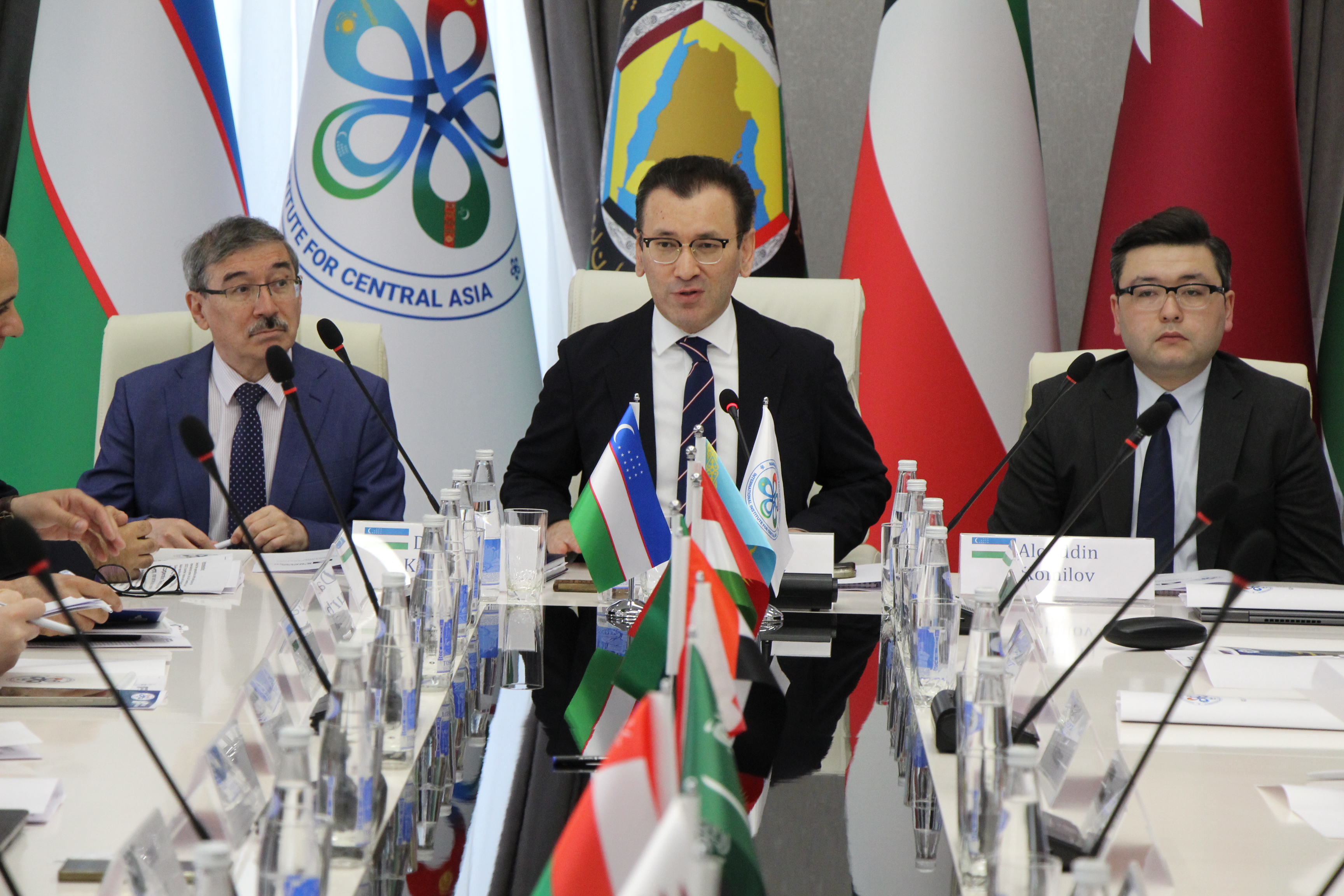
It is my pleasure to welcome all our distinguished guests to today’s seminar. I would like to extend my sincere gratitude to our valued partner, the Bourse & Bazaar Foundation, for the active and productive collaboration in organizing this important event. We are thankful to all participants from the Central Asian and Gulf countries who have made the journey to be here. I also wish to express appreciation to our Uzbek colleagues, whose support is particularly significant for us today.
- We convene just two weeks ahead of the second Summit between the Central Asian countries and the Gulf Cooperation Council (GCC), to be held in Samarkand. We bear a special responsibility to formulate practical recommendations for our governments aimed at deepening cooperation.
The decision to hold the Summit of leaders of our two regions in Samarkand highlights the fact that our nations are reviving the centuries-old trade, scientific, and cultural connections that once enabled our ancestors to make an immense contribution to the development of global civilization.
In the context of profound transformations in the global geopolitical and geo-economic landscape, there is a growing need to assess how international developments are shaping the future of interregional cooperation.
- Against this backdrop, it is critical to examine the key drivers and interests that motivate collaboration between our regions.
To advance meaningful cooperation, we must deepen our mutual understanding of the fundamental characteristics and development trends in both regions. This will enable us to identify effective solutions for enhancing economic complementarity and promoting interregional partnerships.
Amid rising global uncertainty, there is an increasing demand for practical mechanisms of cooperation in the field of security to ensure a stable environment conducive to partnership.
Our governments and business communities will also benefit from proposals focused on harmonizing the political and legal frameworks for cooperation, as well as the unification of technical standards.
Energy remains a top priority for our interaction. There is growing mutual interest in technology exchange and joint investment initiatives, especially in the context of the global energy transition.
In the area of trade, we should consider steps toward establishing a free trade zone and negotiating a comprehensive trade agreement. Transport connectivity is another pressing priority. The commencement of construction on the China–Kyrgyzstan–Uzbekistan railway, coupled with collaboration with the European Union on the development of the Trans-Caspian route, enhances the prospects for the Trans-Afghan railway corridor. Investments from Gulf countries in this project will greatly contribute to the interconnectedness of our two regions.
We also look forward to proposals that will strengthen academic, cultural, and humanitarian exchanges, as well as cooperation among civil societies. These efforts are essential for expanding people-to-people ties and laying a strong foundation for long-term partnership. In this regard, issues of labor mobility and the establishment of a visa-free tourism regime between our regions are of particular importance.
- A key objective moving forward is the further institutionalization of interregional cooperation. At present, both sides are finalizing an Agreement on Friendship, Regional Connectivity, and Cooperation, alongside a Joint Summit Declaration, which is expected to include new institutional frameworks.
Several “C5+” formats with other partners have already established secretariats—some even in virtual form. Such mechanisms may prove useful for implementing summit-level decisions and enhancing overall cooperation between the two regions.
In conclusion, I would once again like to thank all participants for joining us today. I wish you a productive seminar filled with engaging presentations, dynamic discussions, and concrete proposals for advancing economic integration between the countries of Central Asia and the Gulf Cooperation Council.
Thank you for your attention.