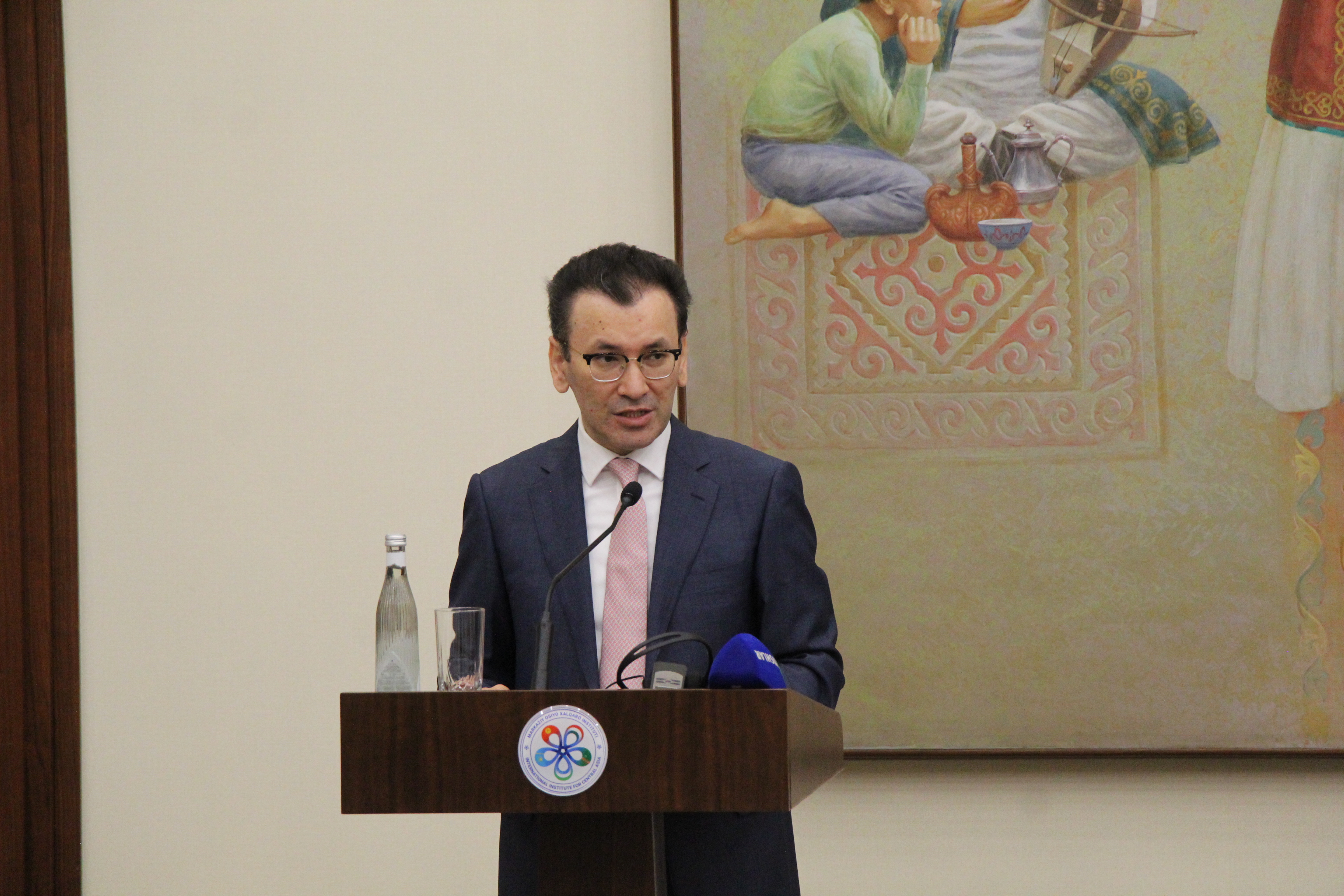
OPENING SPEECH
at the First First Central Asia and Korea
Think Tanks Forum
(Tashkent, July 30, 2024)
Dear Forum Participants,
Esteemed Heads and Members of Delegations from Central Asia
and the Republic of Korea,
Your Excellency Ambassador Won Do-yeon,
Dear Friends,
First and foremost, allow me to express my sincere gratitude to Mr. Ri Chong Kuk, Executive Director of the Central Asia-Korea Cooperation Forum Secretariat, and to all Korean representatives and experts who have traveled to Tashkent to participate in our conference.
I would also like to extend special thanks to the representatives and experts from think tanks across Central Asia who accepted our invitation to come and speak at this forum. Your presence in this hall stands as a tangible testament to the successful progress of regional cooperation and integration.
I am delighted to welcome the leaders and representatives of think tanks, ministries, and agencies from Uzbekistan, who have taken the time to participate in this significant event.
Dear conference participants,
Our Central Asia-Korea Think Tank Forum takes place following the historic visits of His Excellency President Yoon Suk-yeol to Uzbekistan and other countries in the region in June of this year, the launch of the “Korea-Central Asia K-Silk Road” initiative, and the upcoming First Summit of the Central Asia-Korea Cooperation Forum scheduled to be held in Seoul in 2025.
As the Korean leader noted, this strategic initiative represents a “continuation of 30 years of experience” in cooperation between the Republic of Korea and Central Asian countries. Over these decades, our Korean partners have undoubtedly made a tremendous contribution to the modernization of our economies and the overall development of our independent states.
President of Uzbekistan Shavkat Mirziyoyev emphasized that Korea is a time-tested, special strategic partner of Uzbekistan and supported the proposal to hold the first summit in Seoul in the format of “Central Asia – Korea.”
Established in 2007, the “Korea-Central Asia Cooperation Forum” has become an important platform for dialogue among official representatives, business leaders, experts, and broader public circles from our six countries, serving as an additional driver of bilateral cooperation.
In this context, the assessments and proposals presented today could be useful for the upcoming 17th Ministerial Meeting of the Central Asia-Korea Cooperation Forum, scheduled to take place in Seoul in November this year. During this meeting, the parties will discuss key issues related to the preparation of the first summit of our country leaders and exchange views on the K-Silk Road initiative.
Dear colleagues,
In the context of escalating global security conflicts and geopolitical rivalry, the efforts of Central Asian countries to enhance regional cooperation and productive interaction with leading global partners, including the Republic of Korea, have gained particular importance.
The Korean side welcomed the transformative processes occurring in our region and highly valued the key role of Consultative Meetings in strengthening stability, security, and sustainable development in the region.
President Yoon Suk-yeol, summarizing the significant outcomes of his tour in the region, emphasized that the Korean government will support more active engagement of Korean companies and experts with Central Asia.
To further enhance the effectiveness of interactions between the Central Asian region and the Republic of Korea, developing new approaches to organizing multilateral cooperation is significant, especially in light of preparations for the first summit in the “Central Asia-Korea” format in 2025 and the promotion of the K-Silk Road initiative.
In this context, there is an increasing need to strengthen expert exchange and practical collaboration between the countries of the region and South Korea, and accordingly, to review traditional approaches to cooperation in all priority areas.
In this regard, during the first session titled “Mutually Beneficial Partnership Between Central Asia and the Republic of Korea for New Geopolitical Dynamics: Vision for the Future and Key Priorities,” we propose to discuss key approaches and main directions for deepening the strategic partnership.
First and foremost, we look forward to a comprehensive presentation by the Korean participants of the conceptual foundations of the K-Silk Road initiative, key directions for further political dialogue, and the advancement of mutually beneficial partnerships, particularly in the economic sphere and other major areas.
In turn, it will be important to hear the views of experts from our region on their main priorities and tasks for cooperation with Korea, including regional projects where the rich investment and technological potential of Korean partners can be utilized.
We would also like to discuss in more detail the issues related to advancing interaction in the “Central Asia-Republic of Korea” format, which will contribute to the successful organization of the upcoming summit of heads of state in Seoul.
In this context, particular interest lies in exchanging opinions on further strengthening the role of the Forum Secretariat, which has become a pioneer among other “Central Asia plus” formats.
In the second session titled “Reconstructing the Global Value Chain and Economic Security: Mutually Beneficial Cooperation in Energy and Key Minerals,” it is proposed to focus on exchanging views on coordinating approaches to cooperation in trade-economic, transport, and energy sectors.
After his trip to the region, Korean President Yoon Suk-yeol paid special attention to the potential of partnerships focused on mineral resources, energy, and infrastructure. In Uzbekistan, the leaders of the two countries agreed to create a high-tech hub with an emphasis on critically important mineral resources, chips, chemistry, machine engineering, smart agriculture, infrastructure and urban planning, and green energy.
It seems that there are already significant achievements and even greater expectations for the realization of important infrastructure and investment projects aimed at shaping a sustainable future in Central Asia and the Republic of Korea. The opinions of Korean partners on advancing these plans are of particular interest.
In the third session titled “Addressing Climate Change: Forward-Looking Strategies for Water Security and Sustainable Water Resource Management,” the main focus is expected to be on discussing measures for climate adaptation and resource conservation.
Given the worsening situation with water resources, rapid climate changes, and energy transition challenges, we need to develop new, mutually acceptable measures for rational water use and advanced technologies for green economic transformation, especially in key industrial sectors and agricultural production.
In this regard, we look forward to receiving analyses of the issues and well-founded proposals from invited experts and specialists on promoting promising cooperation projects in the areas of climate adaptation and resource conservation.
In the fourth session titled “Strategic Interaction in the Era of Technological Hegemony: Joint Approaches to ICT and Education in Artificial Intelligence,” the focus will be on strengthening cooperation in education and science. It is important to enhance the effectiveness of joint efforts to improve the quality of human resources and, in the near term, concentrate collaborative activities on strengthening connections in youth, education, science, and technology.
In this context, promising opportunities include joint training programs with "dual diplomas," expanding digital knowledge among youth, collaborative training of IT and AI specialists, and strengthening support for vocational education in line with contemporary requirements and Korea’s best standards.
An interesting and useful dialogue might also be about national and regional identity issues of our countries, which could be significant for bringing our peoples closer together. This includes the increasing interest in Korea in studying the languages, history, and culture of Central Asian countries.
Considering the unique role of Korean communities in the multinational states of our region in developing cooperation with Korea, as well as the growing number of Central Asian citizens studying and working in Korea, it could be very beneficial to intensify the dialogue on the prospects of deepening humanitarian ties between our countries and the impact of this process on our cooperation.
Dear Forum Participants,
In general, we can confidently say that the established trustful and constructive relationships between Central Asian countries and the Republic of Korea are becoming systematic, constructive, and intensive.
The recent visits by President Yoon Suk-yeol to our region and the upcoming first summit of the Central Asia-Republic of Korea Cooperation Forum, as well as the advancement of the K-Silk Road initiative, mark a new chapter in the long history of our countries' interaction. They create real opportunities for a fuller realization of the potential for mutually beneficial cooperation and our joint advancement on the path to peace, progress, and prosperity.
I wish the participants of today’s discussion productive work, rich professional exchanges, and excellent results!
Thank you for your attention!