Honorable Ambassador Extraordinary and Plenipotentiary of the Republic of Kazakhstan to the Republic of Uzbekistan, Beibut Bakirovich! Honorable heads of diplomatic missions, honorable conference participants!
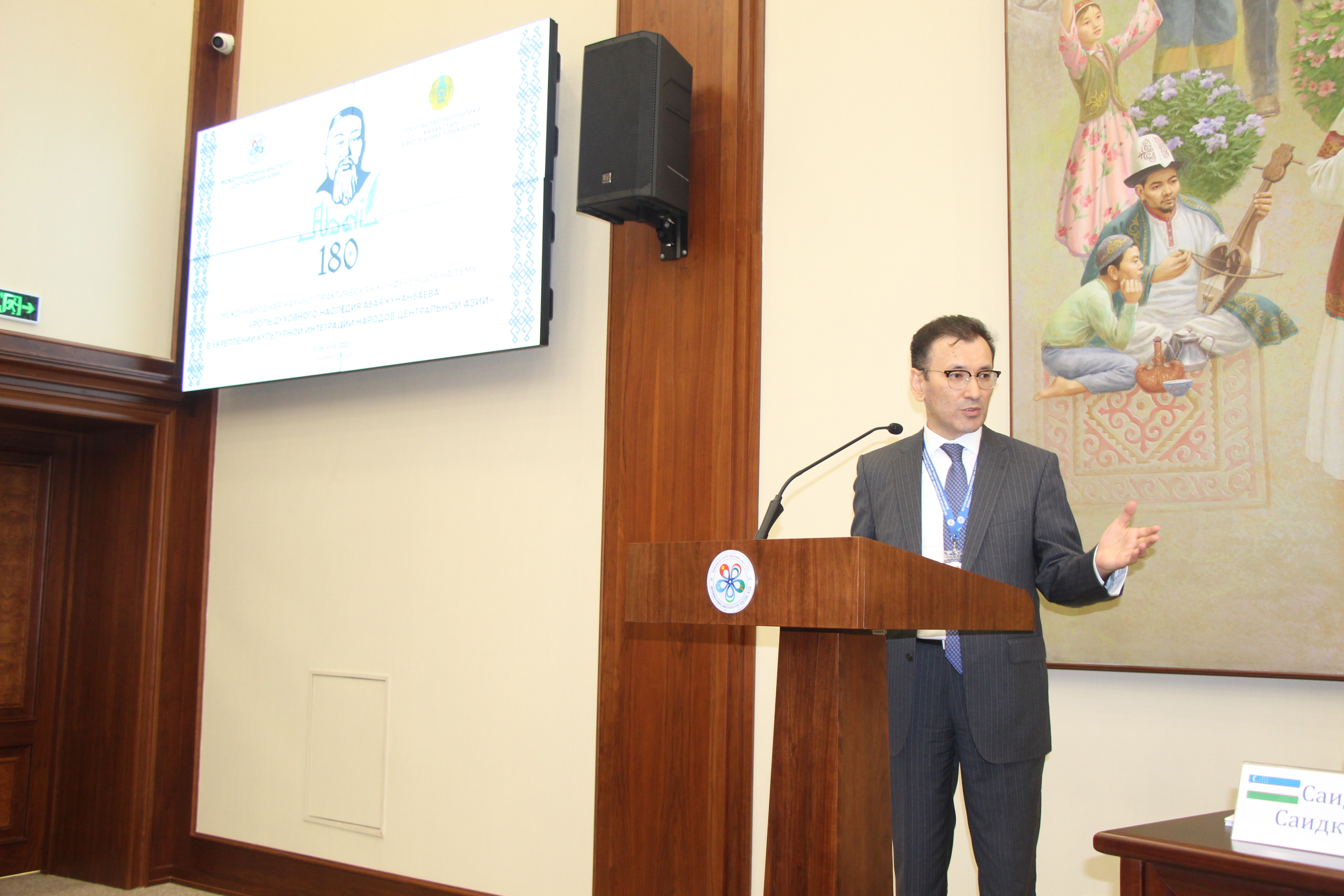
First of all, allow me to warmly welcome all of you to this conference organized by the International Institute for Central Asia with the support of the Embassy of the Republic of Kazakhstan in the Republic of Uzbekistan.
I express my deep gratitude to honorable Beibut Bakirovich and the entire staff of the Embassy of the Republic of Kazakhstan for their active assistance in organizing this conference, as well as for inviting honored guests from Kazakhstan – Kydyr Torali, Director of the Islamic Research Institute under the Spiritual Administration of Muslims of Kazakhstan, and Dariya Perneshovna Kozhamzharova, Academician of the National Academy of Sciences of the Republic of Kazakhstan. I extend special thanks to the ambassadors, diplomats, and representatives of the scientific community whose presence honors us and who have made a significant contribution to today’s conference. Such a distinguished group of participants lends the event special significance and serves as a clear confirmation of the deep and mutual interest in developing cultural cooperation in our region.
Honorable guests! It is gratifying to emphasize that this conference naturally continues the established and proven tradition of holding joint forums, symposia, and scientific meetings. Within this framework, we have repeatedly referred to the creative and philosophical heritage of the outstanding poets and thinkers of our region – Alisher Navoi, Abdurakhman Jami, Magtymguly Pyragy, Chingiz Aitmatov, and others. These events have rightfully become important milestones in developing humanitarian dialogue and strengthening cultural ties in Central Asia.
Today, we are united by a common and noble goal – to comprehensively comprehend the heritage of the great poet and thinker Abai Kunanbayev. In Uzbekistan, Abai's name is surrounded by respect and sincere love. His works have long become an integral part not only of Kazakhstan's cultural heritage but also a common spiritual code uniting our peoples based on historical proximity and harmony of values. Abai Kunanbayev was distinguished by deep moral wisdom: in his works, he paid great attention to questions of friendship and human relations. For instance, he wrote:
"Жаман дос– кўленке: кундиз куни қашсан да, қаша алмайсын; бултты кўнде издесенгде, таппайсынг"
("A bad friend is like a shadow: on a sunny day you run but cannot escape; on a cloudy day you look but cannot find"), emphasizing the importance of true friendship that remains faithful in difficult times.
These thoughts show that Abai’s spiritual heritage serves as a living guide for strengthening human ties and mutual understanding between peoples. The recognition of the value of these ideas in modern society is reflected in specific state initiatives. In his welcoming speech on the occasion of the 180th anniversary of the great Abai Kunanbayev’s birth, the President of the Republic of Kazakhstan, Kassym-Jomart Tokayev, noted:
"Abai's rich heritage has become a spiritual guide not only for the Kazakh people but for all of humanity. His thoughts and precepts will never lose their relevance. Therefore, it is very important to research and popularize Abai's work, grasping the deep meaning of his productions."
These words emphasize the international significance of the great poet and philosopher’s heritage and confirm his role in strengthening the cultural integration of the peoples of Central Asia.
Honorable colleagues! Our conference program combines two interrelated and strategically important themes:
The first session is dedicated to the moral foundations and philosophy of Abai Kunanbayev. In his famous prose cycle "Words of Edification" ("Kara soz"), which includes 45 parables and philosophical reflections, he criticized the stagnation of the traditional way of life and obsolete habits, asserting eternal values – kindness, mercy, and the pursuit of personal responsibility. Many of his conclusions and instructive findings remain surprisingly modern, accurately describing existing and still uneradicated problems of society. Abai saw the path to progress in the spiritual renewal of the individual through enlightenment, calling for the abandonment of dependence and superstitions, and the cultivation of independent thinking and moral maturity.
He is often called the "architect of new thinking" – a thinker who sought to raise the consciousness of the people to a higher level.
The second session is dedicated to Abai's role as a cultural bridge between the peoples of Central Asia. His heritage represents a unique fusion in which nomadic tradition, Islamic spirituality, and European philosophical thought are organically intertwined. Translations of works by Lermontov, Goethe, and Byron into the Kazakh language not only opened access to world cultural treasures for the Kazakh people but also contributed to the formation of a new level of literary worldview, laying the foundation for a dialogue of cultures in the region.
According to researchers, Abai's poetry and philosophy became a powerful source of inspiration for the leaders of national revival. His views on freedom, dignity, and identity had a long-term influence on the formation of Kazakhstan's modern foreign policy, setting its course toward mutual respect and open integration into the world community. On the sidelines of the conference, we will examine how this cultural code continues to operate today – inspiring joint regional initiatives, strengthening the atmosphere of spiritual dialogue, and forming a common space of historical memory that becomes a reliable foundation for the further convergence and cooperation of the peoples of Central Asia and the formation of our regional identity.
Together, both sessions form a single narrative in which Abai's heritage appears not only as an object of scientific study but also as a resource for spiritual growth and regional interaction. Honorable friends! Today's meeting acquires special symbolic significance in the year of celebrating the 180th anniversary of the birth of the great Abai Kunanbayev – an event that emphasizes the enduring value of his ideas and philosophy. As an ancient Kazakh wisdom says:
"A person without friendship is like a tree without roots."
United by a common history and spiritual values, our peoples have strengthened mutual support and the desire for unity over centuries. Today, we continue this path, relying on the rich cultural heritage and humanistic ideals of the great Abai Kunanbayev.
I am confident that this conference will be an important milestone in the development of mutual understanding and good-neighborliness between the countries of Central Asia. I believe its results will serve to strengthen trust and constructive dialogue, as well as become an impetus for new joint initiatives aimed at peace, stability, and sustainable development of our entire common region.
Thank you for your attention!