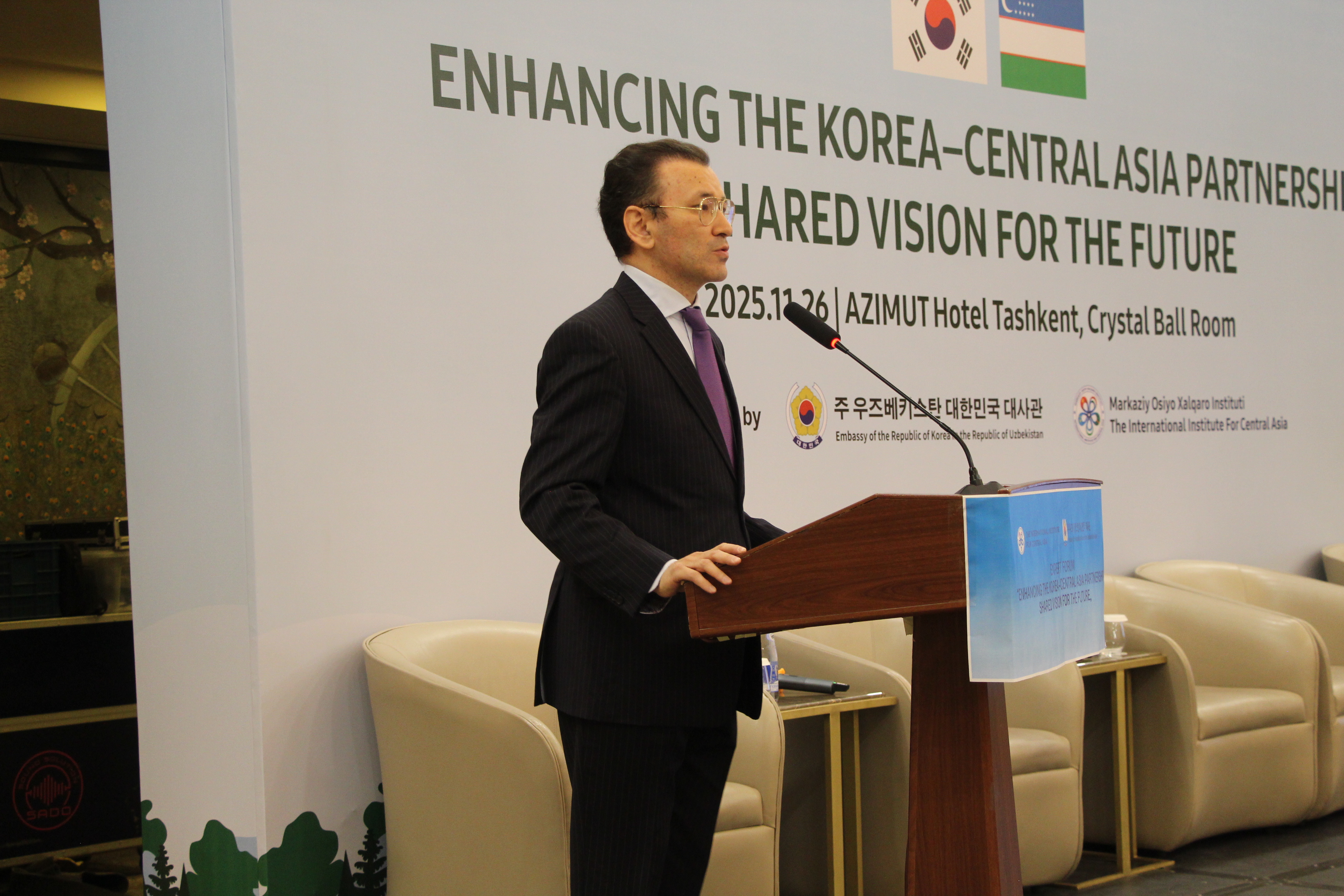
I am truly delighted to welcome you all to this Expert Forum here in sunny Tashkent. Your presence today is greatly appreciated. I would also like to extend my heartfelt gratitude to Ambassador Won Doyeon – a cherished partner and dear friend – whose support has made this exceptional event possible.
Dear colleagues,
As you all know, the world today is undergoing rapid changes. Geopolitical alignments are shifting, global trade tensions are intensifying, major power rivalries are ongoing, and instability is affecting different regions, all while international relations are becoming increasingly fragmented. In this context, our cooperation is more important than ever. We must stand together.
Central Asia has chosen a path of partnership with all. This is why we have established more than ten C5+ formats, bringing together over 40 countries and two regional organizations across the globe – eleven G20 members, including the Republic of Korea.
In fact, the “Central Asia – Republic of Korea” cooperation format was one of the first our region set up with international partners, back in 2007. Since then, we have held 17 forums, and our relations continue to grow dynamically. Today, we hold ministerial meetings, have a dedicated Secretariat, and run the Central Asia – Republic of Korea Business Council.
Our cooperation in this format brings significant economic benefits. Bilateral trade between Korea and the Central Asian states has grown from $200 million in the 1990s to $9 billion in recent years – an increase of 35 times over the past three decades. Cumulative investment exceeds $4,08 billion. In 2023, Korea ranked as the 4th largest import sources for Kazakhstan and Uzbekistan.
I am especially pleased to see the growing ties between think tanks in Central Asia and the Republic of Korea. We now have an established Think Tank Forum, with two successful meetings already held – last year in Tashkent and this year in Bishkek. Today, we have come together once again to exchange ideas, share experiences, and explore new opportunities for collaboration.
We have also developed multilayered cooperation with Korea: strengthening civil society and people-to-people ties through education programs and tourism, promoting economic collaboration via business councils, fostering policy and knowledge exchanges through think tank forums, conducting parliamentary dialogue through meetings of speakers of parliament, and advancing ministerial diplomacy through the Korea–Central Asia Cooperation Forum.
We are now ready to elevate our cooperation with Korea to an even higher level. Next year, we will have the first-ever Central Asia – Republic of Korea Presidential Summit. This landmark meeting will open a new chapter in both our regional engagement, creating a truly high-level platform for dialogue and partnership.
Expert forums like this one play an important role in preparing the ground for that Summit. They help us clarify priorities, generate new ideas, and build a shared understanding of the opportunities ahead.
Our region focuses on six key priority areas in cooperation with Korea: industrial modernization, transport and logistics, energy, climate change and the environment, health and medical services, and education and culture. These areas have formed the foundation of the Korea–Central Asia Cooperation Forum Secretariat.
Dear participants,
I must note that our discussions are taking place at a particularly important moment for Central Asia. We are entering a new era of regional cooperation. Just a few days ago, Tashkent hosted the Seventh Central Asian Summit – the region’s main annual platform for high-level dialogue. At the summit, it was announced that Azerbaijan has become a full-fledged member of our regional cooperation format.
This development shows that our cooperation model is evolving into a flexible, consensus-based platform – a “new type of integration” focused on shared interests and practical outcomes.
I would also like to touch on one more important outcome of the Summit. At this meeting, President Shavkat Mirziyoyev put forward the idea of establishing a Central Asian Community. If realized, this initiative would give our region a stronger, more unified voice on the international stage. It would also create new opportunities for cooperation with our partners – including the Republic of Korea – through a more structured Central Asian format.
Dear friends,
All these make our today’s gathering especially significant. Today we will discuss key areas of future cooperation, including fostering business partnerships and people-to-people engagement, advancing regional collaboration in clean and green energy and critical minerals, and driving sustainable economic growth through digital transformation and artificial intelligence.
Our main objective is to develop policy recommendations, strategic insights, and practical proposals that will help shape the future agenda of the upcoming Presidential Summit.
Thank you for your attention and wish you all productive discussions today.