Ladies and Gentlemen, Distinguished Participants!
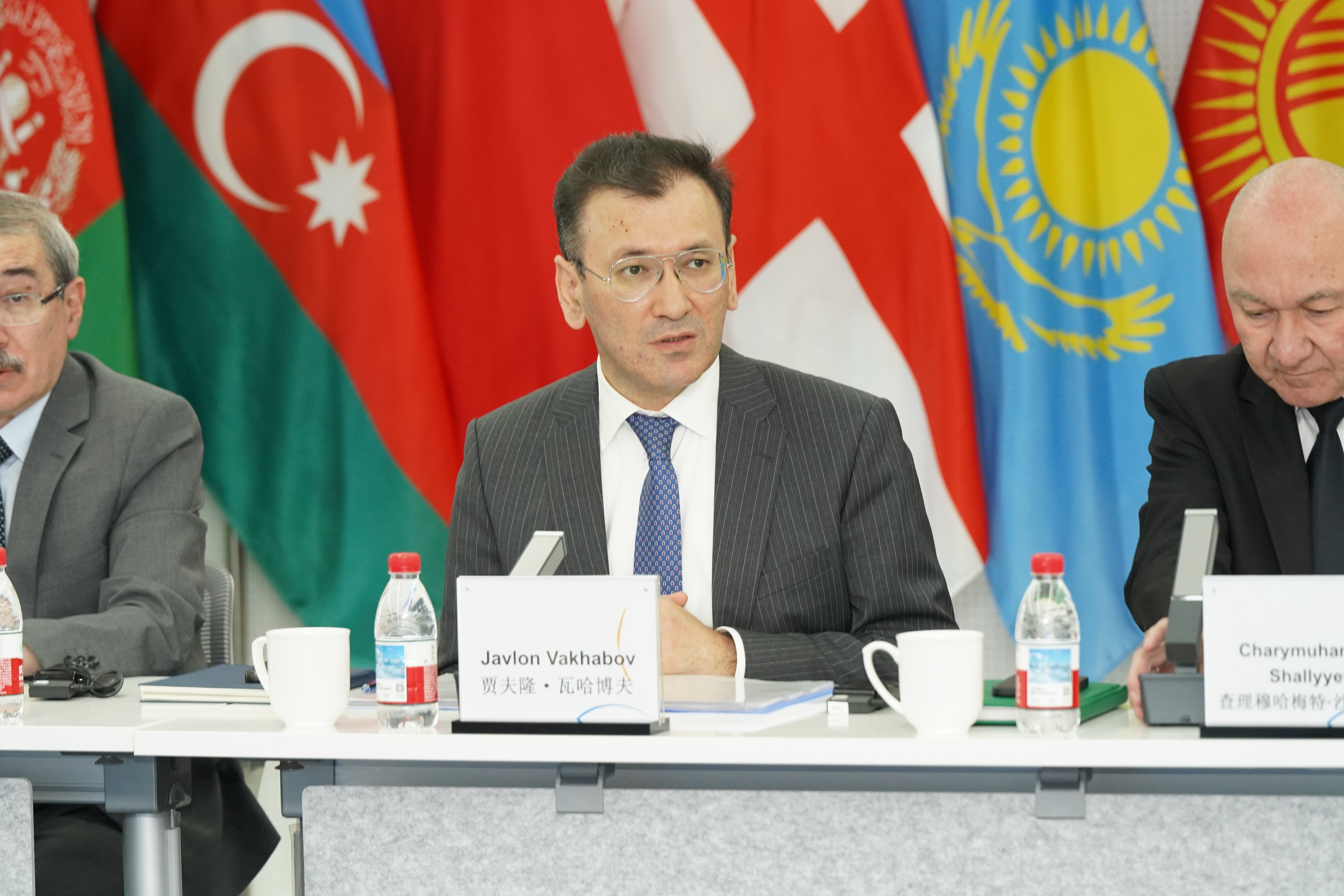
First of all, let me express my sincere appreciation to the CAREC Institute team, and in particular to Mr.Charymukhammet Shallyyev, for initiating today’s roundtable devoted to the opportunities for Uzbekistan’s economic cooperation within the CAREC Program, the Program’s role in advancing economic integration in Central Asia, and China’s experience in preventing vulnerable groups from falling back into poverty.
Uzbekistan attaches great importance to the implementation of reforms aimed at liberalizing the economy, creating a favorable environment for investors, expanding participation in global value chains, fundamentally modernizing social and industrial infrastructure in the regions, and improving the quality of life of the population.
International financial institutions, including the Asian Development Bank (ADB), the Islamic Development Bank, the European Bank for Reconstruction and Development, the World Bank, and the International Monetary Fund, make a significant contribution to the successful implementation of these transformations.
I would like to note that 2026 has effectively become a year of strengthening Uzbekistan’s financial and investment potential. This is reflected in the hosting of the 59th Annual Meeting of the ADB Board of Governors in Samarkand, the organization of the 5th Tashkent International Investment Forum, as well as the successful public listing of shares of Uzbekistan’s national companies on the London Stock Exchange.
I would like to particularly highlight the role of the ADB, which has become a strategic partner of Uzbekistan in implementing large-scale reforms and advancing socio-economic transformation. The ADB’s portfolio in Uzbekistan has reached $16 billion, while new opportunities for cooperation are opening up through the $12,5 billion partnership program signed during the Meeting of the ADB Board of Governors in Samarkand.
The CAREC Program plays a vital role in realizing the development strategies of Uzbekistan and other Central Asian countries. It makes a significant contribution to modernizing and expanding the economic potential of nations across Central, Eastern, and South Asia, as well as the South Caucasus.
Currently, 44 projects are being implemented in Uzbekistan under the CAREC framework, with a total value exceeding $14 billion. The largest share belongs to the transport and logistics sector, which accounts for 24 of these projects. Within this sector, a significant portion of the highways and railways that make up the CAREC transport corridor network has already been modernized under the "Corridor 2, 3, 5, and 6" projects.
Additional opportunities for regional cooperation are emerging through the construction of the China–Kyrgyzstan–Uzbekistan Railway, which is expected to strengthen regional connectivity as part of the China–Central Asia–West Asia Economic Corridor under the Belt and Road Initiative.
The Andijan Region plays a strategic role in this corridor, serving as a gateway for the China–Kyrgyzstan–Uzbekistan railway and facilitating cargo flows across Uzbekistan and wider to Central Asia.
In this regard, developing logistics centers and dry ports in Andijan will create new opportunities for efficient cargo management along the China–Kyrgyzstan–Uzbekistan Railway, providing the smooth movement of goods across Uzbekistan and onward to Europe and the Middle East.
Dear colleagues!
In his remarks at the ADB Board of Governors’ Meeting in Samarkand, President Shavkat Mirziyoyev emphasized the importance of ensuring the stable functioning of transport corridors. In this context, the proposed Digital Customs and Logistics Alliance under the CAREC Program offers a timely solution to simplify customs procedures, digitalize trade processes, and enhance cross-border cargo flows.
Uzbekistan’s cooperation with the CAREC Program has also demonstrated significant results in the energy sector, which accounts for around 40% of the Program’s investment portfolio, or $5.1 billion. One of the most promising areas for further cooperation is the development of renewable energy.
Today, Uzbekistan is the leading destination for foreign direct investment in renewable energy in Central Asia. Between 2003 and 2025, our country accounted for 56% of all foreign direct investment in this sector across the region, totaling nearly $18 billion.
We highly appreciate the CAREC Institute’s recognition of Uzbekistan’s significant potential in renewable energy development. As part of the Institute’s research, Uzbekistan was identified as one of the regional leaders in this field and recommended as a pilot country for the Investment Promotion Program.
The practical recommendations developed under this program will contribute to further improving the investment climate, mobilizing new investment, and promoting the sustainable development of renewable energy in Uzbekistan and across Central Asia.
Dear friends!
Today’s event is of particular significance as it takes place during the anniversary year marking the 25th anniversary of the CAREC Program. Taking this opportunity, I would like to congratulate all member countries, development partners, and everyone who has contributed to the advancement of the CAREC Program over these years.
I would also like to express my sincere appreciation to the CAREC Institute, which plays a key role in promoting regional economic cooperation and makes a valuable contribution to achieving the objectives of the Program.
I would like to reaffirm the readiness of the International Institute for Central Asia to further strengthen cooperation with the CAREC Institute, building upon the Memorandum of Understanding signed between our institutions. We are ready to actively engage in expert consultations, promote exchanges among young researchers, and organize joint events.
Within the framework of this partnership, we are prepared to expand joint research activities, including studies on the opportunities for artificial intelligence applications in Central Asia, opportunities for green financing, and the introduction of water-saving solutions in the agricultural sector.
Given the significant potential for renewable energy development in Central Asia, we also propose, together with the CAREC Institute, to further enhance regional expert cooperation in this area, taking into account the key findings and recommendations presented in your report on the investment ecosystem for renewable energy in Central Asia.
Dear participants!
In Uzbekistan, issues related to development and improvement of the well-being of the population represent a key priority of state policy and serve as a foundation for strategic planning.
Addressing the ADB Board of Governors in Samarkand, President Shavkat Mirziyoyev noted that over recent years Uzbekistan has attracted $150 billion in foreign investment and established thousands of modern enterprises. Exports of goods and services have tripled, while GDP has increased from $50 billion to $147 billion.
The President also emphasized that improving the well-being of every family and every citizen remains a key priority of the country's reform agenda. As a result, the incomes of 8.5 million vulnerable citizens have increased, while the poverty rate has declined from nearly 35% to 5.8%.
Under the Uzbekistan 2030 Strategy, the Government aims to expand the country's economy to over $240 billion, achieve upper-middle-income status, and eradicate poverty.
Dear colleagues!
China undoubtedly plays an important role in the development of Uzbekistan and the entire Central Asian region. The People’s Republic of China is Uzbekistan’s largest trading partner.
An important indicator of the growing economic cooperation is the increase in the number of enterprises with Chinese capital operating in Uzbekistan, which grew from 2,1 thousand in 2023 to 5,2 thousand in 2026. In 2025, Chinese investment in Uzbekistan’s economy reached $15.8 billion, with a target set to increase this figure to $21 billion. This goal will be supported by the active operations of the regional office of the China Eximbank, established in Tashkent in 2024 following an agreement between the two heads of state.
One of the promising areas of bilateral cooperation is interaction in the field of socio-economic development and improving the well-being of the population.
China has achieved remarkable results in this area. Between 2012 and 2020, through the implementation of a targeted poverty alleviation program, nearly 100 million rural residents were lifted out of poverty. Following the eradication of absolute poverty, China’s focus has shifted toward preventing the recurrence of poverty, increasing household incomes, and promoting the comprehensive development of rural areas.
This experience is of significant interest to Uzbekistan. Particularly valuable are China’s approaches to targeted social assistance, rural economic development, and entrepreneurship promotion. Adapting these practices to Uzbekistan’s national context could contribute to further strengthening the socio-economic well-being of the population.
An important step in advancing cooperation in this area will be provided by the Joint Action Plan between Uzbekistan and China on Poverty Reduction Cooperation for 2026–2027.
Its implementation will facilitate the exchange of experience in poverty reduction, the introduction of modern approaches to rural development, and the expansion of employment opportunities for the population.
Dear participants!
There are significant opportunities to further strengthen the strategic partnership through the Central Asia–China cooperation format. Following the successful summits in Xi’an and Astana, this mechanism has made rapid progress in establishing its institutional and legal framework.
In this context, the establishment in Urumqi of the Central Asia–China Poverty Reduction Cooperation Center and the China-Central Asia Cooperation Center for Desertification Prevention is of particular importance. I am confident that these institutions will become important drivers of both regional and bilateral cooperation between China and the countries of Central Asia.
I would like to particularly emphasize that, in the outcome documents of the first two “Central Asia–China” Summits - the Xi’an and Astana Declarations - the heads of states reaffirmed their commitment to pooling efforts in the field of poverty reduction, as well as expressed their readiness to support institutions and organizations interested in further promoting trade and economic cooperation between Central Asian countries and China.
In this regard, today’s roundtable agenda includes discussions on cooperation between Uzbekistan and the CAREC Program, as well as the exchange of experience in poverty reduction and improving the well-being of the population.
Dear colleagues,
Taking this opportunity, I would like to present several proposals aimed at further deepening our cooperation with the Xinjiang Uyghur Autonomous Region.
First, we propose, together with the CAREC Institute and our partners from Xinjiang, to enhance research on the comprehensive development of regions along the China–Kyrgyzstan–Uzbekistan railway corridor. Particular attention could be given to strengthening interregional trade and economic ties, digitalizing infrastructure, and introducing renewable energy solutions.
Second, in order to strengthen the region’s climate resilience, we invite our partners in China and other CAREC countries to join the “Green Belt of Central Asia” initiative – a joint program aimed at ecosystem restoration, combating desertification, and preserving the region’s natural potential. This initiative will help us jointly address the growing impacts of climate change on water resources, ecosystems, and sustainable development in Central Asia.
Third, we propose expanding cooperation among think tanks, universities, research institutions of Uzbekistan and Xinjiang in order to promote expert dialogues and develop proposals for promising areas of cooperation. Particular attention should be given to scientific and expert exchanges in the fields of transport, agriculture, and energy.
Such cooperation will contribute to developing well-balanced approaches and practical recommendations for advancing bilateral and regional cooperation, taking into account the need for continuous expert analysis and professional exchange in the context of rapidly evolving regional processes.
In conclusion, I would like to wish this expert discussion a successful outcome, insightful presentations, and productive recommendations.
Thanks for your attention.