Distinguished colleagues, distinguished participants,
Let me begin by welcoming all those taking part in today’s roundtable and expressing my sincere appreciation for the interest you have shown in its subject.
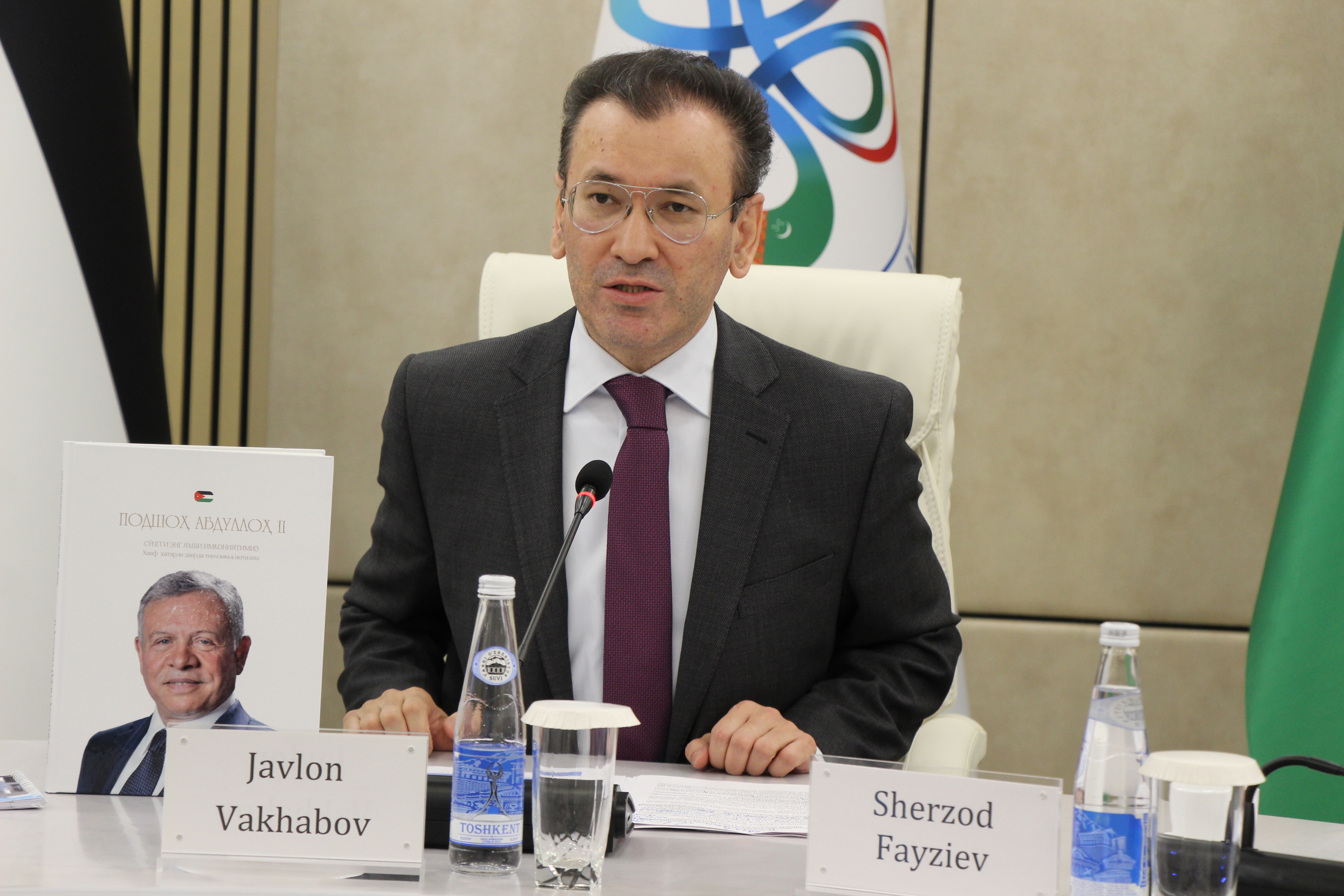
Today we gathered to celebrate the publication of the Uzbek version of the book by His Majesty King Abdullah II of the Hashemite Kingdom of Jordan, “Our Last Best Chance: The Pursuit of Peace in a Time of Peril,” published in 2011.
There could not be a better time to discuss these valuable insights than on the eve of President Shavkat Mirziyoyev’s historic visit to the Hashemite Kingdom of Jordan. Turning to this work today is, I believe, especially timely. The Middle East remains one of the most complex regions in terms of international security.
To my mind, King Abdullah II’s book offers a way to view regional processes and challenges in light of the current trends and transformations in international relations.
Its very title, “Our Last Best Chance,” underscores a particular responsibility for the future of the region. At the heart of the narrative lies the conviction that peace calls for timely political decisions, consistent diplomacy, and a readiness to seize the opportunities that arise.
Against this backdrop, I would like to dwell on three points that strike me as especially significant for today’s discussion.
First. Political will, mutual trust, and a readiness to compromise are essential to achieving durable peace.
The book is at once a personal testimony by King Abdullah II as a direct participant in the key processes of Middle Eastern politics and a reflection on the causes that have stood in the way of peace in the region.
The Palestinian–Israeli conflict holds a central place in the work. His Majesty stresses that its resolution is impossible without recognition of the legitimate rights of the Palestinian people, guarantees for Israel’s security, and a willingness to compromise.
Drawing on his own life, King Abdullah II observes: “One constant in my life ever since I was a small child has been the conflict between the Israelis and the Palestinians.”
This sentence shows how deeply the Palestinian question is woven into the King’s personal and political experience. For him it is not only a regional problem but a factor that shapes the security prospects of the entire Middle East.
Of fundamental importance here is the two-state solution to the Palestinian question that Jordan supports, the creation of an independent Palestinian state living side by side in peace and security with Israel.
This approach is consonant with the position of Uzbekistan, which consistently advocates a just and lasting settlement of the Palestinian question on the basis of UN resolutions and the internationally recognized two-state principle.
Equally deserving of attention is King Abdullah II’s stance on interfaith harmony, the promotion of moderation, and countering extremism.
The book put forward the concept of a “Middle Eastern Benelux,” envisaging the economic integration of Jordan, Israel, Lebanon, and a future Palestinian state. Such a union, in his words, “would become an economic power-house.”
Today Jordan places its emphasis on other, more pragmatic formats of regional cooperation, in particular trilateral engagement with Iraq and Egypt in energy, trade, industry, and infrastructure. A parallel can be drawn here with Central Asia, where regional cooperation, economic interdependence, and infrastructure connectivity are likewise being steadily reinforced.
Second. Jordan’s pragmatic diplomacy and its experience in the security dimension offer a fresh perspective on the mechanisms for ensuring regional stability.
Jordan sits in a difficult geopolitical setting and has for many years faced the consequences of regional crises. The Hashemite Kingdom has consistently sought to pursue a balanced foreign policy.
Characterizing his country’s position, King Abdullah II notes: “I live in a rough neighbourhood.” Behind this concise formulation lies a deep understanding of the geopolitical realities of the Middle East, where the security of one state depends on the processes unfolding around it.
The distinctive feature of the Jordanian approach lies in combining principle with pragmatism. Amman maintains constructive relations with international and regional partners, keeps channels of dialogue open, and works to ensure that disagreements do not foreclose opportunities for engagement.
This experience, in our view, deserves attention for its ability to take the complexity of the regional environment into account, to avoid confrontation, and to defend national interests.
One practical embodiment of this approach has been the Aqaba Process, launched by King Abdullah II in 2015. This international initiative is aimed at strengthening coordination among states in countering terrorism and extremism, sharing experience, and developing joint approaches to security. Its flexible format makes it possible to bring states and international partners together around specific challenges without creating rigid institutional structures.
Recently in Astana on November 6, 2026, Central Asian leaders met within the framework of the Aqaba Process. This marked an important stage in the development of Central Asia – Jordan cooperation as well as between Uzbekistan and Jordan in the field of regional security.
In his address, President Mirziyoyev stressed that today’s threats call not only for technological and law-enforcement solutions but also for systematic work in education, enlightenment, and human development. A common outlook between the two leaders is evident here: countering extremism must rest not only on security measures but also on the promotion of moderation, interfaith harmony, enlightenment, and resilient social values.
Third. Central Asia, Jordan, and the Gulf states hold considerable potential to shape a closer space of interregional cooperation.
In recent years Central Asia has come a long way in strengthening regional engagement. Thanks to the political will of the region’s leaders, many accumulated tensions have been overcome, trust has been restored, and a fundamentally new atmosphere of good-neighbourliness has taken shape.
Today Central Asia is shaping its own model of regional engagement, grounded in respect for sovereignty, consensus, mutual regard for interests, and the practical implementation of joint initiatives. These approaches echo the ideas set out in King Abdullah II’s book, that the resilience of each state depends in large measure on the character of its relations with its neighbours and its ability to build mutually beneficial cooperation.
An important avenue for broadening Central Asia’s external ties is the development of cooperation with the Middle East, including the states of the Gulf Cooperation Council (GCC) and Jordan. The first summit of the leaders of Central Asia and the GCC, held in Jeddah in July 2023, laid the political foundation for wider engagement, the development of transport and logistics infrastructure, and the realization of long-term economic projects.
At the same time, it is important to broaden Central Asia’s engagement with the Middle East by drawing on the potential of Jordan and other regional partners, which would widen economic cooperation and the scope for joint initiatives.
Distinguished colleagues,
I would like to say a few words about the steady development of relations between Uzbekistan and Jordan.
The state visit of His Majesty King Abdullah II to Uzbekistan in August 2025 marked an important stage in bilateral cooperation. It resulted in the signing of 15 documents covering a broad range of areas.
Concrete practical results have since been achieved. In February 2026 the Uzbekistan–Jordan Business Council was established, in April the first meeting of the Joint Intergovernmental Commission took place, and on June 30 regular direct air service between Amman and Tashkent began.
Relations between Uzbekistan and Jordan are thus being steadily filled with practical substance, creating a foundation for broader bilateral cooperation. In this connection, I would like to single out three priority areas capable of giving the partnership additional momentum.
The first is economic complementarity and investment cooperation. Jordan holds competitive advantages in pharmaceuticals, medicine, the chemical industry, and services, while Uzbekistan possesses significant natural, industrial, and human resources, as well as a sizeable domestic market. Bringing these strengths together creates the conditions for joint production, the localization of manufacturing, the expansion of trade, and access to third-country markets.
The second is water and climate resilience. Jordan’s experience in the sound use of water, modern irrigation technologies, and the adaptation of agriculture to climate change is of practical interest to us. The similarity of our water and climate challenges opens opportunities for the exchange of technologies, research, and practical solutions, as well as for joint research and applied projects.
The third is transport connectivity and humanitarian engagement. The development of air links, the refinement of logistics mechanisms, and the expansion of business contacts can strengthen ties between Central Asia and the Middle East. Education, science, tourism, and cultural and humanitarian exchanges hold an important place on this agenda, with particular potential in engagement among universities, medical and research institutions, and centres for the study of religion and Islamic heritage.
I would separately note the prospects for cooperation among think tanks. IICA has an interest in strengthening contacts with Jordanian research institutions, holding joint expert events, and preparing practical recommendations for the development of interregional cooperation. Expert dialogue, I am convinced, should not merely accompany political processes but serve as an instrument in its own right for generating initiatives and shaping the cooperation agenda.
Distinguished colleagues,
In closing, I would like to underscore that Central Asia and the Middle East hold considerable potential for the further deepening of mutually beneficial cooperation, the strengthening of regional security, and the building of interstate trust.
I am confident that today’s discussion will contribute to a deeper understanding of King Abdullah II’s ideas, to the development of new approaches to interregional engagement, and to the identification of promising areas for cooperation between Uzbekistan and Jordan.
I wish all participants a productive discussion. Thank you for your attention to these matter.