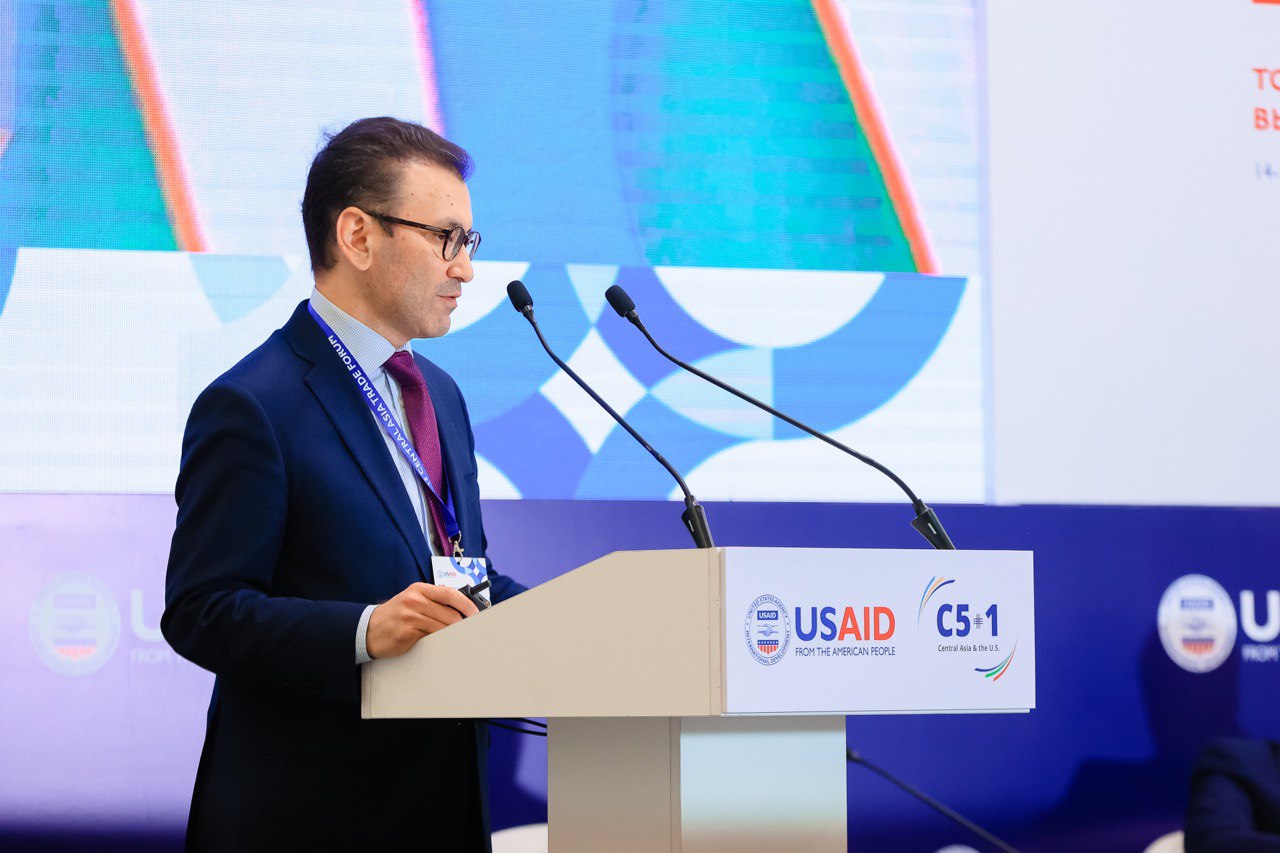
Full text of the speech by the Director:
Dear participants,
First and foremost, I would like to extend a warm welcome to all representatives from official and business circles, experts, and express sincere gratitude to the Government of Kazakhstan and the United States Agency for International Development for their outstanding organization of this Forum.
It is a great honor for me to participate in this forum, given the increasing importance of issues related to expanding regional trade in Central Asia.
The convening of such a significant event is a logical continuation of the agreements on further deepening mutual understanding and expanding practical partnership between the countries of Central Asia and the United States, reached at the first C5+1 summit held in New York in September last year.
Prospects for expanding our trade and economic cooperation, developing transport corridors in Central Asia, and advancing the 'green agenda' were discussed during the summit, which undoubtedly will strengthen our economic cooperation and ensure the long-term economic stability of the region.
Dear friends!
Central Asia is currently experiencing a qualitatively new stage of transformation in intra-regional relations. Clearly, the regional policy of H.E. President of Uzbekistan Shavkat Mirziyoyev has played a significant role in shaping the new political atmosphere in Central Asia. With the support of other countries in the region, we have effectively managed to reset relations, overcoming many previous negative trends.
The Consultative Meetings of the Heads of State of Central Asia played a significant role in this process. They laid down a new paradigm of interstate relations and provided the basis for strengthening unity and restoring the former power of the region.
As a result, the last 6-7 years have become a historic period of economic development for Central Asia, characterized by stable and sustainable growth, as evidenced by key macroeconomic indicators.
In particular, the combined GDP of the region's countries has grown by 70% over the last decade, exceeding $450 billion. Intra-regional trade volume has reached $11 billion, more than doubling over the past 10 years. The total external trade turnover of the countries of Central Asia has reached $225 billion, almost doubling compared to seven years ago.
In Uzbekistan, trade turnover with Kyrgyzstan and Turkmenistan has grown by more than 5 times (reaching $1 billion and $1.1 billion respectively in 2023), with Tajikistan by 3 times ($756 million), and with Kazakhstan by 2.5 times ($4.4 billion), reaching a total of $7.2 billion (compared to $2.5 billion in 2016). A similar situation is emerging in trade between the region's countries and their neighbors.
Investment cooperation within Central Asia has been revitalized, growing by 5.6 times. Uzbekistan has established investment funds with Kyrgyzstan and Tajikistan to finance large joint projects. Similar funds were previously established with these countries by Kazakhstan.
Within these investment funds, projects in automotive manufacturing, electrical engineering, textile industry, agriculture, etc., have been initiated. As a result, the number of joint ventures involving Uzbekistan and the countries of the region has increased by more than 5 times over 6 years - from 312 to 1,600.
Currently, the mechanism for establishing such zones with Turkmenistan (at the "Khorezm-Dashoguz" checkpoints), Tajikistan ("Oybek-Phottehabod"), Kyrgyzstan ("Kyzyl-Kiya"), and Kazakhstan (the International Industrial Cooperation Center "Central Asia" based on the "Gisht-Kuprik - Zhibek Zholy" checkpoint) has been launched.
We believe that these projects will significantly streamline trade processes, contributing to the growth of trade volumes between countries, strengthening interregional economic ties, creating new industries, and consequently, new jobs.
In this context, I would like to note that construction of the International Industrial Cooperation Center "Central Asia" (in the Syrdarya region of Uzbekistan and the Turkestan region of Kazakhstan) is planned to commence as early as August of this year. The products manufactured there will be supplied to the markets of Uzbekistan and Kazakhstan, as well as exported to third countries.
It is expected that construction will be completed by 2027. The implementation of this project will contribute to achieving the goal of doubling mutual trade between the two countries, increasing its volume to $10 billion.
Dear Colleagues,
As you can see, the level of cooperation has noticeably increased. However, today we are faced with the question of sustaining the momentum and dynamics of cooperation for the future, looking ahead 5-10 years. It is necessary to consider that the economies of the countries in the region are less diversified, have lower technological levels, and operate under lower-level economic models, heavily reliant on natural resources and the export of raw materials. These factors hinder further development of regional cooperation.
Moreover, the relatively small scale of the regional market has a diminishing effect on the investment activity of large foreign companies. According to the Asian Development Bank's assessment, the region's share in global trade remains at less than 1%. Despite the geographical proximity of the countries in the region, which should create favorable conditions for trade and economic cooperation, barriers persist that hinder the deepening of interstate trade relations.
These barriers include discrepancies in currency, tax, and customs regimes, which, among other things, are a reason for some countries' participation in alternative integration associations. An important issue remains that countries in the region apply varying degrees of liberalization in their trade and economic cooperation models. These include the Eurasian Economic Union (EAEU) and the CIS Free Trade Area (FTA) agreements within the Commonwealth of Independent States (CIS).
Meanwhile, Turkmenistan and Uzbekistan are not members of the World Trade Organization (WTO). Kazakhstan and Kyrgyzstan participate in the EAEU, the CIS FTA, and bilateral FTAs, Tajikistan and Uzbekistan are participants in the CIS FTA and bilateral FTAs, while Turkmenistan only engages in bilateral FTAs. All of this undoubtedly affects the pace of trade integration in the region.
As a result, mutual trade accounts for only 9.9% of the total external trade volume of Central Asian countries, with around 80% of this trade occurring between Uzbekistan and Kazakhstan. Regional integration in trade and investment will help address these constraints. President Shavkat Mirziyoyev of Uzbekistan has repeatedly emphasized that current circumstances necessitate decisive steps to shape a new model of economic cooperation in Central Asia. It is important to identify new growth points and new drivers of our development for the long term.
To maintain further sustainable development, Uzbekistan advocates for deepening cooperation in the following areas:
First, further facilitating mutual trade.
Joint steps are needed to eliminate tariff and non-tariff barriers to trade, harmonize legislation and converge technical regulations, sanitary and phytosanitary norms to form a full-fledged free trade zone without exceptions and restrictions.
For reference: a full-fledged free trade regime between the countries of Central Asia has not been formed. The bilateral and multilateral free trade agreements in force between the countries of the region provide for tariff and non-tariff exemptions from the free trade regime.
In addition, various non-tariff barriers exist in relations between the countries of the region in the form of technical regulations, sanitary and phytosanitary norms.
Concerted steps are needed in the digitalization of customs procedures. Studies conducted by the World Trade Organization show that only the introduction of paperless trade can reduce trade costs by an average of 14.3%.
In this regard, a significant step forward was taken in October 2023 in Samarkand. This occurred during the meeting of the Ministers of Economy and Trade of the Central Asian countries and the Director of the United States Agency for International Development (USAID), Samantha Power, on regional integration issues.
Considering the fact that the WTO covers more than 97% of global trade, we believe that Uzbekistan's accession to the organization will not only strengthen the country's position on the international stage but also create new opportunities for economic growth and development of regional trade.
Last year, Uzbekistan concluded bilateral negotiations with 11 WTO member states. It has signed Protocols with 9 of them, including Nigeria, Georgia, Saudi Arabia, Turkey, Mongolia, Japan, Israel, Singapore, and the Dominican Republic. Protocols are expected to be signed with Sri Lanka and Thailand in the near future. Negotiations with many other WTO members are expected to be completed by the end of this year.
All of this is a vivid confirmation of Uzbekistan's aspiration to more openly integrate into global trade. In these circumstances, we hope that the American side will consider the possibility of lifting the Jackson-Vanik amendment concerning Uzbekistan and other Central Asian countries, as well as establishing a permanent Most Favored Nation (MFN) trade regime. This will contribute to further strengthening trade relations between our countries and expanding access to international markets.
For reference: the Jackson-Vanik amendment was enacted in 1974 in relation to the USSR. The amendment continues to apply to some former members of the USSR even after its dissolution. From 2000 to 2012, Kyrgyzstan, Georgia, Ukraine, Armenia, Moldova, and Russia were exempted from this restriction. However, Kazakhstan, Tajikistan, Turkmenistan, and Uzbekistan still face this limitation.
Secondly, the creation of new growth points and drivers of development for the long term.
First and foremost, the focus is on furthering industrial cooperation. It is crucial to pay special attention to this issue, as expanding trade relations within the region and with third countries will require a transition to trading in high value-added products. Uzbekistan advocates for deepening cooperation and implementing major industrial projects, including through attracting foreign investment and advanced technologies, in sectors such as mineral fertilizers, polymers, metal products, agricultural machinery assembly, as well as the production of finished textile and food products.
Significantly, the region already demonstrates close cooperation in industrial cooperation. Joint ventures with Kazakhstan have been established for automobile and textile production, while collaborations with Tajikistan and Kyrgyzstan have initiated the production of electrical products.
The presence of an extensive mineral and raw material base in the region, along with a growing human capital, enables the establishment of long high-tech production chains in Central Asia. This significantly contributes to increasing the industrial potential of the region.
Collaboration in the manufacturing sector will not only increase profitability but also enhance the region's global competitiveness.
Our countries have already begun implementing regional cooperation projects. Examples include the construction of the Kambar-Ata-1 Hydro Power Plant involving Kazakhstan, Kyrgyzstan, and Uzbekistan, and the Yavan HPP involving Tajikistan and Uzbekistan. The presentation of these projects to investors at the Third Tashkent International Investment Forum was a key event of the gathering.
For reference: In January 2023, Uzbekistan, Kyrgyzstan, and Kazakhstan signed a Roadmap for the construction of the Kambar-Ata-1 HPP. According to specialists, the total installed capacity of the Kambar-Ata-1 HPP will reach 1860 MW and will generate 5.6 billion kWh of electricity per year.
In June 2024, a Road Show is planned to be held in Vienna to determine the project's financing model.
As part of the forum, the Trade Connect Central Asia+ (TCCA+) program was also launched, aimed at stimulating economic development and integration among the five Central Asian countries and Azerbaijan. This fully aligns with the objectives of today's meeting.
In our opinion, significant potential for the development of regional and international trade is also linked to targeted programs aimed at attracting foreign direct investment and modern technologies from leading countries worldwide into the development of locally sourced raw materials and high-value-added production. For instance, experts propose initiating projects such as 'Made by Japan in Central Asia.' This would allow Japanese companies to invest in the production of goods for export, not to Japan, but to neighboring countries and regions.
Thirdly, enhancing the transport and transit potential of the region.
The deficit in transport connectivity among the region's countries also acts as a significant deterrent to the development of economies and social progress.
It is sufficient to say that for the Central Asian countries, which lack access to seaports, the share of transportation costs for goods to external markets can reach 50% of the final product's cost.
According to the World Bank's Logistics Performance Index, which assesses the ease of trading and the state of trade logistics at the national and international levels, in 2023, Central Asian countries ranked low compared to the global average (Kazakhstan - 79th out of 139 countries, Uzbekistan - 88th, Kyrgyzstan - 123rd, Tajikistan - 97th).
For reference: in Kazakhstan, the quality of trade and transport infrastructure was rated at 2.7 on a scale of 1 to 5 (in Germany - 4.1, in the USA - 4), in Uzbekistan - 2.6, in Kyrgyzstan - 2.3, in Tajikistan - 2.5, in Turkmenistan - no data.
The presence of numerous barriers in the transport system prevents the region from being included in global value chains.
Considering that it takes years to create hard infrastructure, we need to increase border crossing efficiency by developing soft infrastructure, such as advancing digital document flow, digital payments, etc.
The implementation of e-TIR and e-CMR systems is promising in this direction, as they facilitate cross-border trade and expedite customs clearance procedures using paperless document standards.
For reference: e-TIR is an international digital paperless document system that simplifies and accelerates cargo documentation procedures during customs control. e-CMR is an electronic version of a transport document that paperlessly standardizes contractual terms for road freight transport and contributes to the overall cargo transportation process.
The advantages of these digital platforms include:
1) Reducing transportation times by up to 80% and expenses by up to 38%; 2)Decreasing the number of errors in preparing transport documents; 3)Accelerating data processing in real-time; 4)Enhancing transparency and reducing corruption; 5) Having a positive impact on the environment due to reduced paper usage.
Furthermore, it is important to unite our efforts in implementing promising cross-border projects, such as the China-Kyrgyzstan-Uzbekistan railway and the Uzbekistan-Afghanistan-Pakistan railway, as well as the Middle Corridor linking our region with Europe.
The implementation of these projects will contribute to transforming our region into a key transit hub on the Eurasian continent. In particular, the implementation of the Trans-Afghan route, initiated by the President of Uzbekistan, could reduce the delivery time of goods to Pakistan by about five days and decrease transportation costs by at least 40%.
For reference: Recently, a meeting took place in Kabul between the Minister of Transport of Uzbekistan, I. Makhkamov, and the Acting Foreign Minister of Afghanistan, Amir Khan Muttaqi. The Uzbek delegation, led by the minister, included a team of engineers working on the project for preparing the feasibility study of the Trans-Afghan railway. Within a few weeks, the next delegation from Uzbekistan will arrive with equipment to begin practical work on laying the track.
For reference: The President of Kyrgyzstan announced in May of this year that construction of the China-Kyrgyzstan-Uzbekistan railway will begin in October 2024. Deputy Minister of Transport of Uzbekistan, Zh. Choriev, stated at the Tashkent Investment Forum that the cost of the project is estimated at $5.1 billion.
Dear friends,
I would also like to draw your attention to the prospects of economic cooperation between the countries of Central Asia and the United States. The first-ever summit of leaders of Central Asian countries and the United States in the 'C5+1' format, held in New York in September last year, was a truly historic event, defining the future directions of our multi-faceted cooperation.
The American side proposed creating a Private Sector Business Platform and initiating a Dialogue on Critical Minerals within the diplomatic platform 'C5+1.' In March 2024, the first Business Forum 'B5+1' was successfully held. It was dedicated to promoting regional free trade and diversifying export routes for Central Asian countries.
In October 2023, a Ministerial Meeting on Regional Connectivity in the 'C5+1' format took place in Samarkand. In this context, the region understands that to actively attract advanced technologies and investments, it is necessary to continue improving the investment and business environment, create conditions for fair competition, and ensure the independence of the judicial system.
These initiatives will undoubtedly contribute significantly to the long-term economic stability of Central Asia by expanding the region's access to global markets and attracting international investments.
In conclusion, allow me to once again express sincere gratitude to the organizers of the conference for their diligence and efforts in creating this platform for discussing important topics related to the development of regional trade in Central Asia. I am confident that our discussions today will lead to constructive ideas and proposals that will help strengthen trade and economic cooperation in our region.
Thank you for your attention!