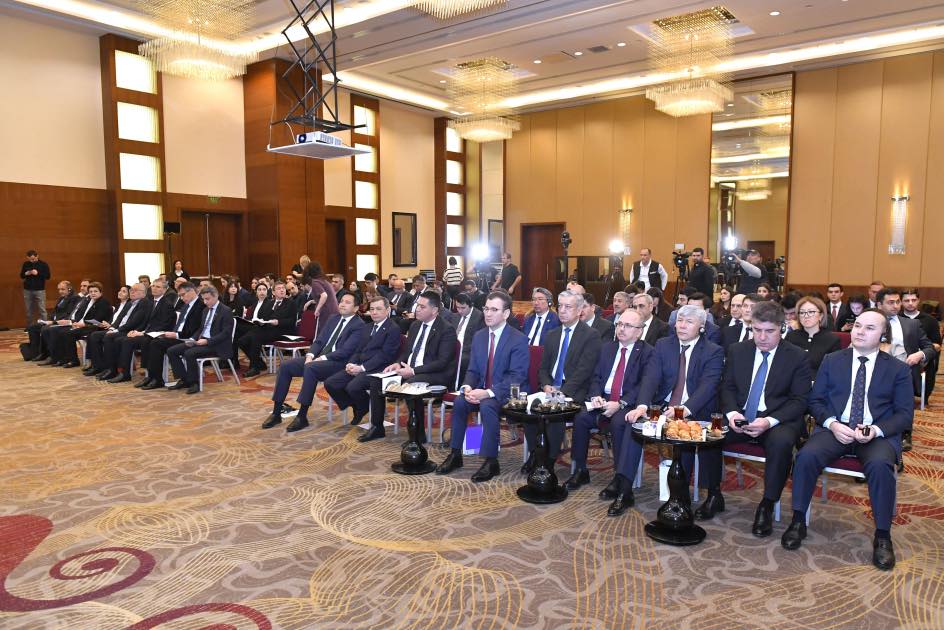
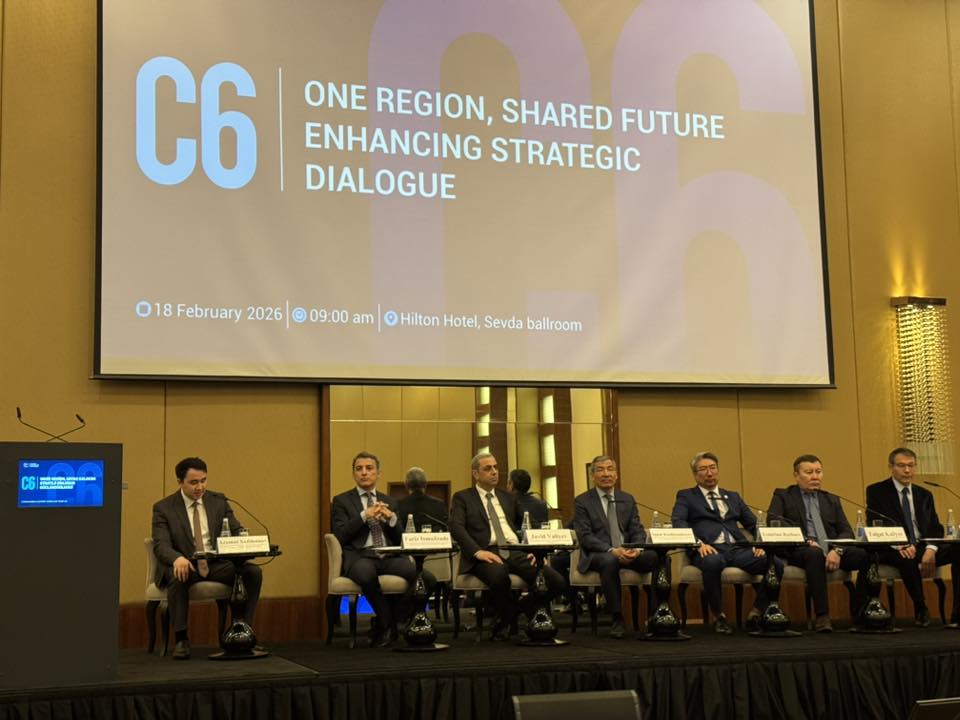
The conference brought together heads of analytical centers from Central Asian countries and Azerbaijan, as well as officials and representatives of the diplomatic corps in Baku.
During the event, participants discussed prospects for deepening strategic dialogue within the C6 framework, including the development of coordinated approaches and the establishment of sustainable cooperation mechanisms in the fields of economy, transport and logistics, regional security, and sustainable development.
In his address, the Director of the International Institute for Central Asia, Javlon Vakhabov, emphasized that Azerbaijan’s accession to the Consultative Meetings of the Heads of Central Asian States format effectively reshapes the region’s geopolitical and geoeconomic architecture, uniting Central Asia and the South Caucasus into a single space of cooperation.
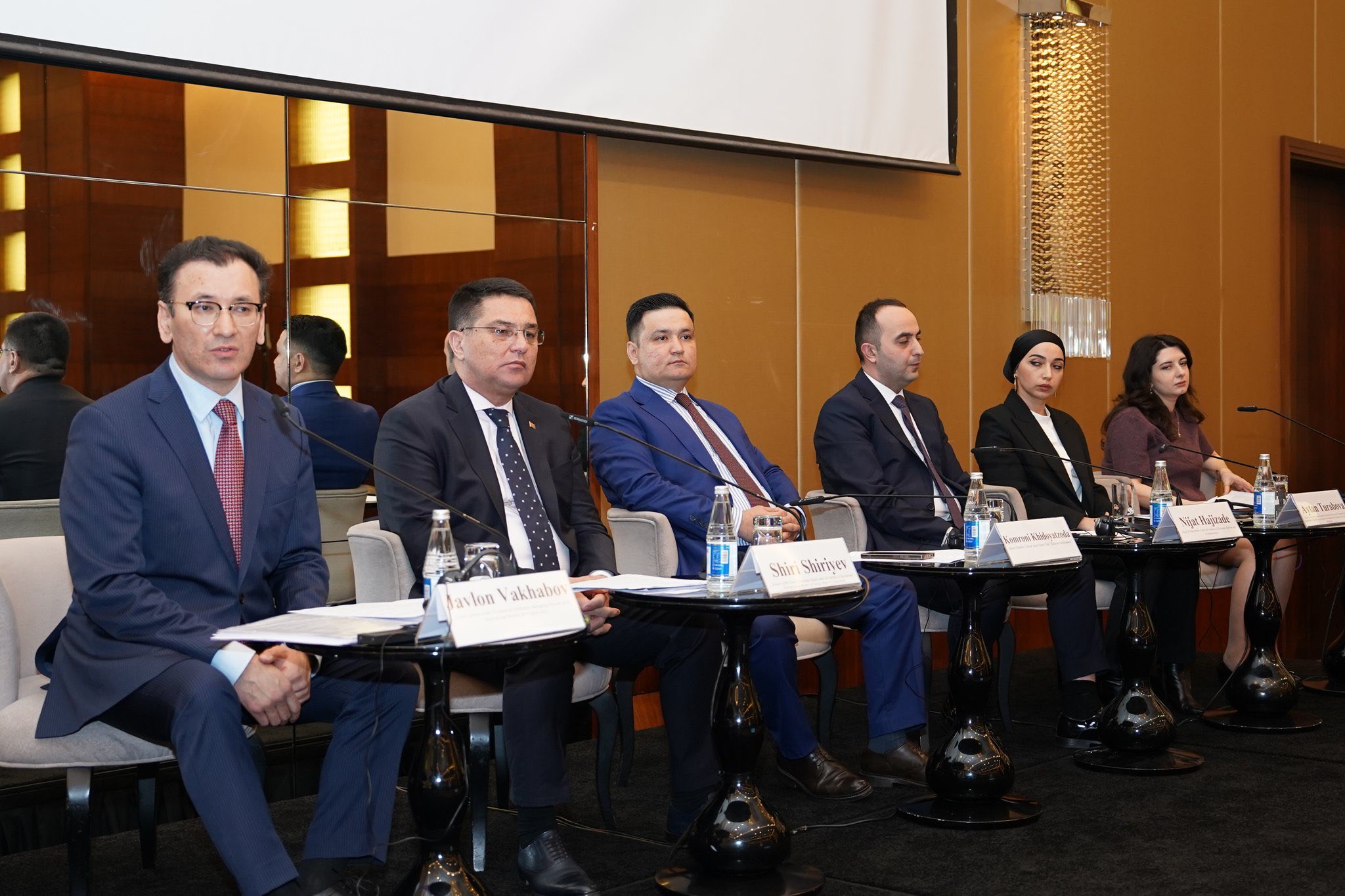
“Azerbaijan serves as a key bridge between the two regions. A connecting belt is effectively forming from the Caspian region to the Black Sea and Mediterranean directions, transforming Central Asia from a landlocked region into a land-linked space,” noted J. Vakhabov.
Speaking at the conference, Farid Shafiyev, Chairman of CAIR, highlighted the timeliness of Azerbaijan’s accession to the CMHCAS format and stressed the need to create a more integrated, institutionalized, and forward-looking framework for cooperation, capable of providing sustainable and long-term interaction among the countries. According to him, this is precisely the function that the C6 format is intended to fulfill.
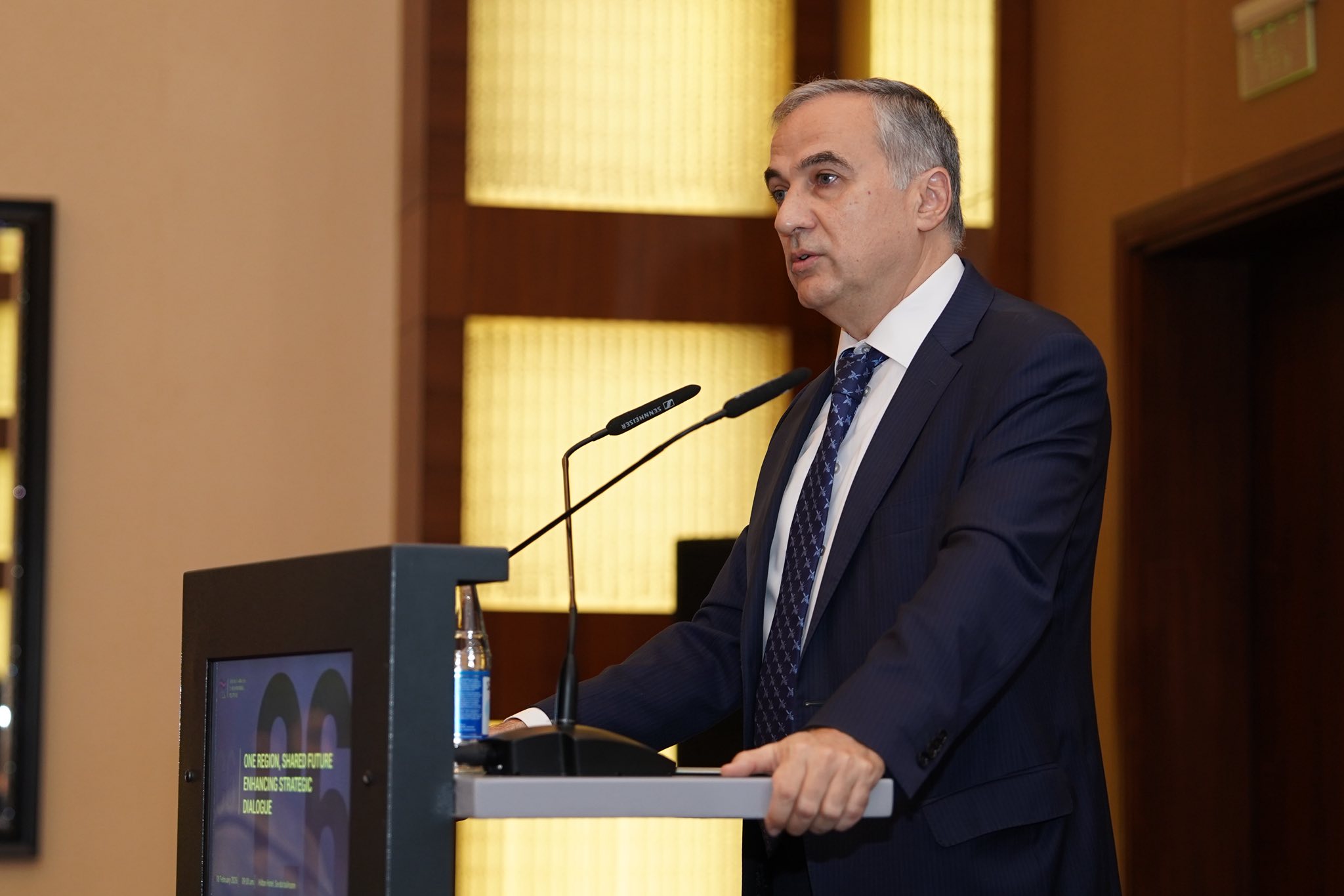
“Central Asia is for Azerbaijan not merely a neighboring region, but a natural partner. Transforming geographical proximity into partnership, geography into advantage, and common challenges into solutions constitutes the core strategic logic of C6,” F. Shafiyev stated.
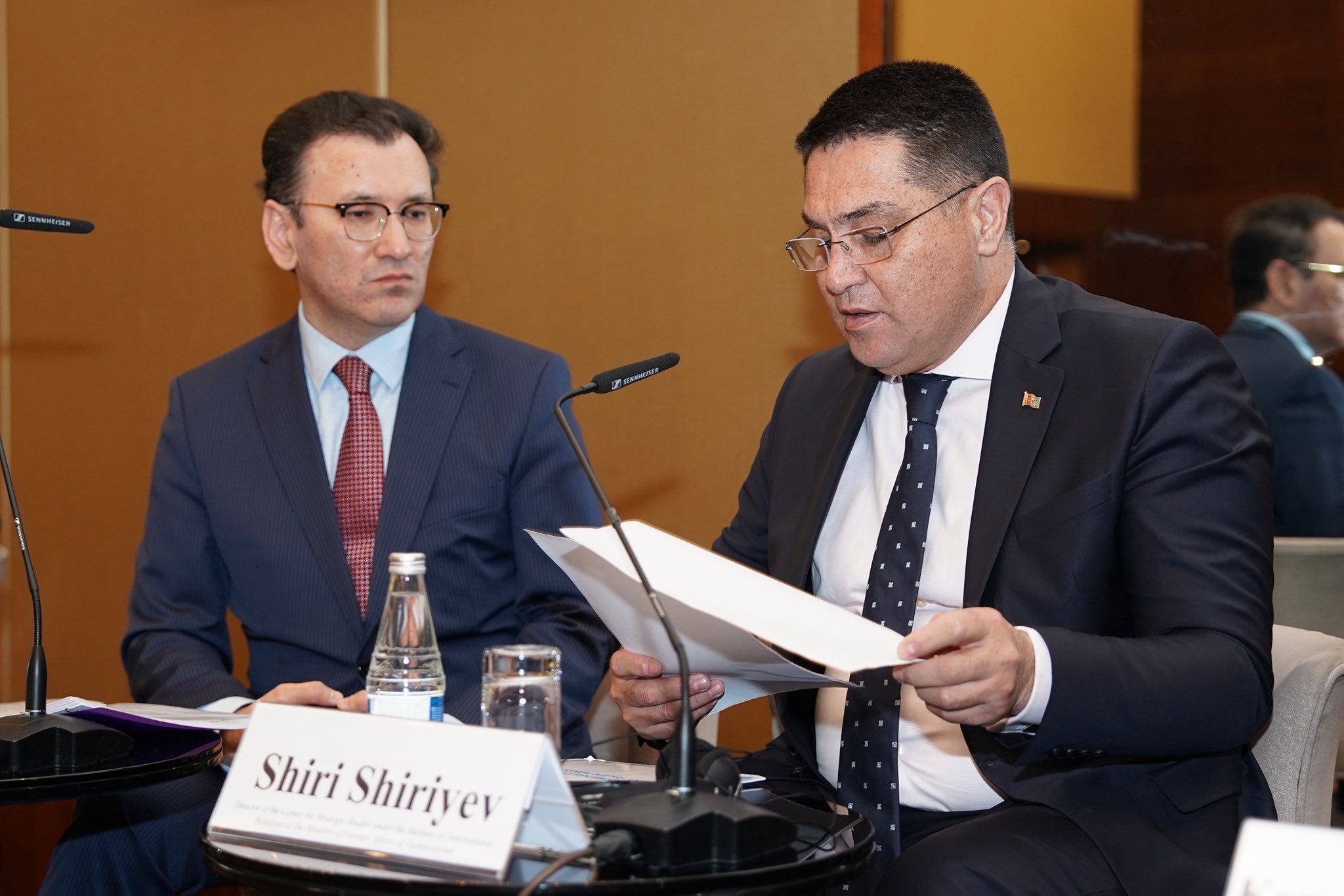
Sh. Shiriev, Director of the Strategic Studies Center at the Ministry of Foreign Affairs of Turkmenistan, noted that Azerbaijan’s accession to the CMHCAS format opens a new chapter in regional interaction and creates opportunities for C6 to become an effective mechanism for coordinating actions, strengthening economic ties, and building trust through humanitarian cooperation and experience exchange.
Sanat Kushkumbayev, Chief Research Fellow at the Kazakhstan Institute of Strategic Studies under the President of Kazakhstan, emphasized that Azerbaijan’s inclusion in the Central Asian format reflects the restoration of historically established ties between the regions. According to him, the key goals of such cooperation remain unchanged – expanding economic contacts, improving population welfare, and gradually harmonizing economic relations.
Javid Veliev, Board Member of the Center for Analysis of International Relations, noted that a unified geopolitical identity has already formed between Azerbaijan and Central Asian countries, which is a natural and logical process. This is due not only to shared historical heritage but also to transformations over recent decades in the fields of economy, trade, transport, energy, and security, which have objectively strengthened mutual interest in closer cooperation.
Meanwhile, political scientist and public administration expert from Kyrgyzstan Sheradil Baktygulov stated that the Middle Corridor is one of the key instruments for unlocking Central Asia’s potential and facilitating its deeper integration into the global economy. This involves not only closer alignment of the regional states but, above all, the creation of conditions for mutually beneficial business cooperation and improving the welfare of countries along the route. He emphasized that the Middle and Southern Corridors are not in competition but complement each other, forming a multimodal transport system that uses rail, road, and maritime connections via the Caspian Sea.
Komroni Khidoyatzoda, Board Member of the Central Asian Expert Club “Eurasian Development,” noted that, despite Tajikistan being outside the main line of the Middle Corridor, the country considers it a priority direction due to the need for access to international transport routes and the use of transit opportunities of neighboring states. According to him, diversifying the corridors will promote increased transport, reduce delivery times, and expand Central Asia’s trade potential. The expert emphasized that the Middle Corridor should be regarded as an instrument for sustainable socio-economic development of the region and for expanding access to European markets, including integration of northern and southern transport directions.
Talgat Kaliev, Member of the National Kurultai under the President of Kazakhstan, highlighted that Central Asian countries possess significant rare-earth resources, high human capital, and relatively lower labor costs, which form the region’s competitive advantages. In his view, this creates opportunities for attracting advanced technologies in exchange for resources, with subsequent development of domestic production capacities at a qualitatively new level. It was noted that the transition from raw material exports to a model of exchanging resources for technology will gradually strengthen the region’s production-technological base and enhance human capital.
At the conclusion of the conference, participants acknowledged the high potential of the C6 format for strengthening interregional connectivity and establishing sustainable cooperation mechanisms. The meeting in Baku confirmed the key role of expert dialogue in supporting the long-term development of Central Asian countries and Azerbaijan.