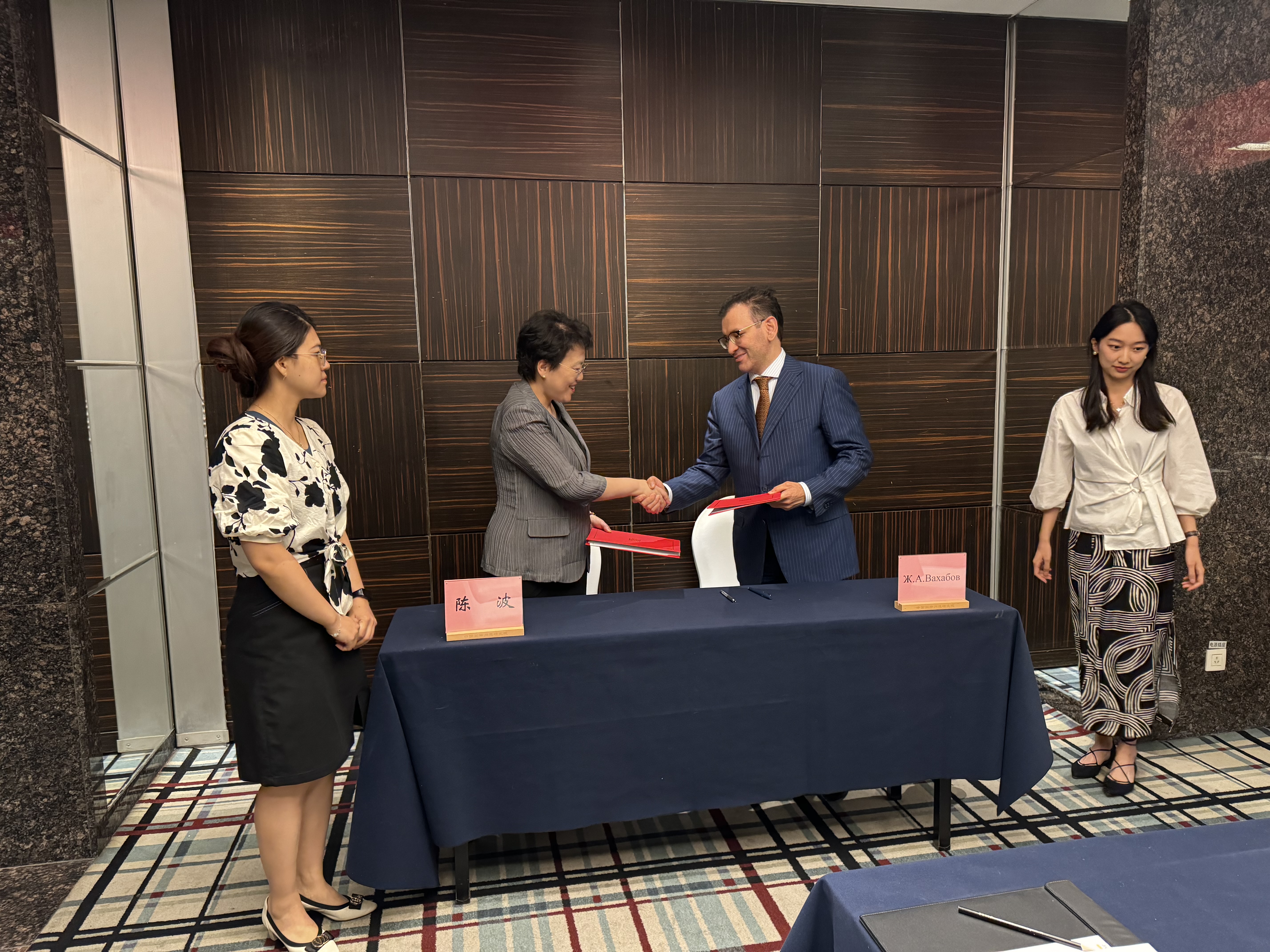
As part of the participation of the delegation of the International Institute of Central Asia (IICA) in the jubilee meeting and international conference dedicated to the 70th anniversary of the Five Principles of Peaceful Coexistence in Beijing, IICA Director Javlon Vakhabov signed cooperation agreements with the heads of the Chinese Academy of International Affairs under the Ministry of Foreign Affairs of China and with the Institute of Social Development of Europe and Asia of the Center for Development Studies under the State Council of China.
The agreements provide for regular joint forums, seminars, conferences, round tables and briefings, exchange of experience and printed publications, implementation of joint research projects and programs on issues of mutual interest.
The China Academy of International Affairs (CAMP) is the main analytical structure of the Ministry of Foreign Affairs of the People's Republic of China, which studies the problems of international politics and world economy. It was established in 1956 as China's first foreign policy think tank. The Academy prepares analytical papers on security, politics and economics and other issues of expert support for China's foreign policy.
The Institute for Social Development of Europe and Asia of the Development Research Center of the State Council of the People's Republic of China (ISREA) is China's leading research institute aimed at analyzing and studying the political, economic, and social development of countries in the Eurasian region. Established in 1989, it provides the Chinese leadership with information, advice, and policy recommendations to promote China's friendly relations with the CIS and Central Asian countries.