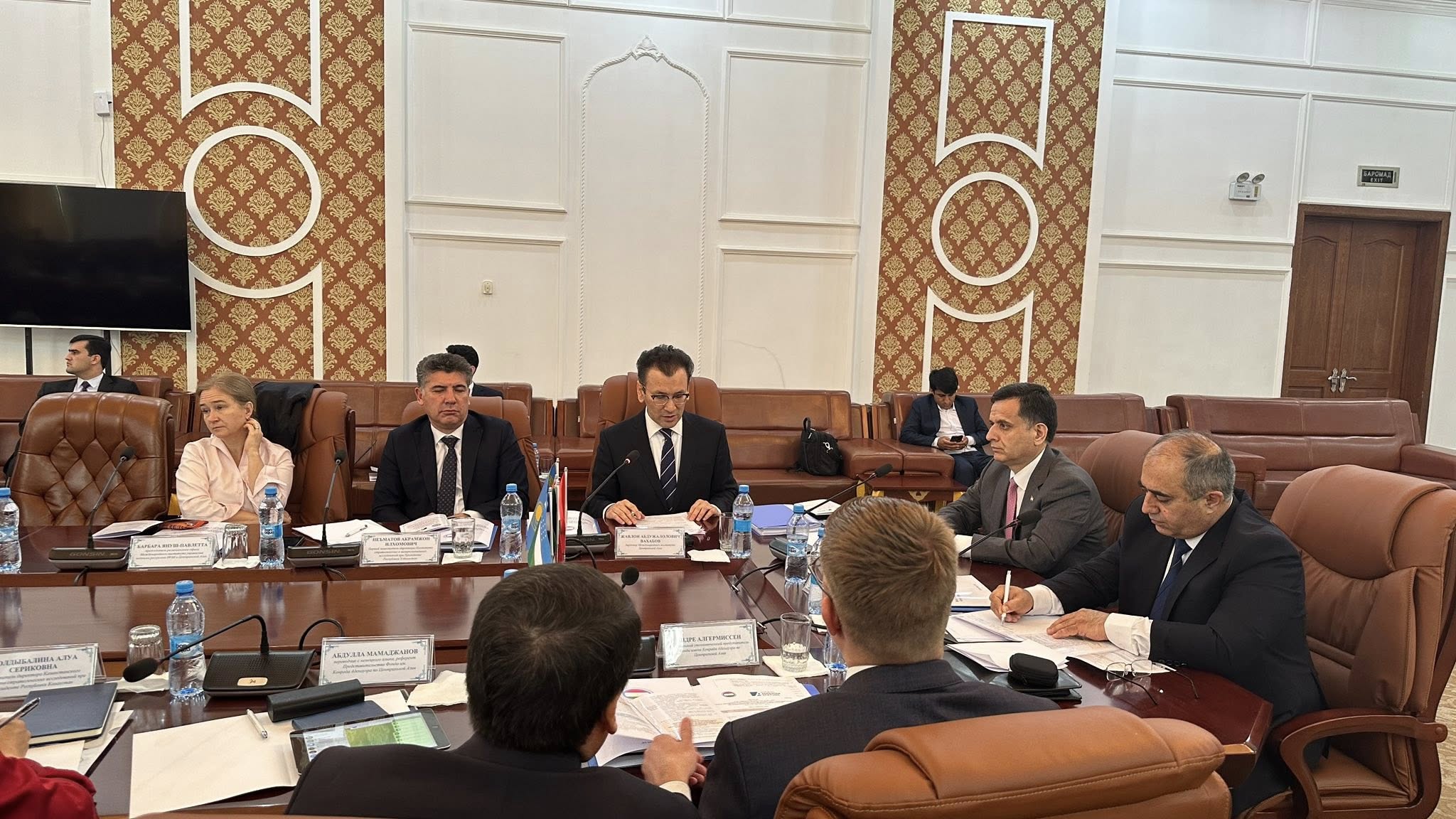
Dear Mr. Khayriddin Usmonzada,
Dear Mr. André Algermissen,
Distinguished participants of the conference,
Today, the process of regional consolidation in Central Asia has acquired a steady and irreversible momentum. The region is witnessing the emergence of conditions conducive to profound political transformation, economic modernization, and, in the longer term, regional integration and full-scale international connectivity.
The firm commitment of Central Asian leaders to regional rapprochement, their pragmatic approach, and their willingness to seek flexible diplomatic solutions based on mutual respect and consideration of interests have laid the foundation for profound change.
A major contribution to this transformation has been made by the format of the Consultative Meetings of Heads of State, initiated by the President of Uzbekistan, Shavkat Mirziyoyev. The regular dialogue among leaders in the five-party format has significantly reduced tensions and paved the way for the peaceful resolution of inter-state disputes and conflicts through reasonable compromise.
As a result of six summits held since 2018, a number of crucial decisions have been taken and agreements reached among heads of state to establish regional cooperation mechanisms, as well as the conceptual and legal framework for collaboration in priority areas.
A milestone in this process was the adoption of the “Concept for Regional Cooperation Development – 2040” at the 2024 summit in Astana. This document reflects a shared vision for regional cooperation across key sectors, including institutional development of the Consultative Meetings and collaboration in the water and energy sector.
The Consultative Meetings have become an effective mechanism for harmonizing interests, addressing existing challenges, and identifying solutions to key issues in both multilateral and bilateral contexts across the region.
The key drivers of regional consolidation have been the convergence of national interests and the alignment of priorities aimed at ensuring domestic and regional stability, external security, sustainable socio-economic development, and deeper integration into the global economy amid ongoing transformations.
It is especially important to highlight the growing awareness among regional elites of the need to enhance cooperation and jointly advocate for shared interests on the international stage.
Progress in resolving long-standing inter-state disputes also deserves special attention, as it strengthens political trust and good neighborliness and boosts regional cooperation.
Noteworthy developments in this regard include the signing, in March of this year, of the state border agreement between Tajikistan and Kyrgyzstan, the trilateral meeting of the leaders of Tajikistan, Kyrgyzstan, and Uzbekistan in Khujand in early April, the signing of a document on the junction of the three borders, and the adoption of the trilateral Khujand Declaration of Eternal Friendship.
A prominent example of constructive compromise was the agreement between Tashkent and Bishkek on joint use of the Chashma spring, which had previously been a source of dispute and conflict. While the spring remains within Kyrgyz territory, Uzbekistan will be entitled to use two-thirds of the actual water flow.
These developments clearly reflect the deepening of regional cohesion and open new prospects for strengthening security and cooperation in the Fergana Valley—an area of critical importance for the entire region.
This progress has enabled Central Asian states to effectively respond to global transformations by engaging in more cohesive and strategic interactions with key global partners through the “Central Asia plus” formats. This has not only attracted greater foreign investment and financial-technical assistance but also enhanced the region’s overall international visibility and agency.
In this context, a major achievement in 2022–2023 was the elevation of several “CA+” formats from ministerial to head-of-state level. In 2025, the region continues to pursue dynamic engagement with external partners. In April, the first full Central Asia–EU Summit was held in Samarkand; a second summit with China is expected in Astana this summer, followed by summits with the Gulf Cooperation Council and the Russian Federation in the autumn.
I would like to underscore the active role of Tajikistan in advancing regional consolidation. The 5th Consultative Meeting, held in Dushanbe in 2023, was of historic significance. Key outcomes included the agreement to establish a Council of National Coordinators for the Consultative Meetings, pacts to enhance land transportation connectivity and to coordinate youth policy directions, as well as a jointly developed roadmap with the WHO for advancing healthcare in the region.
Also discussed was the potential establishment of a Secretariat for the Consultative Meeting of Central Asian Leaders (CMCAL).
President Emomali Rahmon of Tajikistan introduced several vital initiatives at the summit, including proposals to develop cooperation programs in agriculture, industry, and new technologies; a concept for integrating regional logistics hubs; and the idea of creating a Central Asian Media Association.
The summit also adopted a resolution aimed at strengthening the institutional and legal frameworks of the International Fund for Saving the Aral Sea.
This year, Uzbekistan holds the chairmanship of the Consultative Meeting of Heads of State, placing a special responsibility on all government agencies and the expert community of our country.
Our core objective is to ensure the deepening of regional consolidation and to continue enhancing international cooperation within the “CA+” formats.
Key priorities of Uzbekistan’s chairmanship include strengthening the Consultative Meeting mechanism, developing core institutions of regional cooperation, further advancing economic collaboration, ensuring stability and sustainable development in the region, and promoting Central Asia as a unified socio-cultural space.
The most important benchmarks for this work have been laid out in the “Concept for Regional Cooperation Development – 2040,” which guided the preparation of Uzbekistan’s chairmanship agenda and program.
While acknowledging the achievements in regional cooperation and multilateral engagement, it is also essential to address the persisting challenges, identify pathways for overcoming them, and explore prospects for deepening cooperation in key areas.
First and foremost, in the sphere of security, it is vital to strengthen five-party coordination. The recent second meeting of national security secretaries in Samarkand is an important step in this direction. A meeting of the heads of regional intelligence services was also recently held in Uzbekistan, signaling further prospects for institutionalizing security cooperation.
At the same time, radicalization—especially among youth—remains a serious concern. Of particular alarm is the recruitment of citizens into regional and international terrorist organizations operating abroad, including in conflict zones in the Middle East.
Cross-border organized crime and drug trafficking also require greater attention and joint action.
In these circumstances, enhanced cooperation among security services—both within the region and with key external partners—is critical. Equally important is the recognition that these challenges require comprehensive responses, including socio-economic improvements and stronger engagement of civil society, expert networks, and business communities.
The 2040 Concept outlines plans to hold regular Central Asian forums on security and cooperation, as well as regional expert forums. We believe it is important to expand participation in these platforms by involving representatives of relevant institutions and independent experts, and to move beyond “symbolic participation” toward the joint development of concrete proposals to ensure stability and security in the region.
In the economic sphere, despite the growing momentum in trade, investment, energy, and transport cooperation, the share of intra-regional trade remains modest. According to the Islamic Development Bank, it stood at just 7.2% in 2022. This is largely due to the raw-material focus of regional exports, underdeveloped transport infrastructure, and insufficient coordination on trade facilitation (customs and other procedures).
In this context, there is a pressing need to explore analogues to the European Coal and Steel Community—which laid the foundation for European integration. In our region, such a unifying mechanism could be built around existing collaborative platforms in the energy and water sectors, where joint projects and interests already create natural incentives for deeper integration.
Another important step could be the harmonization of trade and customs procedures, development of regional value chains, and industrial cooperation. These measures would help to diversify the structure of exports, strengthen regional connectivity, and reduce dependency on external markets.
The implementation of large-scale infrastructure projects—such as the construction of the China–Kyrgyzstan–Uzbekistan railway and the Mazar-i-Sharif–Kabul–Peshawar corridor—will greatly enhance the transit potential of Central Asia and transform the region into a vital link in global supply chains.
In this regard, the region must continue to pursue effective cooperation with global financial institutions and development partners to attract the necessary investment, expertise, and technology.
Strengthening institutional frameworks for regional interaction also remains a priority. The establishment of dedicated secretariats, expert councils, and working groups within regional formats would ensure continuity of dialogue and implementation of adopted decisions.
Equally important is the development of a common information space. The creation of the Central Asian Media Association, proposed by President Rahmon, could serve as a platform for balanced and objective coverage of regional processes, combating disinformation, and strengthening the sense of a shared regional identity.
In the field of youth policy, coordinated efforts to enhance educational mobility, establish joint academic programs, and support innovation and entrepreneurship among young people will serve to foster a new generation of regional leaders committed to cooperation and shared progress.
In conclusion, the process of regional consolidation in Central Asia is entering a new, more mature phase. It is characterized by growing political will, expanding practical cooperation, and increasing international recognition of the region’s strategic importance.
Uzbekistan, as the current Chair of the Consultative Meeting of the Heads of State, is committed to doing its utmost to strengthen and advance this process, ensuring that the region becomes not only a space of peace and stability, but also one of innovation, connectivity, and sustainable development.
I am confident that the results of today’s conference will contribute meaningfully to our shared vision for the future of Central Asia, and I wish all participants fruitful discussions and new ideas for practical collaboration.
Thank you for your attention.