Dear Anatoly Vasilyevich,
Esteemed colleagues, ladies and gentlemen,
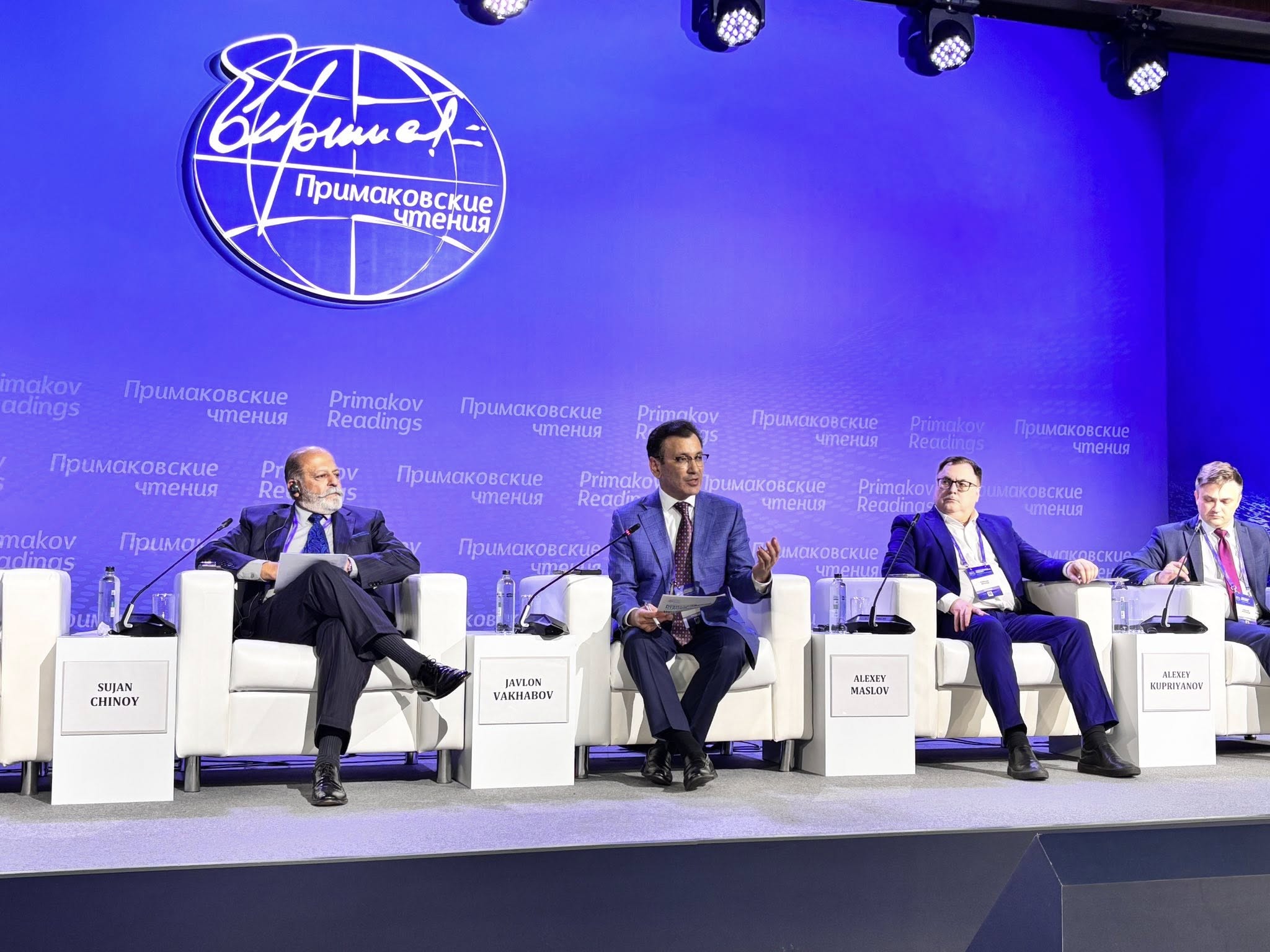
I would like to thank the organizers for the invitation
and the opportunity to participate in such a prestigious platform
for strategic dialogue. The Primakov Readings have become a significant forum where not only pressing contemporary challenges are discussed,
but also long-term directions for international development are shaped.
In the context of escalating geopolitical instability, the importance
of open and honest dialogue is especially heightened. We need to develop collective, coordinated approaches that will strengthen international cooperation based on mutual respect and equality.
- The global security architecture is undergoing a systemic crisis. Destructive conflicts are gaining renewed momentum, and mutual distrust between global and regional powers is deepening. The intensification
of rivalry is leading to heightened tensions, the emergence of new challenges, and threats to both security and sustainable development.
We are deeply concerned about the unfolding developments in the Middle East, where ongoing instability is resulting in severe humanitarian consequences and exacerbating risks to international security. Eastern Europe continues to experience a prolonged period of tension. The Afghan issue also remains highly relevant.The country is still grappling with
a humanitarian crisis, which continues to affect its socio-economic situation.
These challenges are not confined to conflict zones. They destabilize trade and transport chains, undermine energy security, and increase inflationary and migration-related risks. In such unpredictable conditions, the importance and role of regional mechanisms capable of consolidating countries to ensure a more resilient system of international relations
is growing significantly.
All of this demands a high degree of adaptability, coordinated action, and readiness for collective response from the countries of the region.
- In this context, Central Asia presents an important and positive example of responsible development. In recent years, the region has moved from fragmentation and mistrust to dialogue, pragmatic partnership,
and growing mutual integration.
Since 2017, under the leadership of President Shavkat Mirziyoyev, Uzbekistan has clearly designated Central Asia as the top priority of its foreign policy. This marked a turning point. A fundamentally new format
of regional cooperation was launched — the Consultative Meetings
of the Heads of State of Central Asia (CMHSCA), built on the principles of good neighborliness, respect for sovereignty, and mutual benefit.
Today, Central Asia is a platform for constructive cooperation, where states address sensitive issues through dialogue and reciprocal compromise. Revived and reinvigorated mechanisms of bilateral and multilateral engagement have helped reduce tensions, build trust, and initiate a range of regional projects.
In 2025, Uzbekistan holds the chairmanship of the Consultative Meeting of the Heads of State of Central Asia. Its key priorities include:
First, deepening political dialogue. The focus is on building trust
and institutionalizing mechanisms of dialogue. Uzbekistan advocates
for regular engagement at the highest and governmental levels, as well
as the establishment of working structures capable of ensuring stable and predictable long-term cooperation. A key priority also includes harmonizing approaches to major issues on the regional agenda.
Second, expanding economic cooperation. Over the past five years,
the volume of intra-regional trade among Central Asian countries has nearly doubled, surpassing $10 billion in 2023. A stable trend has emerged toward mutual investment, joint development of industrial zones, agro-clusters,
and cooperative value chains.Uzbekistan proposes moving toward
the creation of a unified regional economic space—one where barriers are minimal, and benefits are shared.
Third, developing transport and communication potential. This involves the creation of a modern, efficient, and interconnected infrastructure network. Uzbekistan is actively advancing projects to align major East–West corridors (including the China–Kyrgyzstan–Uzbekistan railway) and North–South routes (particularly the Uzbekistan–Afghanistan–Pakistan corridor), which will significantly enhance Central Asia’s access
to global markets.
Fourth, cooperation in water and energy security. This is one of the region’s most sensitive yet critical priorities. Open negotiation platforms have been initiated to achieve a fair balance between the interests
of upstream and downstream countries. Efforts are underway to develop mechanisms for the sustainable and mutually beneficial use
of transboundary water resources, as well as to synchronize regional efforts in transitioning to green energy.
Fifth, strengthening cultural and humanitarian cooperation. Uzbekistan places strong emphasis on fostering dialogue between peoples, reinforcing shared values, and cultivating a common regional identity.
In 2024, cultural weeks and public diplomacy forums were held; academic mobility programs are being implemented, and joint educational platforms are being launched. Particular attention is being given to the promotion
of digital education and the expansion of youth exchanges.
- As a result of profound transformations that have taken place in recent years, Central Asia today demonstrates not only a revival of intra-regional cooperation, but also a growing degree of foreign policy agency. The region is increasingly asserting itself as an independent and responsible actor in international affairs and is becoming an important center of attraction for both global and regional stakeholders.
Currently, more than 10 active “CA+” dialogue formats are in operation, including CA–Russia, CA–China, CA–GCC, CA+EU, CA+USA, CA+Japan,
and CA+Korea. These platforms address a wide range of issues including security, development, and technology.
I would like to emphasize in particular: these formats are not directed against any third parties. On the contrary, they are practical and pragmatic in nature, aimed at generating mutual economic benefits. Moreover, the “CA+” formats contribute to the diversification of the region’s external economic relations, enhance the resilience of its states, and broaden their international economic and humanitarian horizons.
We attach particular importance to the development of the “Central Asia–Russia” format. A historic milestone in this direction was the first summit held in this configuration in Moscow in 2022. For the first time, the heads
of state of the five Central Asian countries and the President of Russia held
a comprehensive meeting, which resulted in a shared political commitment to establishing regular, multifaceted, and pragmatic cooperation.
The Moscow summit reaffirmed the strategic nature of the region’s relationship with Russia and underscored the mutual readiness to develop coordinated approaches in key areas such as security, transport, energy, industrial cooperation, education, science, healthcare, and cultural
and youth exchanges.
From our perspective, the “Central Asia–Russia” format holds significant potential for systematic institutionalization. Russia remains
the largest trade and economic partner for the countries of Central Asia. Russian companies are actively engaged in investment projects across Uzbekistan, Kazakhstan, Kyrgyzstan, Tajikistan, and Turkmenistan —
in sectors such as energy, engineering, metallurgy, transport,
and agriculture. Millions of our citizens work in Russia, contributing to its economy while maintaining strong humanitarian and interpersonal ties.
At the same time, our relationship is based on far more than shared economic interests. Central Asia and Russia are bound by deep historical, cultural, educational, and linguistic ties that have evolved over centuries
of coexistence. The Russian language continues to serve as one of the primary languages of interethnic communication in the region,
and graduates of Russian universities play a prominent role in the governance, science, culture, and economies of Central Asian states.
The countries of Central Asia will always regard Russia as a priority partner and a reliable ally. Moreover, we are deeply committed to sustainable development, maintaining stability along our borders, and fostering constructive cooperation with our Russian partners based on trust, good-neighborliness, and mutual support.