Dear colleagues, distinguished guests,
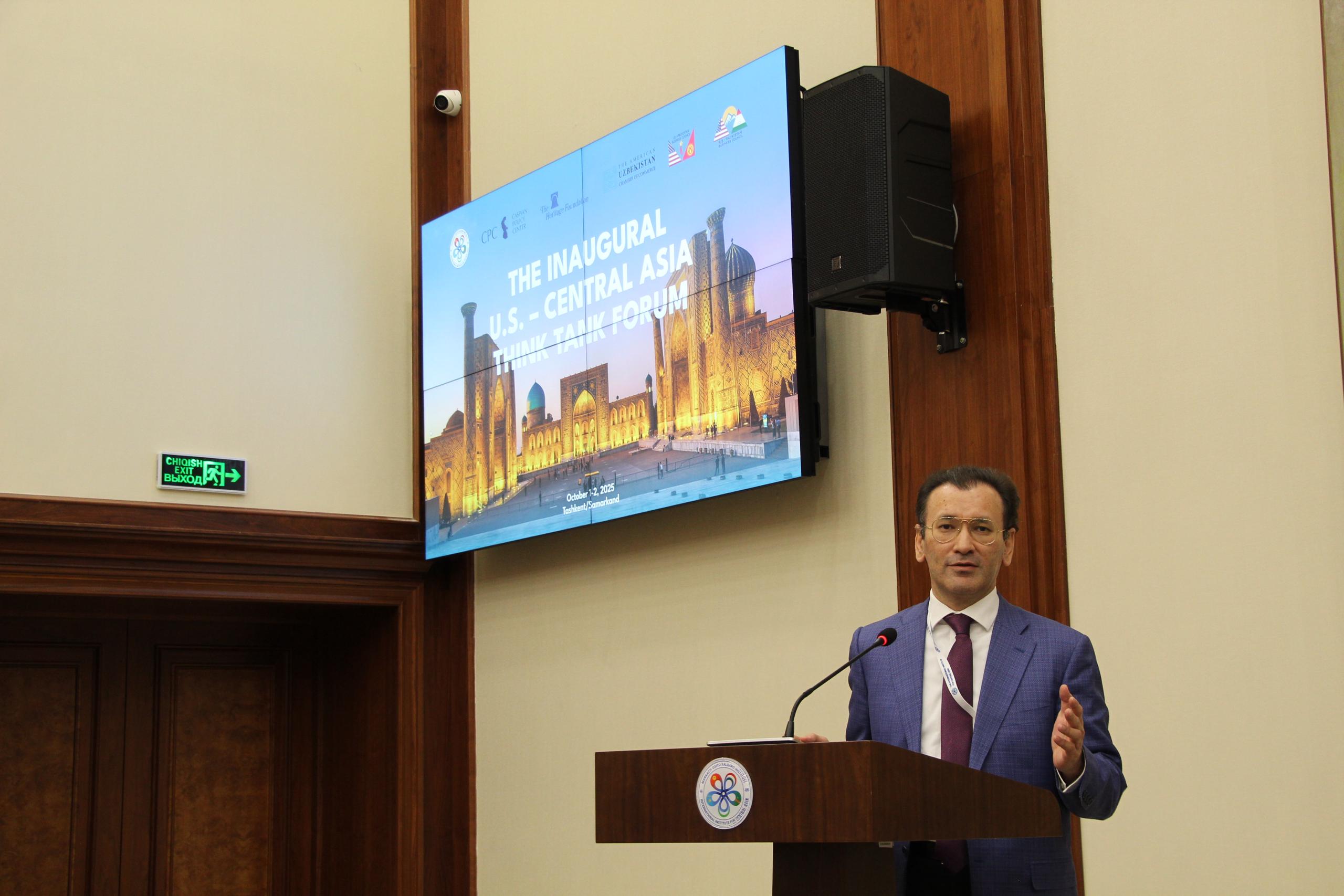
It is a true pleasure to welcome you to the inaugural U.S.-Central Asia Think Tank Forum here at the International Institute for Central Asia. I’m especially grateful to all of you – policymakers, business leaders, scholars, and think tank colleagues – for making the journey to be with us. Many of you I’ve known since my time as Uzbekistan’s Ambassador to the United States in Washington, D.C., so your presence here today means a great deal to me.
I would like to thank Mr. Nifti, CEO of the Caspian Policy Center; Dr. Carafano, Senior Counselor to the President of the Heritage Foundation; and Ms. Son, Executive Director of the American-Uzbekistan Chamber of Commerce, the US-Kyrgyzstan Business Council, and the US-Tajikistan Business Council, for their support in organizing this wonderful event today. I see this as the first step in our partnership, and I hope it will grow and continue for many years to come.
I’d also like to highlight something special. Today is Teacher’s Day in Uzbekistan, an official holiday. And yet so many of you chose to be here with us. For that, I am especially thankful. In many ways, this forum is also about learning from one another, so perhaps the timing is quite fitting.
I think there really couldn’t be a better moment for this forum. Next month marks exactly 10 years since the launch of the C5+1 Format, celebrating a decade of dialogue and collaboration. As you might know, in November 2015, then-U.S. Secretary of State John Kerry hosted the inaugural C5+1 meeting, establishing a new platform for dialogue and cooperation between the United States and the five Central Asian countries. These efforts culminated with the presidential summit in New York in 2023.
We have high hopes that the next high-level C5+1 Summit, bringing together the presidents of all five Central Asian countries and the United States, will take place later this year.
Moreover, just last week, all five Central Asian leaders visited the United States to attend the 80th Session of the UN General Assembly. In this regard, we attach special importance to President Mirziyoyev’s historic visit, during which he met with U.S. President Donald Trump and reaffirmed not only Uzbekistan’s, but also Central Asia’s commitment to deepening strategic partnership with the United States.
That was an important milestone, and today we are here to build on that momentum – to bring the same spirit of dialogue and partnership into our think tank and policy communities, and to turn high-level discussions into practical ideas and lasting cooperation.
I should also note that this is the very first gathering of its kind between the United States and all five Central Asian countries. There might have been bilateral or even trilateral think tank dialogues in the past, but never before have think tank representatives from every Central Asian nation and the U.S. come together in this format. That alone speaks to the growing importance of the C5+1 framework and the value of working together on our shared challenges and opportunities.
Dear guests,
Today we are truly honored to be joined by two former U.S. Ambassadors: Ambassador Spratlen, who served in both Kyrgyzstan and Uzbekistan and has first-hand experience with the C5+1 platform, having been here when it was first established; and Ambassador Hoagland, who represented the United States in Kazakhstan, Tajikistan, and Turkmenistan. Together, they bring with them the full picture of Central Asia.
We are also privileged to welcome the current U.S. Ambassador to Uzbekistan, Ambassador Henick, as well as the Ambassadors of the Central Asian countries to Uzbekistan. Your presence adds great weight to our discussions. And of course, Ambassador Henick has a special story — he once served here as a young Third Secretary, when people jokingly called him the “third person” in the Embassy. Now he has come full circle as the top U.S. representative in Uzbekistan.
As you might already know, the United States is currently facing the possibility of a government shutdown. Nevertheless, Ambassador Henick is here with us today and that means a lot to us.
While such a challenge would be unwelcome in Washington, it also serves as a reminder of why forums like this are so important. Dialogue, cooperation, and finding common ground are essential—not only within countries, but also between them. By coming together today, we demonstrate that even in uncertain times, we can continue to advance understanding and strengthen partnership.
I would also like to acknowledge Ambassador Blake, former U.S. Assistant Secretary of State for South and Central Asian Affairs. While he could not join us in person, he has sent his warm regards and recorded video remarks, which we will watch a bit later during the Ambassadorial Session. We also have two former Directors for Central Asia Affairs at the U.S. National Security Council — Dr. Eric Rudenshiold and Prof. Brianne Todd — whose experience at the heart of U.S. policymaking on this region brings invaluable perspective to our discussions today.
I am equally pleased to welcome the heads and representatives of U.S. businesses based here in Tashkent, along with colleagues from the private sector and government agencies.
Dear colleagues,
I won’t take up much time walking through today’s agenda, since you already have the brochure with the concept note and program.
I would just like to highlight that one of the key outcomes of today’s forum will be a report capturing the insights, ideas, and recommendations of our speakers and participants. This report will not only reflect the richness of our discussions, but also serve as a practical resource for policymakers, scholars, and partners in both the United States and Central Asia. My hope is that it helps turn today’s dialogue into concrete steps for deeper cooperation in the years ahead.
Dear participants, I wish you productive discussions and meaningful exchanges throughout the day. Thank you!