Distinguished President Gao Xiang,
Dear Rakhim Rasuljonovich,
Your Excellency Ambassador Yu Jun,
Esteemed participants of the briefing,
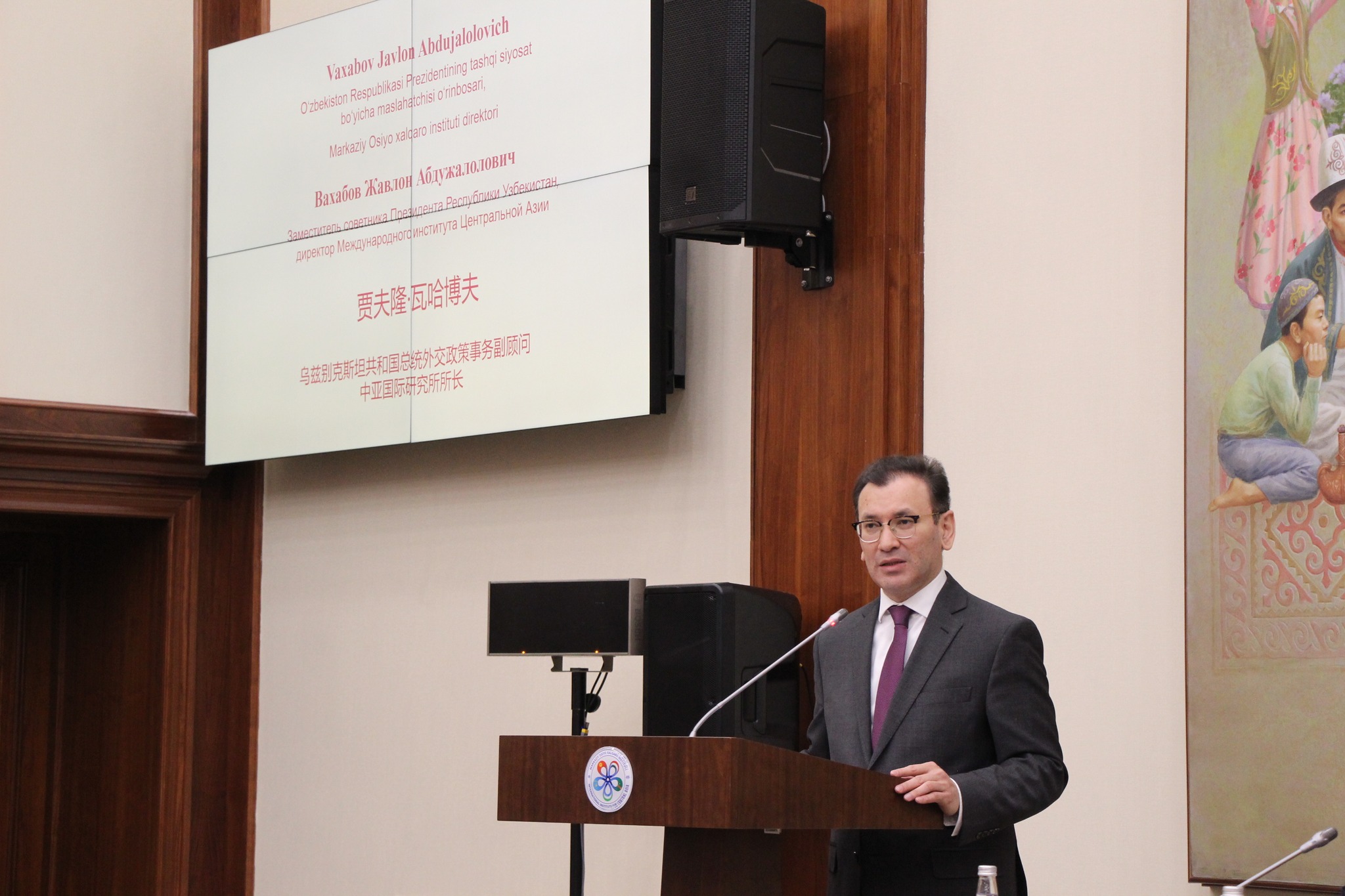
It is my absolute delight to welcome you all. Let me to warmly greet our Chinese guests and everyone gathered in this hall, and to note that it is a great honor for the International Institute for Central Asia to host a delegation of Chinese scholars headed by a member of the Central Committee of the Communist Party of China and President of the Chinese Academy of Social Sciences, H.E. Gao Xiang.
There is no doubt that the scale of the objectives set by the Chinese leadership for the Party and the country over the next five years is truly impressive. The remarkable progress achieved by our close friend, the People’s Republic of China—a reliable and steadfast strategic partner—commands deep respect. This dynamic development creates increasingly favorable conditions for expanding cooperation between Uzbekistan, the broader Central Asian region, and China.
Furthermore, the recent Plenum is of considerable interest to us from the perspective of examining China’s experience in modernization and public administration. The effectiveness of this governance model is convincingly demonstrated by China’s sustained economic growth, as well as its significant technological and social achievements accumulated over decades of reform.
In this sense, today’s symposium serves as a substantive extension of the high-level political dialogue between our respective leaders—President Shavkat Mirziyoyev and President Xi Jinping. Their discourse consistently emphasizes the critical importance of bilateral knowledge-sharing regarding governance architectures and national development strategies.
The Head of our State attaches great importance to the study of China’s experience in public administration, including in the area of poverty alleviation. During meetings held both in the capital and in the regions, the President has repeatedly underscored the value of drawing upon China’s approaches to the modernization of industry, agriculture, education, healthcare, and other key sectors.
Moreover, the exchange of experience has become a substantive area of cooperation within the “Central Asia–China” format. In the Xi’an Declaration adopted at the first summit of this format in May 2023, the heads of Central Asian states highly commended the unique experience of the Communist Party of China in public governance and affirmed the global significance of the Chinese path to modernization.
It is also worth noting that the Plenum of the Central Committee of the Communist Party of China held in October last year attracted close attention across many countries, particularly among international business communities. This interest was largely driven by discussions on the formulation of China’s 15th Five-Year Plan for socio-economic development, a document of considerable global relevance.
This global interest is entirely justified. As the world’s second-largest economy and a preeminent leader in advanced manufacturing, high technology, renewable energy, and logistical infrastructure, China remains a central engine of the global economy. Accounting for over 19 percent of global GDP, the People’s Republic of China continues to be the primary driver of international economic growth.
In this regard, developmental roadmap during the 15th Five-Year Plan will be of substantial importance not only for the global economy, but also for the socio-economic development of many countries—particularly China’s neighbors, including the states of Central Asia.
Let me, esteemed President Gao Xiang, express my gratitude for the information regarding the essence and content of the decisions of the 4th Plenum of the CPC Central Committee, which define China’s further progress along the path of modernization. The exchange that took place on these matters will contribute to finding common ground, promoting mutually beneficial cooperation, and aligning the development strategies of the two countries.
We were particularly struck by China’s declared intention during the Plenum to “expand openness to the outside world” and to advance the implementation of the Belt and Road Initiative, which will undoubtedly deepen the all-weather strategic partnership between Uzbekistan and China.
In conclusion, I wish successful implementation of the decisions of the 4th Plenum, including the adoption and execution of the 15th Five-Year Plan. I would also like to express confidence that further achievements in the modernization of Uzbekistan and China will contribute to strengthening Uzbekistan-Chinese cooperation for the benefit of our peoples.