Distinguished professors, researchers, and students,
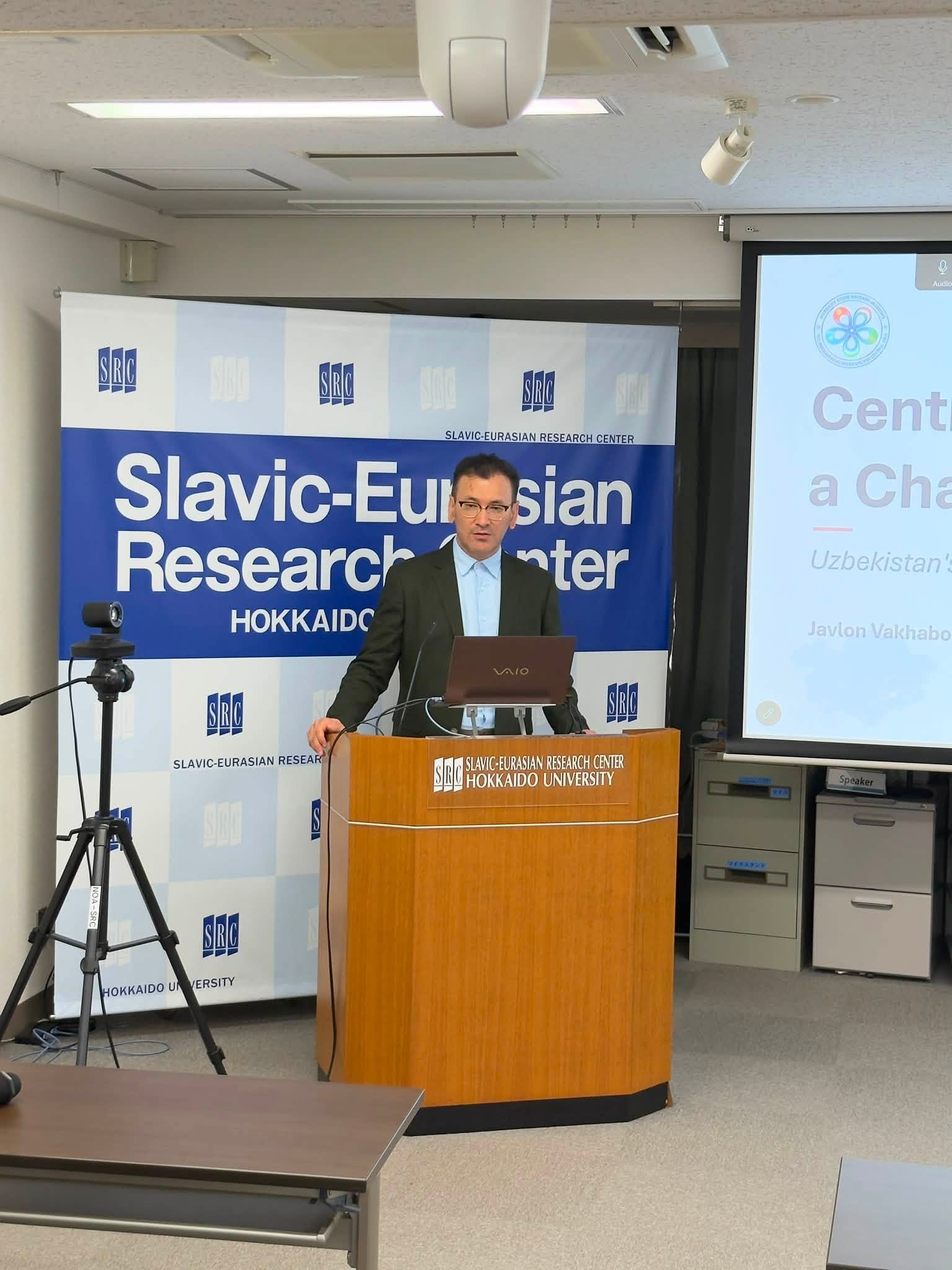
It is a great honor for me to speak here today. First of all, I would like to sincerely thank our Japanese partners for the invitation and for this opportunity to speak on the future of cooperation between Central Asia and Japan.
Today, I would like to share our view of the profound changes taking place in Central Asia, speak about Uzbekistan’s foreign policy priorities, and discuss the role that cooperation with Japan plays in this process.
Against the backdrop of global turbulence, Central Asia today is demonstrating its unique nature and is becoming one of the most stable and resilient regions in the entire Eurasian space. This is not a coincidence, but the result of the purposeful policies of the countries of the region.
In 2016, Uzbekistan launched large-scale reforms that affected virtually all spheres of national life. One of the most significant changes was a qualitative reassessment of the country’s foreign policy course.
Speaking at the United Nations General Assembly, the President of Uzbekistan identified Central Asia as the main priority of our country’s foreign policy. At the heart of this new course was a simple but fundamental idea: it is impossible to build a prosperous Uzbekistan without a stable Central Asia. That is why we placed our emphasis on open dialogue, mutual trust, and good-neighborliness, guided by the principle of “zero problems with neighbors.”
Today, we can say with confidence that the reforms in Uzbekistan have given a powerful impetus to the transformation of the entire region. Thanks to open and trust-based dialogue among the leaders of the Central Asian states, as well as joint practical efforts to strengthen intra-regional cooperation, a “New Central Asia” is gradually taking shape: a region with shared interests, common goals, and a growing understanding of collective responsibility for its own future.
It is not only us who speak about these changes. They are also being noted by our international partners, including representatives of Japan’s expert community.
Over the years of close interaction, the countries of the region have managed not only to resolve most of the problematic and highly sensitive issues that had long complicated relations, but also to consistently build their own model of regional stability, based on trust, mutual consideration of interests, and shared responsibility for the future of the region.
First and foremost, this concerns the issue of state borders. I believe that the outcomes of last year’s March summit of the leaders of Uzbekistan, Tajikistan, and Kyrgyzstan in the city of Khujand, as well as the signing of the Treaty on the Junction Point of State Borders and the Khujand Declaration on Eternal Friendship, should be viewed as the quintessence of this shared commitment and interest in expanding cooperation.
These documents marked not only the end of many years of mutual distrust and territorial disputes in one of the most, as many experts noted, explosive and conflict-prone regions of the world, where, unfortunately, there had already been numerous human casualties, but also laid the foundations for a new model of regional interaction based on trust, good-neighborliness, and recognition of shared responsibility for the security and development of the region.
Let me give a personal example. About ten years ago, traveling from Tashkent to Dushanbe took almost an entire day. One had to fly to Termez, which is the southernmost city in Uzbekistan, and then travel for several hours by car across the border. Today, there are direct flights between our capitals, and the entire journey takes less than an hour. This is only the outward manifestation of much deeper changes.
Moreover, we are already moving to the next stage: between Uzbekistan and Kyrgyzstan, the state border can now be crossed using ID cards. Similar arrangements are being discussed with our Kazakh and Tajik partners.
Equally significant changes are taking place in water and energy cooperation. For many years, water resources were perceived as one of the most sensitive issues on the regional agenda. Today, however, the countries of Central Asia are jointly implementing the project to build Kambarata HPP-1. This is a fundamentally new model of interaction, based not on competition for resources, but on the joint search for mutually beneficial solutions.
Another important example is the development of transport connectivity. Today, Central Asia is consistently shaping a new architecture of transport and logistics links, seeking to fully realize its transit potential. Alongside the implementation of the China–Kyrgyzstan–Uzbekistan railway, the development of the Trans-Caspian International Transport Route is gaining particular importance, opening up new opportunities for the formation of an efficient land corridor between East Asia and Europe. No less important as a strategic project is the construction of the Trans-Afghan railway, which will connect Central Asia with the markets of South Asia and provide the region with additional access to seaports.
In other words, Central Asia is gradually moving from resolving accumulated bilateral problems to forming a full-fledged regional development agenda.
As a result, today we see an entirely different regional dynamic: the expansion of investment cooperation and the implementation of cooperative projects in trade, industry, energy, transport, agriculture, and other sectors. These processes also have a very concrete economic dimension. In just eight years, the combined GDP of the Central Asian countries has grown almost 2.5 times and reached $520 billion, while foreign trade has more than doubled to $253 billion. The growth of mutual trade is especially telling: from $2.4 billion to $11 billion, or more than fourfold. Mutual investment over this period has grown by more than 5.5 times.
A key role in this process belongs to so-called annual Summits of Central Asian leaders. They have become an important platform for developing a common vision of regional development and finding mutually acceptable solutions to the most sensitive issues.
The outcomes of the 7th Summit of the Leaders of Central Asia, held in Tashkent last year, should be seen as a vivid confirmation of this positive dynamic. Today, its results can be described as historic, while the format of interaction itself has proven to be relevant, unique in its own way, and effective.
For the first time, issues related to the further institutionalization of regional cooperation were discussed in such substantive detail, including the possible creation of a “Community of Central Asia,” the strengthening of the legal framework, the establishment of a rotating Secretariat and a Council of Elders, as well as the implementation of joint projects in the economic, investment, digital, and infrastructure spheres.
A breakthrough decision was the accession of Azerbaijan to this format. This is driven by the objective logic of the region’s development. Today, Central Asia is increasingly moving beyond a purely intra-regional agenda and is becoming the core of a broader space of connectivity that links Central Asia and the South Caucasus through transport, energy, and trade projects.
In the meantime, it would be premature to say that Central Asia has already formed a complete model of regional integration. On the contrary, the region is currently searching for its own model of integration, one that would take into account our historical characteristics, level of economic development, and the specific nature of political interaction.
That is why we carefully study the experience of other regions of the world. The models of ASEAN, the European Union, and other regional associations are of great interest to us. We seek to understand which mechanisms have proven successful, what lessons can be drawn, and which solutions require adaptation to the conditions of Central Asia.
In this context, Japan’s perspective and experience are especially valuable to us. For many decades, your country has played an important role in the development of regional cooperation mechanisms, successfully combining bilateral diplomacy with active participation in multilateral formats in the Asia-Pacific region and beyond, including APEC, ASEAN Plus, the G7, and the CPTPP.
Distinguished colleagues,
All these changes are naturally attracting growing attention from the international community. As regional cooperation strengthens, Central Asia is increasingly asserting itself as an independent actor in international relations.
One confirmation of this is the active development of the “Central Asia Plus” format. Today, twelve such mechanisms connect our region with nearly 40 countries and two regional organizations, representing around 75% of world GDP and four billion people. These formats include six G7 countries and twelve members of the G20.
This is taking place against the backdrop of intensifying competition among major powers. China has become Central Asia’s largest trading partner, with trade in goods reaching $106 billion in 2025. Russia remains an indispensable partner, with trade turnover with the five Central Asian states exceeding $45 billion, while retaining important links through labor migration, energy networks, education, security cooperation, and inherited infrastructure. The European Union is also a major economic actor: it is Central Asia’s second largest trading partner and the largest investor, accounting for more than 40% of investment in the region.
These figures show that Central Asia is not moving in one direction only. Rather, the region is expanding its room for maneuver by developing relations with different centers of power. This is the essence of Central Asia’s multi-vector diplomacy.
As you all know well, Central Asia is a landlocked region located in a very complex geopolitical environment. Around us are several major powers, including nuclear-armed states such as Russia, China, and Pakistan. At the same time, our most direct southern access to seaports depends either on transit through Afghanistan toward Pakistan’s ports, or through Iran toward the Persian Gulf and the Indian Ocean. Yet both Afghanistan and Iran remain affected by regional instability, while Iran is also under extensive Western sanctions.
So geographically, Central Asia operates in a difficult environment. This is why pragmatism, flexibility, and diversification have never been abstract concepts for the region. They are practical necessities.
Therefore, for us, multi-vector diplomacy is not simply about balancing among major powers. It is about strategic autonomy. And strategic autonomy does not mean isolation or distancing ourselves from any partner. It means having options: several routes to global markets, several sources of investment, several diplomatic platforms, and several reliable economic partners.
At the same time, it is fundamentally important that cooperation in the “Central Asia Plus” format does not replace regional integration, but, on the contrary, rests upon it. The more cohesive Central Asia becomes, the more in demand its dialogue with external partners will be.
Dear friends,
Cooperation with Japan is a crucial part of Central Asia’s external relations. It is symbolic that Japan was the first country to propose, back in 2004, an institutional format of interaction known as “Central Asia plus Japan Dialogue.”
In doing so, Tokyo recognized the strategic significance of our region long before many other partners and understood the need to build dialogue not only with individual states, but with Central Asia as a single space of cooperation.
One important point I want to mention is that Japan’s role is particularly crucial because its engagement with Central Asia has never been limited to short-term political calculations. For more than two decades, Japan has been one of the region’s most reliable development partners. Its cooperation has been built through institutions such as JICA, JETRO and JBIC, combining official development assistance, technical cooperation, infrastructure finance, private-sector engagement, and human resource development.
According to official data, Japan’s cumulative official development assistance to the five Central Asian countries amounted to more than $5 billion in loans, grants, and technical cooperation.
This is why Japan is seen in Central Asia not only as an external donor, but increasingly as a long-term political and development partner. Its comparative advantage lies in quality infrastructure, institutional capacity-building, technology transfer, education, and human capital development.
Over the past years, this format has developed into a stable mechanism of interaction. Nine meetings of foreign ministers, seventeen senior officials’ meetings, and thirteen Tokyo Intellectual Dialogues have been held, and sectoral expert meetings take place regularly. In recent years, practical cooperation in the economic and energy spheres has also been actively developing, including through the Economic and Energy Dialogues.
An important milestone was the first “Central Asia–Japan” Summit, held in Tokyo in December last year. The Tokyo Declaration adopted following the summit defined the long-term guidelines of our partnership and identified three key areas for further interaction.
The first is sustainable development. This area is especially relevant for Uzbekistan. We have set ambitious goals: to reduce greenhouse gas emissions by 50% by 2035 and to increase the share of green energy in total electricity generation to 54% by 2030. That is why we highly value the agreements reached at the summit. They cover the development of energy transition roadmaps, the implementation of projects in green energy and decarbonization, the creation of joint financing mechanisms for climate projects, cooperation in the field of critical minerals, as well as joint work on disaster prevention and strengthening the region’s seismic resilience.
The second is the development of regional connectivity. For the landlocked countries of Central Asia, transport connectivity is not only a matter of logistics, but also a matter of economic competitiveness. Over the past ten years, Uzbekistan’s foreign trade turnover has grown more than threefold, from $25 billion to more than $81 billion. Along with this, the burden on transport corridors has increased significantly. According to World Bank estimates, Uzbekistan’s annual logistics costs amount to around $8 billion, with more than half of these costs incurred outside our country.
Today, Uzbekistan’s share in transit traffic along the Middle Corridor remains no more than 1–2%, although the potential is much higher. According to our estimates, attracting an additional 15–20 million tons of transit cargo annually would generate $400–600 million in additional revenue, attract around $3 billion in investment in logistics infrastructure, and create up to 50,000 new jobs.
That is why the development of regional connectivity became one of the key areas of the Tokyo Declaration, including cooperation on the development of the Trans-Caspian International Transport Route, the modernization of logistics infrastructure and customs administration, the expansion of digital connectivity, cooperation in the field of artificial intelligence, as well as the expansion of humanitarian exchanges.
The third area is human capital development. People are the main resource of our partnership. This is especially relevant for Central Asia, where, according to projections, the region’s population will exceed 114 million by 2050, and around 20 million young people will reach working age. Therefore, investment in education, professional training, and the development of modern competencies is becoming a strategic priority.
In this regard, the Tokyo Declaration provides for the expansion of scholarship programs, the development of cooperation between universities and research centers, the training of civil servants and highly qualified specialists, the strengthening of healthcare systems, support for women’s entrepreneurship, and the creation of a new generation of professionals who will serve as a link between Central Asia and Japan.
To implement these objectives, Tokyo has pledged to invest 3 trillion yen, or around $20 billion, in business projects across Central Asia over the next five years, with the support of Official Development Assistance, export credit agencies, and multilateral development banks.
Moreover, I must note that Japan’s approach to Central Asia is also evolving. The first leaders’ summit reflected a transition from traditional development assistance toward a more forward-looking partnership focused on green transformation, connectivity, digitalization, artificial intelligence, critical minerals, disaster risk reduction, and human capital.
This approach is consistent with Japan’s revised Development Cooperation Charter, which places greater emphasis on co-creation, economic resilience, digital transformation, green growth, and cooperation based on trust and local ownership. In practical terms, this means that Japan’s ODA can serve not only as financial assistance, but also as a catalyst for attracting public and private actors into long-term development projects.
For Central Asia, this is especially valuable. Our region needs partnerships that build capacity, strengthen institutions, modernize infrastructure, and help our countries become more competitive and resilient.
At the same time, the summit also put forward concrete proposals for the further development of the “Central Asia–Japan” format.
First of all, this concerns the institutional strengthening of our partnership. The President of Uzbekistan proposed holding leaders’ summits on a regular basis, once every two years; developing a long-term “Central Asia–Japan 2040” Cooperation Strategy; and establishing an Expert Forum of leading think tanks from our countries. The first meeting in this format is planned to be held at IICA in Tashkent this autumn, and it could become a platform for generating new ideas and supporting the implementation of the decisions adopted.
The second set of initiatives is related to economic development. It was proposed to establish an Investment Fund for Infrastructure and Industry Development in Central Asia, form a Central Asian network of Japanese technology parks in the region, create a “Central Asia–Japan” Digital Hub, and expand the participation of Japanese companies and financial institutions in the modernization of transport, energy, and digital infrastructure.
Third, sustainable development was of particular significance as well. This includes the launch of joint projects in green energy, the creation of regional training centers for specialists in renewable energy and seismic safety, the implementation of joint climate programs, and the strengthening of environmental cooperation.
Finally, people-to-people ties. It was proposed to hold the first Meeting of Ministers of Education and the Forum of University Rectors in the “Central Asia–Japan” format, as well as to adopt a Regional Youth Development Program that would help shape a new generation of specialists who understand both Central Asia and Japan equally well.
At the same time, a natural question arises. We have adopted important documents, identified promising areas of cooperation, and formulated ambitious objectives. But what needs to be done to ensure that these agreements do not remain only on paper? This is why today’s dialogue with the Japanese academic community is especially valuable to us. It is important for us to hear your views: which factors today contribute most to the development of relations between Central Asia and Japan, and which, on the contrary, hold this process back? Which of the proposed initiatives have the greatest potential? What obstacles may arise in their implementation? And how can the expert communities of our countries help turn the agreements reached into real joint projects?
Distinguished colleagues,
To sum up, I would like once again to thank our Japanese partners for their consistent attention to Central Asia and their readiness to develop long-term cooperation with our region.
I am convinced that expert and academic dialogue can become one of the key factors in the further development of relations between Central Asia and Japan. Today, more than ever, there is a need for joint research, the exchange of academic assessments, the implementation of scientific and educational projects, and the training of a new generation of specialists capable of understanding our regions more deeply and finding answers to shared challenges.
For its part, the International Institute for Central Asia is open to the broadest possible cooperation with Japanese universities, research centers, and think tanks. We are ready to work on joint research, organize expert dialogues, exchange experience, and develop practical recommendations.
Meanwhile, it is important for us to understand which topics and areas are of greatest interest to our Japanese partners, which research and projects you consider most relevant, and where you see the greatest potential for joint work. I am confident that precisely such an equal dialogue will allow us to shape a truly meaningful agenda for our cooperation.
In this regard, I would like to invite you to take an active part in the first “Central Asia–Japan” Think Tank Forum, which we plan to hold this autumn in Tashkent at the initiative of the President of Uzbekistan. We see it as a long-term platform for the open exchange of ideas, the development of joint research, and the preparation of practical proposals that could serve as the intellectual foundation for the further development of partnership between Central Asia and Japan.
As Japanese wisdom says: “If we join our strength, we can move mountains.” I am convinced that by combining our capabilities, knowledge, and commitment to development, we will be able to achieve results that will serve the interests of our peoples for many years to come.
Thank you for your attention.