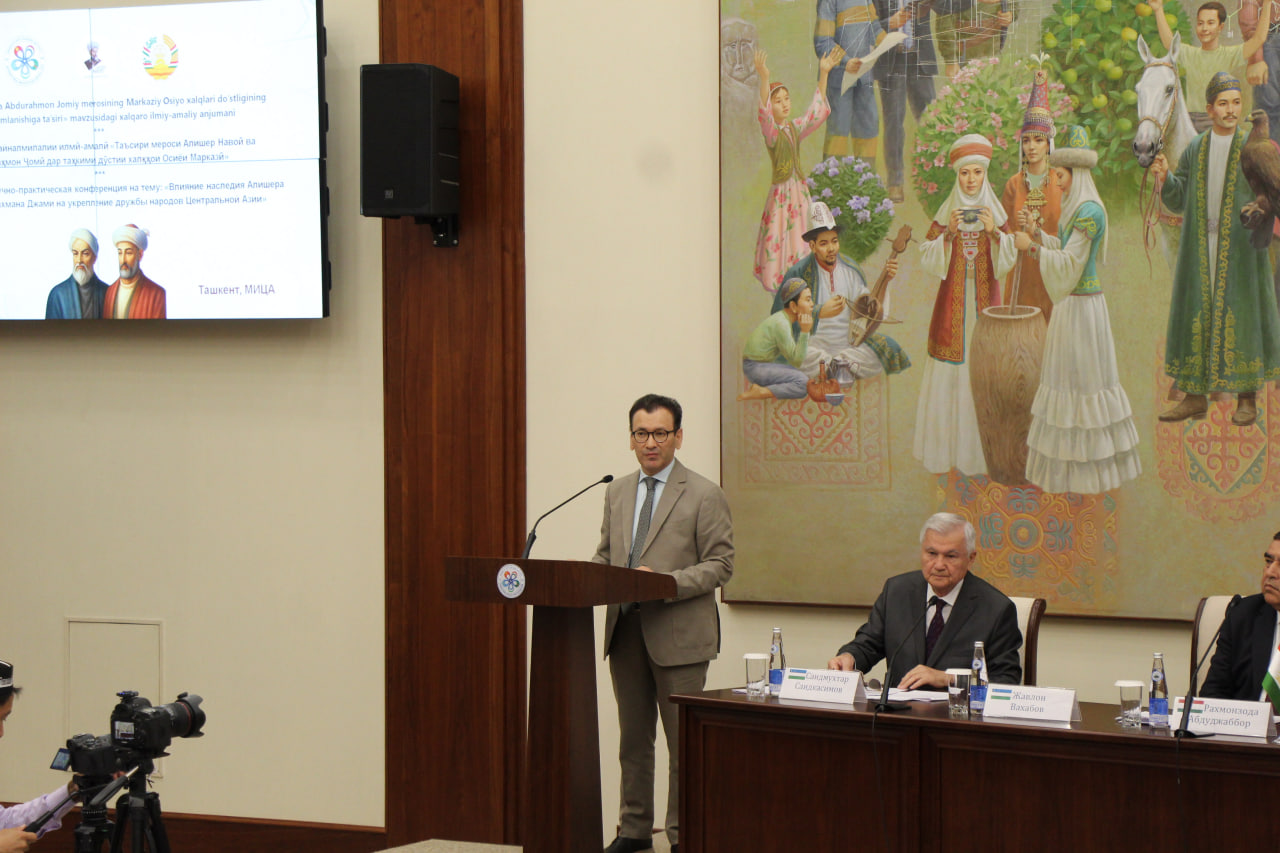
Welcome Remarks by Director of the International Institute for Central Asia, Javlon Vakhabov, at the Opening Ceremony of the International Scientific and Practical Conference “The Influence of the Legacy of Alisher Navoi and Abdurahman Jami on Strengthening the Friendship of the Peoples of Central Asia”
Distinguished guests, ladies and gentlemen, colleagues, dear friends!
On behalf of the International Institute for Central Asia and all the organizers, it is my great honor to welcome you to the opening of this international scientific and practical conference dedicated to the great legacy of Abdurahman Jami and Alisher Navoi, and its significance in strengthening the friendship of the peoples of Central Asia.
Today’s event is held in a special atmosphere—a time when relations between our countries, particularly Uzbekistan and Tajikistan, are experiencing a new era of flourishing and fraternal understanding. This has become possible thanks to the will and political wisdom of the leaders of our states—President Shavkat Mirziyoyev and President Emomali Rahmon—who, by their example of friendship and cooperation, inspire us toward unity, trust, and a commitment to the common good.
History teaches us: when cultures interact, peace grows stronger. This is clearly demonstrated by the centuries-old spiritual legacy of Alisher Navoi and Abdurahman Jami—two great poets, thinkers, and true symbols of the Eastern Renaissance. Their creative works are not only the pinnacle of literature and philosophy but also a living bridge between peoples, cultures, and eras.
The great poet Mir Alisher Navoi, hailed as the "Sultan of the Ghazals," in several of his works—such as “Khamsat al-mutahayyirin,” “Majolis an-nafois,” the qasida “Tuhfat al-afkor,” and his epic “Khamsa”—spoke with deep reverence about his mentor, Abdurahman Jami, highlighting his greatness and virtue. Before composing major works, Navoi would seek Jami’s advice, and Jami himself was the first to read these writings. In the poem “Arba’in,” Navoi wrote about his mentor as follows:
"He is the cup of light among the righteous,
The purest soul—Jami is of them.
Upon life’s path, he is my guide,
My mentor and my spiritual father."
Abdurahman Jami, in turn, gratefully praised the Almighty for granting him the honor of living and creating in the same era as Alisher Navoi, and for being spiritually close to him. As mentioned above, Navoi was for Jami a true source of inspiration, awakening in him a dormant volcano of creativity. Jami, in turn, laid the spiritual and intellectual foundation upon which Navoi rose as a great thinker. All of this is the fruit of Great Friendship—a blessing that united two brilliant hearts.
In this sense, the following lines by Abdurahman Jami vividly reflect his friendship with Navoi:
"He who is joined to his friend in spirit,
Will see his tree of deeds bear fruit.
A friend is the key to the treasure of hope,
A friend is the harbinger of eternal joy.
What is the meaning of existence—without a friend?
What profit or gain—if not for friendship?"
Navoi and Jami were more than poets; they were true guides of humanistic ideals, spirituality, and peace. Jami, as a mentor and friend to Navoi, shaped the moral consciousness of his time through his pen and beliefs. Navoi, the founder of Uzbek literature, elevated his native language to the heights of great culture, infusing his works with profound love for humanity, truth, and justice.
It is symbolic that today, as centuries ago, here in the heart of Central Asia we gather to discuss peace, unity, and cultural dialogue. Just as Samarkand and Herat were once centers of enlightenment, so too do our cities—Tashkent, Dushanbe, Astana, Ashgabat, Bishkek—now serve as platforms for scholarly exchange, open dialogue, and the spiritual rapprochement of the peoples of our region.
The goal of our conference is not only to deepen the academic understanding of the rich legacy of Jami and Navoi, but also to discuss how their ideas can serve us today: in educating youth, strengthening interethnic harmony, and building a stable future for Central Asia as our shared home.
I sincerely thank all participants—scholars, cultural figures, representatives of the diplomatic corps, national centers, and international institutions—for your interest in this topic and your active support.
I wish you all fruitful work, meaningful discussions, and new ideas that will, I am sure, contribute to the further development of friendship and mutual understanding among our brotherly peoples.
Thank you for your attention!