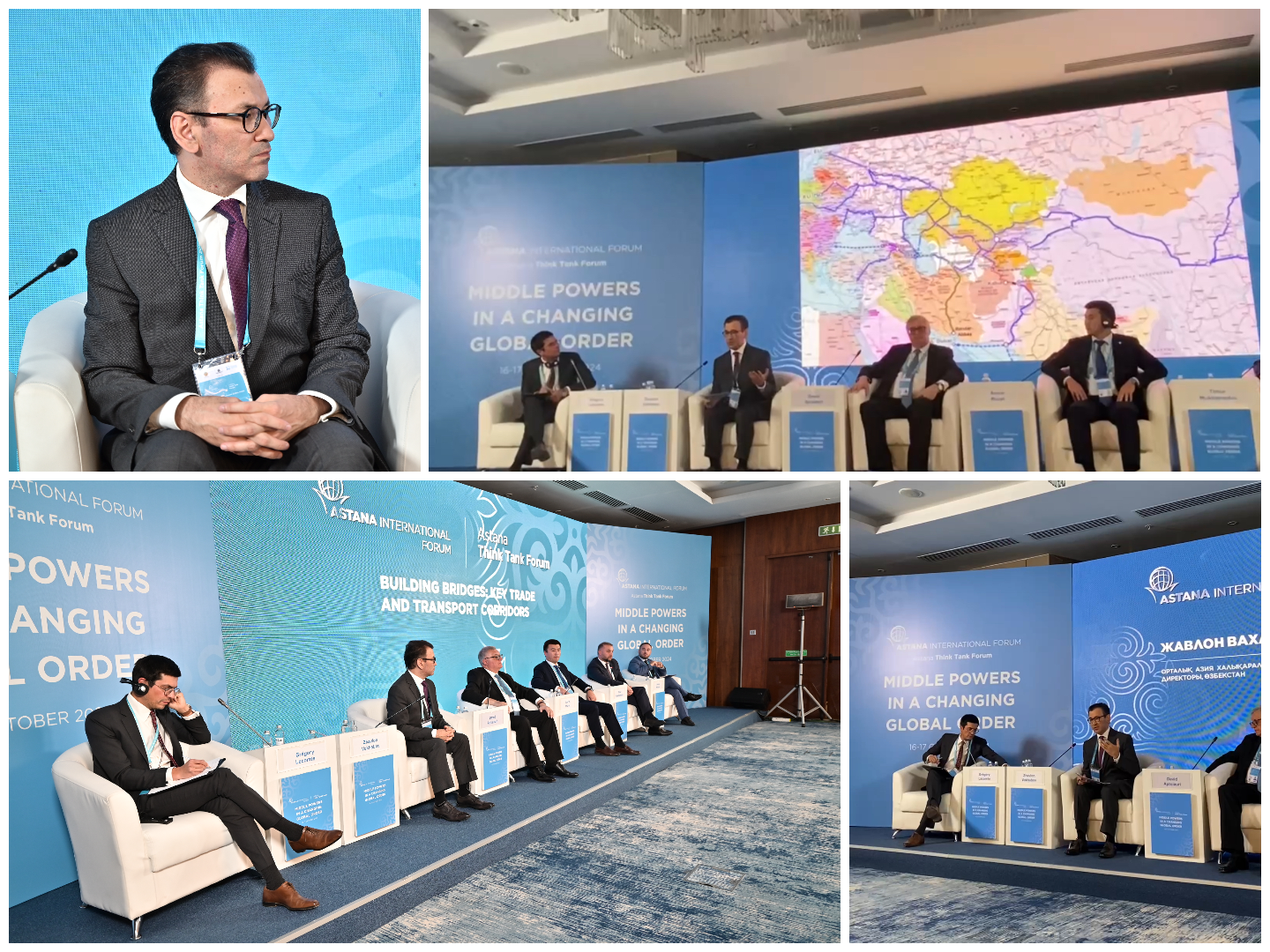
The main theme of the Astana Think Tank Forum 2024 was "Middle Powers in a Changing Global Order: Strengthening Security, Stability, and Sustainable Development." The two-day program of the forum covered aspects of the declared theme such as geopolitical processes in the world and regional security, economy, energy, transport and communications, among others.
President of Kazakhstan Kassym-Jomart Tokayev spoke at the plenary session of the forum. In his speech, he particularly emphasized that Kazakhstan is fully committed to regional policy and close cooperation with all its closest neighbors in Central Asia. "The more cooperation we have here, the better it is for the interests of Kazakhstan, as well as for the interests of other Central Asian countries," said the head of state. According to him, Central Asia is becoming increasingly noticeable on the world map, and the current situation is significantly different from what it was 10 years ago. "Currently, we have active cooperation; multifaceted ties are expanding on many issues. Here in Central Asia, we regularly hold meetings of heads of state. I believe that these meetings are also very useful," added Tokayev.
The Director of the International Institute of Central Asia, Javlon Vakhabov, participated in the forum. Speaking at the session "Building Bridges: Key Trade and Transport Corridors," he stated that creating a network of interconnected trade and transport corridors is the most important strategic task, a guarantee of successful socio-economic transformation of Central Asia and the realization of its geoeconomic potential.
"Central Asia occupies a unique geographical position. The transport corridors we are discussing today can transform the countries of the region from land-locked to land-linked, into a major transport and logistics hub of transcontinental significance, connecting East and West, South and North," emphasized the head of IICA.
At the same time, according to him, today the region remains one of the least interconnected economies in the world. According to World Bank estimates, the region's connectivity indicator averages less than 60% access to global GDP. The share of transportation costs to external markets can reach up to 50% of the final cost of goods, which is significantly worse than the global average of 11%. As a result, our economies are forced to bear a transportation burden 2-3 times greater than in developed countries, said Javlon Vakhabov.
It was noted that the presence of numerous barriers in Central Asia's transport system does not allow for the effective development of trade and economic ties and industrial cooperation between the countries of the region, hinders the attraction of foreign investments, and impedes the region's inclusion in global value chains.
In this regard, the Director of the International Institute of Central Asia believes that an important step in realizing the transport and communication potential of the region could be the development of a unified strategy for regional transport corridors in Central Asia. In his opinion, for joint participation in global value chains, it is necessary to jointly develop projects for the introduction of digital technologies and modern corporate practices in the transport and logistics sphere, modernize the customs control and monitoring system, improve airport infrastructure, and create regional logistics centers.
Furthermore, as Javlon Vakhabov noted in his speech, it is necessary to systematically approach the issues of forming and implementing a coordinated tariff policy, applying benefits and preferences to support national carriers, modernizing the transport network and infrastructure, and increasing the throughput capacity of border points.