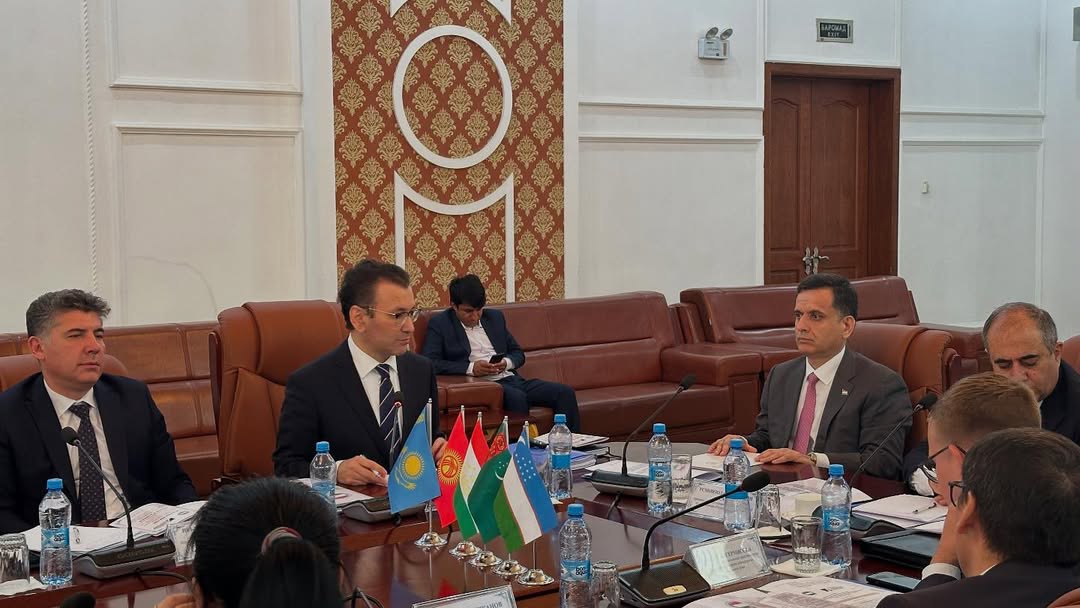
The event brought together over 50 senior officials and experts from governmental and non-governmental research institutions, along with representatives from ministries and agencies of Central Asian countries.
The International Institute for Central Asia (IICA) was represented by its Director, Javlon Vakhabov.
Participants exchanged views on a broad range of issues related to advancing integration in Central Asia. Topics included the development of institutional cooperation mechanisms, the strengthening of regional security, the expansion of humanitarian exchanges, and enhanced joint efforts to combat climate change.
In his opening remarks, CSS Director Khayriddin Usmonzoda highlighted significant progress in resolving long-standing inter-state disputes, which has helped to build trust and foster good-neighborly relations across the region.
He noted that recent developments—such as the signing of the state border agreement between Tajikistan and Kyrgyzstan, the border junction accord, and the Khujand Declaration of Eternal Friendship among Bishkek, Dushanbe, and Tashkent—reflect the mutual interests of the parties and have given new impetus to cross-border people-to-people ties, forming a potential foundation for economic interaction among communities.
In his address, IICA Director Javlon Vakhabov emphasized that increasing regional cohesion has allowed Central Asian countries to better adapt to global transformations and to build more effective cooperation with major international partners through "Central Asia plus" formats. This, in turn, has enhanced the region’s international agency, attracted greater investment, and expanded external support.
On the economic front, Javlon Vakhabov underscored the importance of diversifying export structures, promoting regional industrial cooperation, and launching joint production initiatives. At the same time, he pointed out that intra-regional trade in Central Asia remains very low—amounting to only 7.2% in 2022, according to the Islamic Development Bank. In this context, he stressed the urgency of strengthening trade and economic ties between border regions, including through the creation of cross-border free economic zones.
Regarding humanitarian cooperation, Javlon Vakhabov advocated for the mutual recognition of national ID cards to facilitate travel and deepen people-to-people connectivity. He also proposed the development of regional tourism products based on a “One Tour – Whole Region” concept, which would help expand cultural and tourist flows while fostering a shared sense of unity and a collective identity of “We, the peoples of Central Asia.”
During discussions on institutional aspects of regional integration, Dinara Duishonkul kyzy, Deputy Director of the National Institute for Strategic Studies under the President of the Kyrgyz Republic, emphasized that “integration does not mean the loss of identity; on the contrary, it creates conditions for building mutual trust and deepening partnership.”
In the security session, independent Tajik researcher Sherali Rizoyon noted that the evolving international landscape, despite its challenges, also offers new opportunities for the region. In his view, growing instability and cross-border threats are prompting states to engage in closer cooperation—making regional collaboration not merely desirable, but essential.
Addressing climate challenges, Barbara Janusz-Pawletta, Head of the Regional Office of the International Water Management Institute (IWMI) in Central Asia, stated that limited access to climate data hinders the region’s ability to adapt to water-related, agricultural, and migratory pressures. She proposed the creation of a platform to facilitate knowledge-sharing and best practices between Central Asian states and international organizations in the field of water diplomacy.
Overall, the conference underscored the critical importance of deepening regional integration and reinforcing joint efforts among Central Asian countries to tackle pressing issues related to security, sustainable development, and adaptation to rapidly changing global dynamics.