Distinguished Mr. Farid Shafiev,
Distinguished Mr. Shiri Shiriev,
Dear colleagues,
First of all, allow me to express my sincere gratitude to the organizers for the invitation to participate in this conference and for the opportunity to address this distinguished platform.
The holding of this event is of particular importance, as the issues under discussion are directly linked to the future of regional cooperation, sustainable development, and the strengthening of connectivity among our countries.
Distinguished participants,
In November 2025, Tashkent hosted the 7th Consultative Meeting of the Heads of State of Central Asia. A historic decision was adopted to grant Azerbaijan full-fledged participation in the Consultative Meetings format. This decision has the potential to introduce a new quality to the development of Central Asia.
It is the logical outcome of a sustained process of rapprochement based on civilizational and cultural commonality, converging strategic interests of the six countries, and shared priorities of interregional cooperation.
It is important to emphasize that we are witnessing not merely an expansion of a format, but a broader qualitative shift. The geography of interaction is moving beyond the traditional understanding of Central Asia and acquiring a distinct interregional dimension. Central Asia and Azerbaijan are increasingly perceived as components of a single strategic corridor forming a unified geopolitical and geo-economic region whose international significance continues to grow.
Today, we can speak about the transition from the C5 to the C6 format. We are now six. And this is more than just a number. The countries of the region together with Azerbaijan are shaping the institutional core of a New Central Asia.
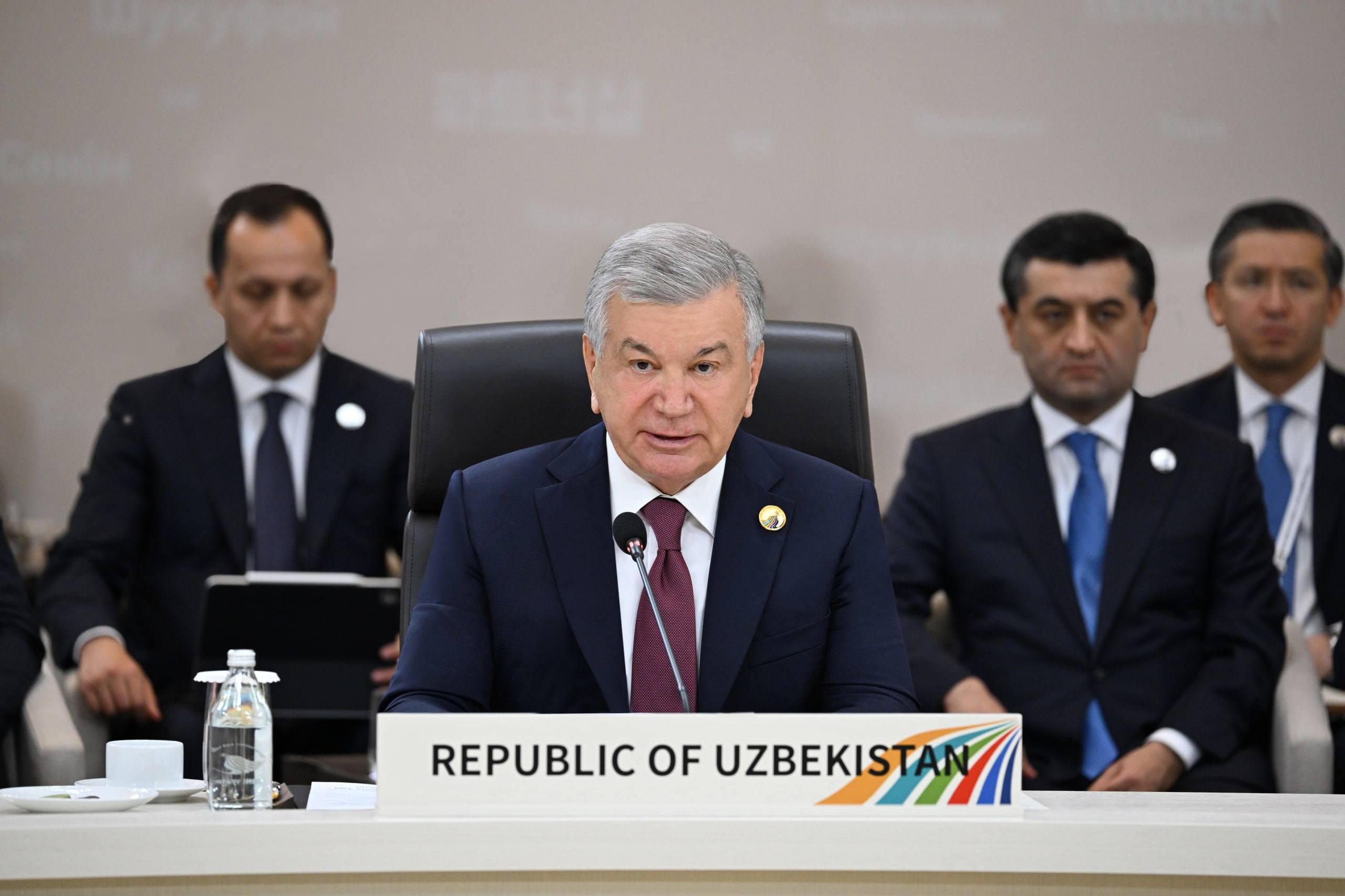
Moreover, this decision symbolizes a transition toward deeper economic connectivity between Central Asia and the South Caucasus, with direct access to European markets. Uzbek President Shavkat Mirziyoyev, speaking about this decision, emphasized: “In essence, we will build a solid bridge between Central Asia and the South Caucasus and pave the way toward the formation of a single space of cooperation.”
Dear colleagues,
Azerbaijan’s accession to the regional format rests upon a strong foundation of bilateral interaction with the Central Asian states, which has been consistently developed over recent years.
Regular visits by President Ilham Aliyev to Uzbekistan, Kazakhstan, Kyrgyzstan, Tajikistan, and Turkmenistan, as well as visits by Central Asian leaders to Baku, have created a solid political basis for multilateral cooperation, accompanied by the signing of numerous agreements. Over the past three years alone, there have been 14 visits by the President of Azerbaijan to Central Asian countries and 23 visits by regional leaders to the Republic of Azerbaijan.
High-level political dialogue has strengthened trust, synchronized strategic objectives, and served as a driver for transition toward an institutionalized format of cooperation. Within the emerging architecture, Azerbaijan is increasingly acting as a connecting link between the regions, a transit and logistics hub, and an active participant in a common geo-economic space. Practical indicators confirm this dynamic: cargo transportation along the Middle Corridor through Azerbaijan has increased by 90 percent over the past three years.
This dynamic is particularly evident in relations with Uzbekistan. Over the past three years, more than 30 high- and highest-level bilateral visits have taken place between our countries. Strategic partnership and allied relations have been established and are being steadily filled with practical content.
During the most recent visit of President Shavkat Mirziyoyev to Baku in July last year, a Roadmap for the implementation of the Treaty on Allied Relations for 2025–2029 was adopted. The Treaty itself was signed in August 2024 during President Ilham Aliyev’s visit to Uzbekistan. On that occasion, President Mirziyoyev noted that “with no other country have we signed such a treaty in such a short period of time.” This became possible because of the strong political will to bring our countries and peoples closer together.
Economic indicators also demonstrate strong growth. Trade turnover between Uzbekistan and Azerbaijan increased by nearly 87.5 percent during the first nine months of 2025 compared to the previous year. Further integration can reinforce this trend and open new markets for both sides. Our leaders have set a clear target of increasing bilateral trade to 1 billion US dollars by 2030, reflecting both high expectations and significant potential for further expansion.
Distinguished experts,
Azerbaijan’s accession creates a qualitatively new geo-economic configuration by uniting Central Asia and the South Caucasus into a single area of cooperation.
The demand for such integration is driven by objective economic and geographic factors. The economies of Central Asian states remain significantly resource-export oriented. Therefore, they require reliable and diversified logistics routes, integrated supply chains, and strengthened industrial and agro-industrial cooperation.
Azerbaijan serves as a key bridge between the two regions, linking transport, energy, and trade routes. In effect, a connecting belt is being formed from the Caspian region toward the Black Sea and Mediterranean directions. This transforms the region from being landlocked into being land-linked, providing access to European, Turkish, and Middle Eastern markets, as well as expanding transit opportunities toward South and Southeast Asia and Africa.
As a result of Azerbaijan’s accession, regional connectivity is strengthened across several key dimensions.
First, transport connectivity. Azerbaijan represents a strategic node of the Middle Corridor linking China and Central Asia with Europe via the Caspian Sea, the South Caucasus, and Turkey. Expansion of transport infrastructure, including the Port of Alat, the Baku–Tbilisi–Kars railway, and modernized airports, creates conditions for increasing cargo flows and reducing delivery times. This reduces dependence of Central Asian states on traditional routes and opens new export pathways.
Second, energy connectivity. Azerbaijan contributes to diversification of regional energy ties. Major oil and gas pipelines pass through its territory, while renewable energy projects are actively developing. This enables Central Asian countries to diversify export routes, integrate into transregional energy chains, and ensure stable supplies to European and Middle Eastern markets.
Third, investment connectivity and industrial cooperation. Azerbaijan’s accession opens prospects for integrated industrial, logistics, and infrastructure development. Joint investments may be directed toward wholesale distribution centers, warehouse clusters, and transport-logistics hubs. Expanded access to macroregional and European markets will stimulate capital inflow and development of transregional production chains.
In the longer term, formation of a unified Central Asia–South Caucasus corridor creates prerequisites for gradual involvement of Georgia and Armenia in selected transport, energy, and climate projects, thereby enhancing transit sustainability and shaping a broader interregional connectivity architecture.
Distinguished participants,
Azerbaijan’s integration into the regional format strengthens the collective weight of the Central Asia–South Caucasus community on the international stage, making the macroregion more significant in dialogue with major external partners.
This opens new opportunities for existing “C5+” formats, expands their potential, and creates prospects for developing a more comprehensive “C6+” track integrating Central Asia and the South Caucasus.
At the same time, coordinated cooperation in transit, energy, security, and development will serve as a source of resilience, ensuring regional stability in conditions of global turbulence.
Moreover, strengthening international agency enables our states to act as independent geopolitical and geo-economic actors and to formulate coordinated positions on strategically important issues.
Dear colleagues,
Azerbaijan’s accession objectively requires transition toward a more structured coordination model with prospects for gradual institutionalization of C6.
To unlock the full potential of the expanded format, existing mechanisms and regulations must be adapted to new realities.
First, legal and procedural alignment. Azerbaijan should be incorporated into the legal and treaty framework of the Consultative Meetings, including adaptation of key strategic documents such as the Treaty on Friendship, Good-Neighborliness and Cooperation and the Concept for the Development of Regional Cooperation “Central Asia – 2040.” This will establish stable frameworks for political dialogue and project implementation.
Second, transport and logistics. Conditions must be created to increase cargo volumes and reduce delivery times. Synchronization of tariffs, unification of electronic transport documentation, and establishment of a common C6 digital window are essential. Creation of a joint C6 investment fund for infrastructure modernization could also be considered.
Third, energy cooperation. Expansion of intra-regional trade and investment in both traditional and renewable energy sources will facilitate diversification of export routes and integration into transregional energy value chains.
Fourth, trade and industrial cooperation. Removing barriers, increasing market accessibility, and stimulating business activity are key tasks. Establishment of an annual C6 Economic Forum as a platform for dialogue among governments, business communities, and experts would be beneficial. A C6 Investment Cooperation Council and joint industrial zones should also be considered.
Fifth, environmental and climate agenda. Joint action on climate change and environmental issues is strategically important. Building on Baku’s experience in hosting the 2024 United Nations Climate Change Conference (COP29), I propose establishing a “Central Asia–Azerbaijan Climate Solutions Platform” to coordinate efforts, exchange best practices, and implement adaptation and green technology projects.
Sixth, digitalization, education, and science. Digital technologies open new integration opportunities. Mutual integration of customs platforms, development of digital corridors for small and medium enterprises, fintech cooperation, and a C6 Digital Platform would accelerate cross-border transactions and investment exchange. Academic cooperation, including potential opening of branches of leading Azerbaijani universities in the region, would further strengthen scientific and educational ties.
Dear friends,
In conclusion, Azerbaijan’s participation in the format creates new opportunities to strengthen connectivity between Central Asia and the South Caucasus.
The expert community bears responsibility for identifying key challenges and proposing concrete, practical solutions.
I am confident that today’s discussions will result in actionable recommendations for advancing regional cooperation.
Thank you for your attention.