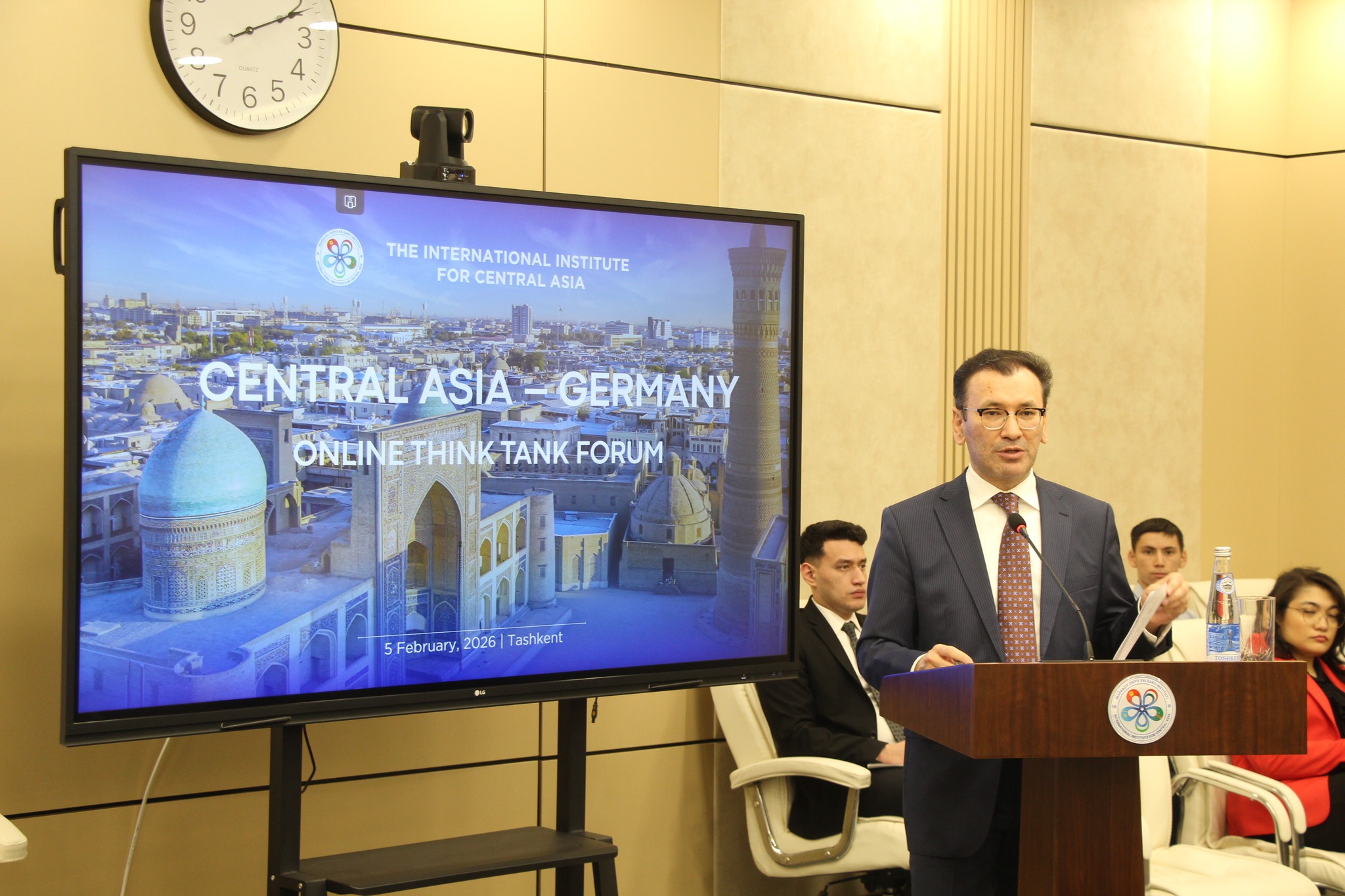
Your Excellency Ambassador Manfred Huterer,
Distinguished guests,
It is a pleasure to welcome you to Central Asia – Germany Online Think Tank Forum. Allow me to express my sincere appreciation, Your Excellency, for accepting our invitation. Your participation here reflects a valued tradition of open dialogue and professional engagement that strengthens mutual understanding.
Dear colleagues,
Today’s event brings together a diverse range of experts and diplomats – a clear indication of the growing interest in the evolving partnership between Central Asia and Germany.
This dialogue is both timely and necessary, as our expert communities assess current trends and consider forward-looking approaches to deepening bilateral and interregional cooperation.
Over many years, Germany has always been the driving force behind the EU’s Central Asia policy. It was under the German Presidency of the EU Council in 2007 that the first EU Strategy for Central Asia was adopted, followed by its comprehensive update in 2019, again on Germany’s initiative. Today, in the context of a 'Zeitenwende', Germany remains our key partner in building a stable, multi-vectoral Eurasian partnership.
In this regard, Your Excellency, I must emphasize that your article on 'German Central Asia policy after the 'Zeitenwende' remains one of the most prominent and insightful analyses in recent years. It has truly set a high standard for our expert dialogue.
Dear friends,
Cooperation between Central Asia and Germany has entered a new stage of qualitative development in recent years, reflecting a growing convergence of strategic interests and practical cooperation. In this context, the “Central Asia – Germany” (C5+1) format plays a pivotal role as a platform for institutionalized political dialogue and the implementation of concrete initiatives aimed at deepening interregional engagement.
Recent summits in Berlin (2023) and Astana (2024) have institutionalized the C5+1 format, elevating it to a new strategic level.
Dear guests,
This positive dynamic has unfolded against the broader backdrop of expanding EU–Central Asia engagement. In this regard, the Samarkand Summit became a milestone in EU–Central Asia relations.
The Samarkand Declaration, adopted as the summit’s final political act, outlined key initiatives, including the Green Strategic Corridor, the CA–EU Clean Energy Partnership and joint transport and logistics projects, as well as enhanced academic and research cooperation.
The CA–EU format has evolved into an unprecedented platform for interregional dialogue. Representing 27 member states and three G7 economies, the EU serves as a strategic heavyweight, providing the institutional depth and systematic partnership essential for Central Asia’s development.
Distinguished guests,
Transport connectivity has gained new strategic importance following disruptions of traditional routes. The development of the Middle Corridor, connecting Central Asia with Europe via the Caspian Sea and the South Caucasus, has become a priority for both the EU and Germany.
The scale of our ambitions is matched by significant resources. Through the Global Gateway and international financial institutions, over €20 billion has been earmarked for critical sectors, ranging from the Middle Corridor to raw materials and climate resilience.
According to estimates by the European Bank for Reconstruction and Development, approximately €18.5 billion in investments will be required to modernize transport infrastructure across Central Asia.
Dear friends,
In October 2025, President Mirziyoyev visited Brussels to sign the Enhanced Partnership and Cooperation Agreement. During his visit, he also met with the European Council and European Commission leaders. This landmark agreement marks a new chapter in relations between Uzbekistan and the EU.
Uzbekistan holds an important place in the regional strategy of Germany, the driving force of the European Union. In September 2024, German Federal Chancellor Olaf Scholz paid an official visit to Uzbekistan, holding bilateral talks with President Shavkat Mirziyoyev. During the visit, a bilateral agreement on migration and mobility was signed.
As one of the leading economies in Central Asia, Uzbekistan is Germany’s major trading partner in the region and a key partner for the European Union as a whole. In 2024, bilateral trade reached approximately €1.2 billion.
Today, some 220 companies with German participation operate in Uzbekistan, contributing to industrial development, technology transfer and vocational training.
Investment in human capital is one of the strongest pillars of German–Uzbek cooperation. Today, around 400,000 people in Uzbekistan are learning German, the highest number in Asia. Nineteen schools are part of the global PASCH network, and Germany and Uzbekistan currently implement 74 joint higher education projects. Flagship examples include cooperation between the Technical University of Munich and New Uzbekistan University since 2022.
Dear colleagues,
The key topics of today’s discussion focus on assessing the current state of cooperation, its future prospects, and main priority areas between Central Asia and Germany.
In this context, the Forum will feature four thematic sessions to address key priority areas: Session 1 will focus on Economic Partnership and Investment; Session 2 will cover Technology, Clean Energy, and Critical Minerals; Session 3 will be dedicated to Infrastructure and Transport Connectivity; and Session 4 will address Investing in Human Capital and Education.
Dear friends,
Looking ahead, I would like to underline that the discussions and practical recommendations elaborated during today’s Forum will not remain purely academic.
They are expected to be duly reflected in the agenda of the Meeting of Foreign Ministers in the “Central Asia – Germany” format, scheduled to take place in late February this year in Berlin. In this sense, our Forum serves not only as a platform for expert exchange, but also as a substantive preparatory mechanism contributing directly to the shaping of the emerging intergovernmental dialogue.
In conclusion, I express sincere gratitude to Ambassador Manfred Huterer and all participants for their engagement.
I am confident that today’s exchange of views will translate into practical cooperation, further strengthening the bridge between Central Asia and Germany and contributing to a more prosperous, open and stable Eurasian region.