Dear Dr. Akmal Kholmatovich,
Dear Vice President Li Hongkui,
Your Excellency Ambassador Yu Jun,
Distinguished participants of the Forum,
First of all, let me to warmly welcome all the participants and express my sincere appreciation to the organizers for the invitation to take part in this distinguished event.
Cooperation between Uzbekistan and China on human rights issues constitutes an important component of the political dialogue between our two countries — comprehensive strategic partners for all weather conditions.
The current high level of bilateral engagement in this area reflects the impressive progress achieved in the development of our strategic partnership, which has reached a qualitatively new stage since 2017. A key role in this process has been played by the close and trusting relationship established between the leaders of our two countries — President of Uzbekistan Shavkat Mirziyoyev and President of the People’s Republic of China Xi Jinping.
Of particular importance is the fact that socio-economic development and multifaceted economic cooperation, both on a bilateral basis and within the frameworks of the SCO and the “Central Asia–China” format, rank among the key priorities of the Uzbek-Chinese strategic partnership.
In this regard, I would like to express my strong support for the profound linkage between human rights and development reflected in the very theme of today’s forum.
In Uzbekistan, issues of development and improving the well-being of the population constitute one of the highest priorities of state policy and serve as the foundation of the country’s strategic planning.
In his address at the meeting of the Board of Governors of the Asian Development Bank, held in Samarkand in early May, the Head of State noted that over recent years Uzbekistan has attracted $150 billion in foreign investment and established thousands of modern enterprises. Exports of goods and services have tripled, while the country’s GDP has increased from $50 billion to $147 billion.
Particular emphasis was placed on the fact that the ongoing reforms are primarily focused on improving the well-being of every family and every citizen. The incomes of 8.5 million vulnerable citizens have increased, while the poverty rate has been reduced from nearly 35% to 5.8%.
Within the framework of the Uzbekistan 2030 Strategy, our Government plans to expand the size of the economy to more than $240 billion, achieve upper-middle-income status, and fully eradicate poverty.
China undoubtedly plays a highly important role in the development of our country and the entire Central Asian region. The People’s Republic of China is Uzbekistan’s largest trading partner. Based on last year’s trade figures, we may already reach this year the target set by our Heads of State, namely to raise bilateral trade to $20 billion and beyond.
An important indicator is the growing number of enterprises with Chinese capital in Uzbekistan, which increased from 2.1 thousand in 2023 to 5.2 thousand in 2026. Chinese investment in Uzbekistan’s economy amounted to $15.8 billion in 2025, with a target set to increase this figure to $21 billion by 2026. This progress will be further supported by the active operations of the regional office of the Export-Import Bank of China, opened in Tashkent in accordance with the agreement reached by the Heads of State in 2024.
This dynamic clearly confirms the strengthening of the partnership between Tashkent and Beijing and opens up new opportunities for deeper cooperation, particularly in the context of Uzbekistan’s accession to the World Trade Organization. There is no doubt that the further advancement of bilateral cooperation will have a positive impact on the socio-economic development of our country.
Significant prospects for strengthening the strategic partnership are also linked to the development of the new regional cooperation format “Central Asia–China”. Thanks to the successful summits held in Xi’an and Astana, the institutional and regulatory framework of this mechanism has been advancing rapidly in a short period of time, and it is increasingly becoming an important driver of both regional and bilateral cooperation between the countries of the region and China.
A key role in this process is played by the Secretariat of this format, which is successfully operating in Xi’an, as well as a series of ministerial meetings and the Central Asia–China Business Council. Its sessions have already facilitated the signing of a substantial package of cooperation agreements between Central Asian countries and Chinese companies.
An important component of cooperation between Central Asian countries and China is also the political dialogue between political parties and civil society institutions. To date, two meetings of the “China–Central Asia” Political Parties Dialogue have been held, serving not only as a platform for exchanging views on inter-party cooperation and governance experience, but also for discussing plans to expand cooperation in areas such as poverty reduction, environmental policy, and digital transformation.
I would particularly like to emphasize that in the final documents of the first two summits of the “Central Asia–China” format, namely the Xi’an and Astana Declarations, the Heads of State of the region and China reaffirmed their commitment to strengthening the central role of the United Nations in maintaining international peace, security, and sustainable development, as well as their readiness to oppose attempts to politicize human rights issues.
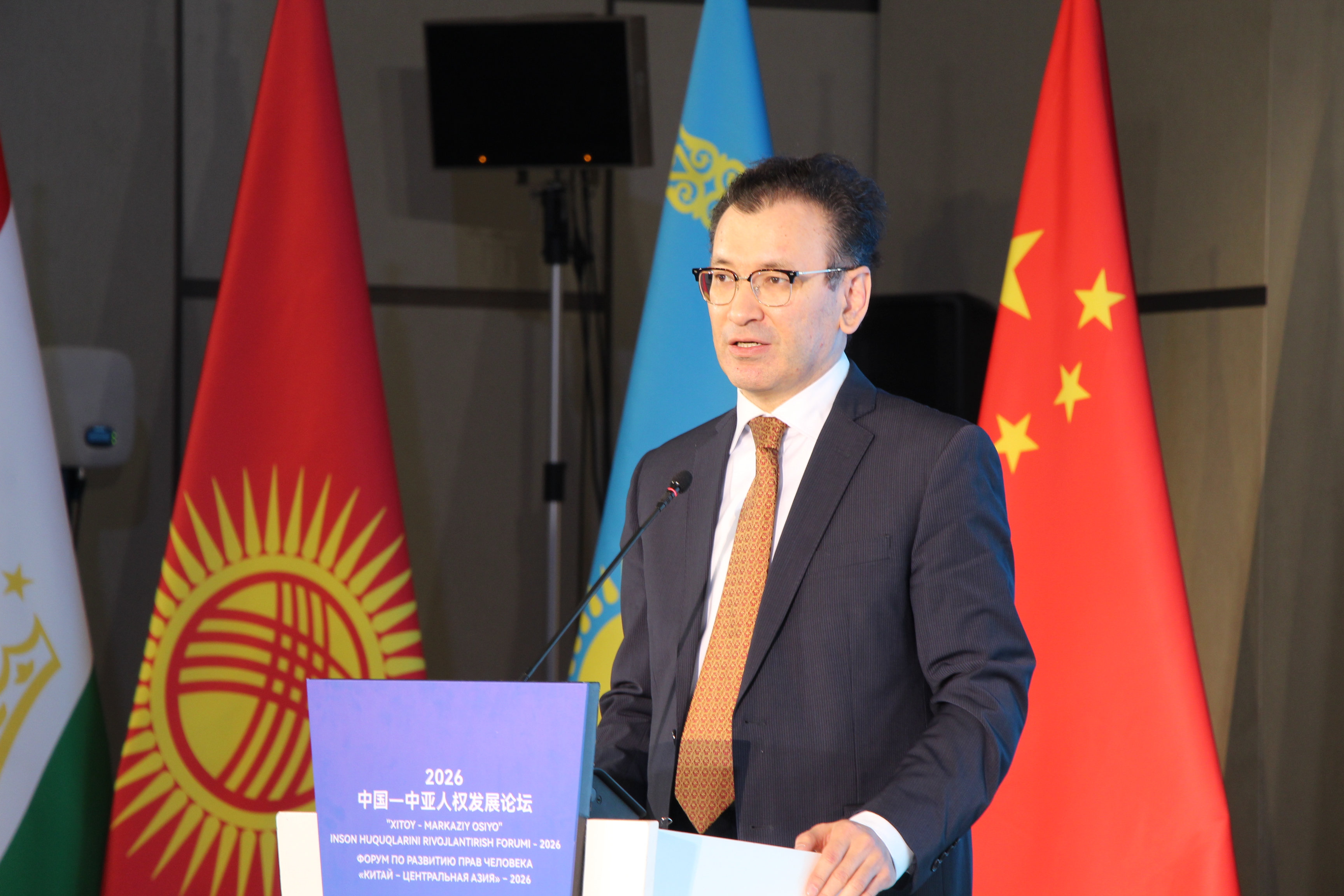
In this context, an important priority of cooperation has been the promotion of interaction within the specialized platform, the “International Forum on the Development of Human Rights China–Central Asia”. It is of fundamental importance that participants in this dialogue proceed from the understanding that poverty eradication and economic progress constitute the foundation for ensuring human rights.
In this regard, the agenda and programme of today’s forum fully deserve strong support, including cooperation in advancing progress in the field of human rights through high-quality development in such areas as poverty reduction and improving the well-being of the population, environmental protection, green development and human rights, as well as the promotion of digital and intelligent technologies.
In conclusion, I would like to wish every success to this distinguished forum, engaging presentations, and productive proposals aimed at further strengthening cooperation between Central Asian countries and China for the benefit of the peoples of our countries.
Thanks for your attention.