Your Excellency Ambassador Ufuk Ulutaş,
Distinguished Ambassadors,
Esteemed colleagues, Ladies and Gentlemen,
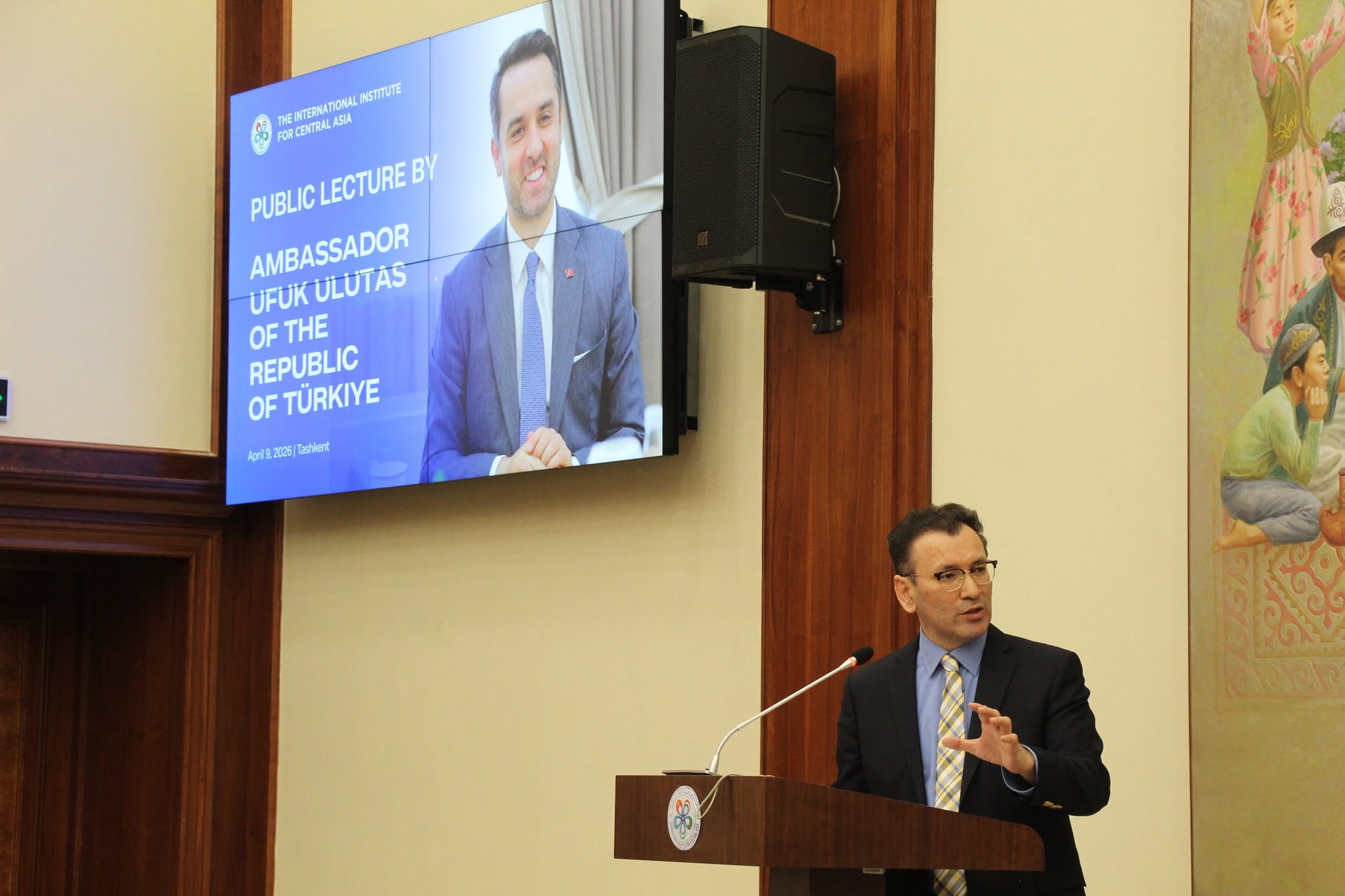
It is a pleasure to welcome you to the International Institute for Central Asia. Allow me to express my sincere appreciation, Your Excellency, for accepting our invitation. Your presence reflects a valued tradition of open dialogue and professional engagement that continues to strengthen mutual understanding between our countries.
Dear colleagues,
Today’s event brings together representatives of ministries, institutions, research centers, universities, and the media – a clear indication of the growing interest in the evolving partnership between Uzbekistan and Türkiye.
This dialogue is both timely and necessary, as our expert communities assess current trends and explore forward-looking approaches to deepening interregional cooperation. The key themes of today’s lecture – Uzbekistan–Türkiye cooperation, Ankara’s priorities for 2026, and the prospects for Türkiye–Central Asia engagement, including within the framework of the Organization of Turkic States (OTS)—are of strategic importance.
Dear guests,
At the very foundation of our relationship lies a historic fact: Türkiye was the first country to recognize Uzbekistan’s independence in 1991. That gesture of friendship and solidarity remains a cornerstone of our partnership, symbolizing mutual respect, shared identity, and a common vision for the future.
Over the past three decades, our cooperation has evolved from symbolic ties into a comprehensive strategic partnership. The meeting between President Shavkat Mirziyoyev and President Recep Tayyip Erdoğan in Ankara on June 6, 2024, marked a new milestone – with the signing of the Joint Declaration on Deepening the Comprehensive Strategic Partnership, which defined clear, forward-looking priorities across political, economic, cultural, and security dimensions.
At the same time, Türkiye engages with Central Asia through regional frameworks such as the Organization of Turkic States (OTS), the Conference on Interaction and Confidence-Building Measures in Asia (CICA), and the Shanghai Cooperation Organization (SCO), while also aligning positions with Central Asian partners—Kazakhstan, Uzbekistan, Kyrgyzstan, Turkmenistan, and Tajikistan—on global platforms such as the UN, OSCE, OIC, and ECO.
Dear guests,
Economic cooperation has demonstrated strong growth dynamics, with trade between Türkiye and Central Asia increasing from $6 billion in 2018 to $14.5 billion in 2025, with a target of $30 billion by 2030. Turkish investments in the region rose 2.5-fold from $1.1 billion in 2016 to $3 billion in 2024, outperforming the overall 34% growth of Türkiye’s investments across Eurasia. Central Asia now accounts for 24% of Türkiye’s total accumulated investment in Eurasia.
The number of Turkish companies operating in the region expanded from 4,000 in 2016 to over 7,000 by 2025. In Uzbekistan, Türkiye ranks as the third-largest investor after China and Russia, with more than 2,000 enterprises, including 438 joint ventures.
Türkiye is positioning itself as a strategic energy hub, providing access to European markets amid shifting supply patterns. The Baku–Tbilisi–Ceyhan pipeline has evolved into a trans-Caspian export route, with Kazakh oil supplied since 2008 and Turkmen volumes since 2010.
Discussions are ongoing on exporting Turkmen gas via the Trans-Anatolian Natural Gas Pipeline (TANAP), including plans to expand its capacity from 16 to 32 billion cubic meters.
Transport and infrastructure connectivity further reinforce regional integration, particularly through the Trans-Caspian International Transport Route (Middle Corridor), linking China and Europe via Central Asia, the Caspian Sea, the South Caucasus, and Türkiye.
A key initiative is the Trans-Caspian Green Energy Corridor, led by Kazakhstan, Uzbekistan, and Azerbaijan with support from the Asian Infrastructure Investment Bank (AIIB), which aims to connect Central Asian power grids to Azerbaijan via a subsea Caspian link and enable electricity exports to Türkiye and European markets.
Human capital, education, and cultural collaboration are expanding through the establishment of joint universities and academic programs across Central Asia, including institutions in Uzbekistan, alongside increased participation in scholarship initiatives such as the Türkiye Bursları program.
The expansion of the Consultative Meetings of the Heads of State of Central Asia to include Azerbaijan in November 2025 provided additional impetus to interregional engagement. This step strengthened linkages between Central Asia and the South Caucasus, enhancing coordination and opening new opportunities for connectivity via Türkiye.
Within the framework of the OTS, strategic documents such as Strategy 2026 and Strategy 2040 outline the development of a common economic space, including deeper energy integration and the potential establishment of a regional development bank.
Dear guests,
Uzbek analytical and research institutions are actively developing cooperation with leading academic and think tank centers of Türkiye. In particular, partnerships have been established with Ibn Haldun University, Ankara Social Sciences University, and TOBB University of Economics and Technology, as well as with prominent analytical centers such as Center for Crisis and Political Studies (ANKASAM), Center for Diplomatic Affairs and Political Studies (DİPAM), and the SETA Foundation for Political, Economic and Social Research.
In December 2025, a Memorandum of understanding was signed between the International Institute for Central Asia and SETA, marking an important step toward strengthening expert dialogue, joint research, and knowledge exchange between our institutions.
Dear colleagues,
In conclusion, I express sincere gratitude to Ambassador Ufuk Ulutaş and all participants for their engagement. I am confident that today’s exchange of views will translate into practical cooperation, further strengthening the bridge between Central Asia and Türkiye and contributing to a more prosperous, open and stable Eurasian region.