Distinguished Professor Usmonzoda,
Dear Colleagues,
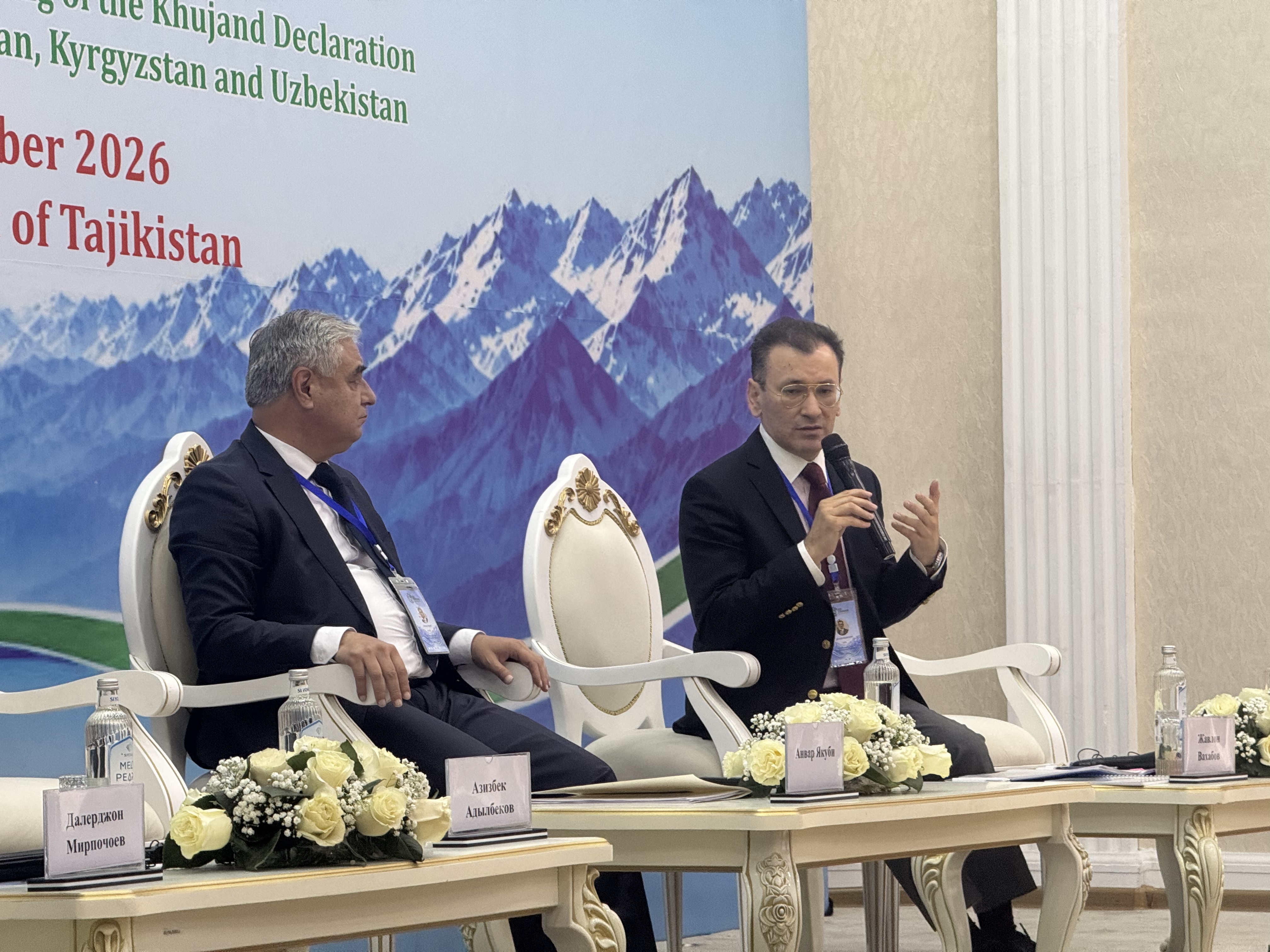
It is deeply symbolic that we are meeting today here in Khujand – a city that has become one of the symbols of a new atmosphere of trust and good-neighbourly relations in Central Asia. Nowhere is our countries’ shared commitment to transforming border areas into spaces of cooperation and joint development more evident.
As we continue our discussion, I would like to focus primarily on the practical dimension – on how the existing potential for cooperation can be translated into tangible outcomes at the level of the Fergana Valley’s individual regions.
The key question before us is this: to what extent is the growth in trade between our countries being matched by deeper economic ties among their regions – through the development of sustainable production chains, greater specialisation, and stronger economic complementarity?
The Fergana Valley is perhaps the most appropriate place to provide a practical answer to this question.
From the perspective of the Valley’s administrative and economic geography, we are speaking primarily about seven regions across three countries.
And here, scale matters.
The Fergana Valley is an economic space of nearly 18 million people.
In other words, it represents a market comparable in population size to that of many sovereign states.
Yet a large market does not, in itself, guarantee high economic efficiency.
For example, the three Uzbek regions of the Fergana Valley account for around 29 per cent of Uzbekistan’s population, but generate approximately 16.5 per cent of the country’s GDP. Their combined gross regional product in 2025 amounted to roughly US$25 billion.
This figure is particularly important to me.
The greatest untapped potential lies in productivity, specialisation, and the ability of neighbouring regions to complement one another.
Each part of the Valley has its own distinct competitive advantage.
Andijan has strengths in mechanical engineering, industrial assembly and engineering expertise, and is set to become an important hub along the China–Kyrgyzstan–Uzbekistan railway.
Namangan has a strong textile and light-industry base, supported by a well-developed network of small and medium-sized manufacturers.
Fergana Region combines chemical and processing industries with agriculture and the production of construction materials.
Sughd Region is one of Tajikistan’s most industrialised regions, with a strong agricultural, processing and raw-material base.
Osh serves as a major trade and services hub for southern Kyrgyzstan.
Jalal-Abad Region combines significant agricultural and energy potential with an increasingly important role in transport and connectivity.
Batken Region has particular strengths in horticulture and cross-border trade.
At the same time, if we are to make economic cooperation across the Fergana Valley more targeted and effective, we need a much clearer picture of how individual regions are already connected: what trade flows exist between Andijan and Osh, between Fergana and Sughd, or between Batken and neighbouring areas; which products cross the border for further processing; and where complementary production capacities already exist.
Such an interregional perspective would allow us to move beyond broad assessments of potential towards more targeted economic policy.
On this basis, I believe we can identify several sectors where a genuine qualitative breakthrough is already within reach.
The first is the agro-industrial sector.
Here, the Fergana Valley should be viewed not as seven separate agricultural areas, but as an integrated, distributed agro-industrial cluster.
Land is objectively scarce in the Valley’s most densely populated areas. At the same time, neighbouring regions have different resource endowments.
This leads to a less conventional, but highly practical conclusion.
A company does not necessarily need to own land on both sides of the border. A more realistic model could be cross-border contract farming.
For example, a processing company based in Andijan, Namangan or Fergana could enter into long-term contracts with farms in Batken, Osh, Jalal-Abad or Sughd, providing technology and guaranteeing the purchase of their produce. The land and income remain with the local producer, while the processor gains access to a reliable and sustainable supply of raw materials.
The next step could be to build a fully-fledged cross-border value chain – from cultivation and storage to processing, packaging and export, regardless of which neighbouring region hosts each stage of the process.
In practical terms, this would mean that apricots from Batken, vegetables from Sughd, or agricultural products from Osh should cross the border not simply as final raw commodities, but as inputs into a shared production chain.
This brings us directly to the second issue – water.
The discussion on water in the Fergana Valley should gradually shift from the question of “who gets how much?” to a different one: “how much value added do we generate from every cubic metre of water?”
And it is precisely here that water connects directly with energy and industry.
One part of the region has mountainous terrain and significant hydropower potential. Another is developing equipment manufacturing and engineering capabilities. A third can provide services, construction materials, or electrical components.
In other words, there is no need for every region to produce the same things. What we need is to learn how to connect different comparative strengths.
The third area is transport and industrial cooperation around the China–Kyrgyzstan–Uzbekistan railway.
This railway is usually viewed primarily through the lens of future transit flows. For the regions of the Fergana Valley, however, its economic impact begins already at the construction stage.
The project will generate demand for construction materials, metal products, food supplies, transport services, equipment maintenance, and a wide range of other services.
For this reason, Andijan and Jalal-Abad should be seen not simply as two points along a future transport corridor, but as a complementary industrial and logistics belt capable of supporting both the construction of the railway and its subsequent operation.
One practical step could be to establish a unified register of certified suppliers across the Fergana Valley for the needs of the project. In the short term, these companies could contribute to the construction phase; over time, they could go on to serve logistics terminals and service centres.
At the same time, a more ambitious objective could be to explore the establishment of a trilateral special economic zone involving Uzbekistan, Kyrgyzstan and Tajikistan in the border areas of the Fergana Valley.
This would not necessarily have to take the form of a single physical site. A more realistic model could consist of interconnected national zones operating under harmonised conditions, designed to host manufacturing, processing, warehousing, certification, logistics, and maintenance services.
Such a trilateral model could focus on sectors where the economies of the Valley’s regions already complement one another in practical terms: construction materials, agro-processing, textiles, electrical engineering, machinery components, logistics, and railway infrastructure services.
The fourth sector is textiles.
This is perhaps where the need to move from a national to an interregional perspective becomes especially clear. The objective is not simply to increase trade, but to ensure that companies in neighbouring regions begin to see one another as natural participants in a shared production chain.
That is when integration acquires real practical meaning: a company in Namangan should be able to select a supplier or contractor in Sughd or Jalal-Abad on the same economic basis on which it would choose a partner within its own region today.
For this reason, I would suggest identifying 10 to 15 specific cross-border value chains, rather than compiling an endless list of potential areas for cooperation.
For example: cotton fibre – yarn – fabric – dyeing – finished garments; agricultural produce – storage – processing – packaging – export; hydropower equipment – steel structures – installation – maintenance.
Each stage should be located where it makes the greatest economic sense.
The fifth area is tourism.
Here, the scale of existing connectivity is particularly evident. In 2025, Uzbekistan received 11.7 million foreign visitors travelling for tourism purposes, including 3.3 million from Kyrgyzstan and 2.7 million from Tajikistan. Together, they accounted for roughly half of all inbound tourist arrivals.
The question today, therefore, is no longer simply how many people cross the border, but how we can extend the length of their stay and increase the value added generated by their travel within the regions themselves.
One possible solution would be to develop short, 48-to-72-hour cross-border itineraries – Khujand–Kokand–Fergana, Osh–Andijan–Namangan, and Batken–Fergana – combining cultural, gastronomic, ecological and event-based tourism.
The very setting of our Forum – the picturesque shores of the Kayrakkum Reservoir, widely known as the Tajik Sea – is itself a vivid illustration of the considerable recreational potential of this part of the Valley.
Another promising segment is medical tourism. In 2025, 86,200 foreign nationals travelled to Uzbekistan for medical treatment, including 59,100 from Tajikistan and 15,600 from Kyrgyzstan. Together, these two neighbouring countries accounted for almost 87 per cent of all inbound medical travel.
This already points to the emergence of a regional market for medical services – one that could be further developed through partnerships among clinics, diagnostic centres, and tour operators in the border regions.
At the same time, the tourism product must develop in parallel with mobility infrastructure. An agreement has been reached with Kyrgyzstan to develop the Keskaner border crossing, which is expected to be twice the size of Dustlik. Expanding border-crossing capacity can make travel within the Valley faster and more convenient.
On the Tajikistan side, an additional boost could come from exploring the expansion of Uzbekistan’s consular presence in Khujand – a natural hub for direct links with the Uzbek part of the Fergana Valley.
It is also important to note that the potential extends well beyond tourism among our three countries. Uzbekistan’s expanding aviation infrastructure makes it possible to view the country as an air gateway for the entire Fergana Valley. A traveller arriving from Europe, the Gulf, or East Asia should be able to continue onward to Khujand, Osh, or Batken as part of a single regional tourism product.
In that case, border, consular and aviation infrastructure would function as elements of a single tourism system, while the economic benefits would be shared across the regions of all three countries.
And finally, there is one more sector that, for some reason, we still rarely view as part of the regional economy – education.
Education, meanwhile, is itself an important form of trade in services.
Today, 30 foreign higher education institutions operate in Uzbekistan, compared with just seven a decade ago. Their number has increased more than fourfold. These include Westminster International University, Webster University, Inha University, and a range of other international education providers and models.
For neighbouring countries, this creates an opportunity to access international education much closer to home, with significantly lower costs associated with travel and adaptation.
In my view, this is more than simply a form of people-to-people exchange.
It is an emerging regional market for education services.
Students generate demand for education, housing, transport, food, and communications. More importantly, however, they become carriers of professional networks that connect our economies.
This is why we could develop joint training programmes specifically for the regions of the Fergana Valley in the very areas we have been discussing today: agricultural technologies, water resource management, hydropower, logistics, textile technologies, tourism, and medicine.
In this way, educational mobility would directly support the production chains that are now beginning to take shape.
Dear Colleagues,
Let me conclude with one final point.
For many decades, the economy of the Fergana Valley was viewed primarily through the lens of how three states divide a single space and its resources.
It is time to frame the question differently:
– how can three states jointly create value within a shared economic space?
If the first stage of our new regional cooperation was about opening borders, the next must be about building and developing interconnected production chains.
If yesterday the central task was to secure peace in the Fergana Valley, today we need to build the economic foundation of that peace architecture.
Then stability will rest not only on the political will of our states, but also on hundreds and thousands of enterprises, joint investments, jobs, transport links, and the tangible interests of millions of people.
It is precisely this kind of economically interconnected Fergana region that, in my view, can become one of the most compelling success stories of the New Central Asia.
Thank you for your attention.